














BCC Turbulence
Category: BCC Warp
Effect Name: BCC Turbulence
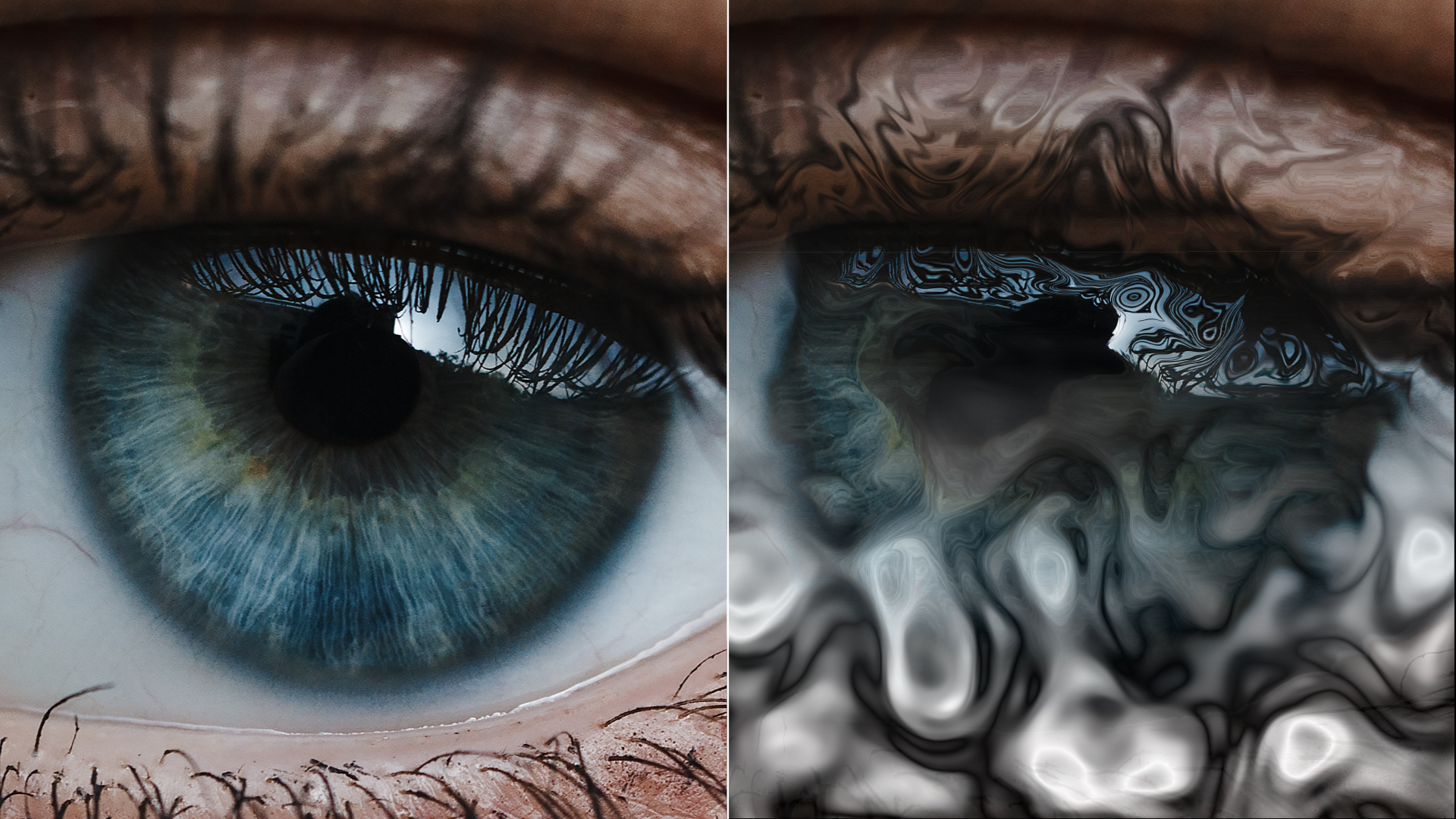
The BCC Turbulence filter, part of the BCC Warp category, is essentially a Displacement Map filter wired to a Noise Map 2 filter for generating the displacement map. Based on the core algorithms that make up the BCC Noise Map 2 filter, the BCC Turbulence filter generates auto-animated gell-like distortion fields in an image clip based on input from the built-in noise map and turbulence controls.
Working with the Filter
Presets and Common Controls
- BCC filters come with a library of factory installed presets plus the ability to create your own custom presets and preview them with the BCC FX Browser™.
- BCC filters also include common controls that configure global effect preferences and other host-specific effect settings.
For more information about working with presets and other common controls, Click Here.
Effect Controls
Mocha Mask and Track
Continuum effects include integrated masking and matte tools that allow you to restrict the effect to specific regions of the image.
- Mocha masks: used to create custom spline masks. Mocha also includes Matte Assist ML and Matte Refine ML, which use machine learning to generate and track masks.
- Pixel Chooser: used to generate geometric shapes, gradients, or mattes based on channel, luma, or color-based selections. Additionally, an AI depth map generator, and an AI-powered face detection model allow for precise control of masks and mattes.
Note: Mocha can also be used to drive geometric parameters. See the Mocha Motion Tracker documentation for details.
For more information, see Mocha and Pixel Chooser.
Compare Mode
The Compare Mode is used to view the filtered result alongside the original source layer. Several split-screen and side-by-side display options are available.
For more information, see Compare Mode.
Beat Reactor
The Beat Reactor is an audio-driven animation system that links effect parameters to an audio track. This allows visual effects to react dynamically to sound without manual key-framing.
For more information, see Beat Reactor Documentation.
- View Texture: Displays the Noise Map.
- Scale: Scales all layers of the noise output.
- Intensity: Sets the intensity of the noise output.
- Reference Level: Sets the phase of the noise output.
Distortion Group
- Process Alpha Only: Causes the distortion to be applied to the alpha channel and leaves the color channels unchanged.
- Master: Sets the scale of both the X and Y displacements.
- X and Y Displacements: Sets the amount that the noise pushes each pixel in the x and y directions.
- X and Y Reference Levels: Sets the noise value that is treated as 0 for the x and y displacements. If X reference is 0, all pixels are pushed left, if it is 100, all pixels are pushed right.
Texture Geometrics Group
The Texture Geometrics group controls the geometry of the initial layer of noise.
- Aspect: Stretches the effect vertically. Aspect is applied before rotation. If the effect is rotated, aspect scales normal to the rotation.
- Offset X/Y: Offsets the effect. The units of this control are not directly related to image size.
- Anchor: Sets the anchor point around which the effect can be scaled or rotated.
- Rotation: Rotates the effect. Applied after aspect and offset.
- Noise Type: Determines look of the Noise.
- Seed: Adds randomness that builds the 3d noise space that is used by the filter. Animating this will result in jumps.
- Interpolation: Sets the mathematical algorithm that interpolates the noise. The default value of Spline gives the smoothest results, but you may find the others interesting.
- Turbulence: Determines the number of layers of Noise. Increasing it makes the noise more complex and slower to render.
Turbulence Settings Group
The Turbulence Settings group contains controls that determine how the extra layers created by turbulence are layered with the original noise layer.
- Feedback: Mathematically, this feeds the noise output from each layer back into the Z value that is used to compute the noise for the next layer. Visually, it produces what might be described as a ‘gnarly’ look.
- Sub Scaling: Controls the scaling of each layer of noise relative to the previous layer. If > 100, each layer is larger than the previous, if < 100, each layer is smaller.
- Turbulence Aspect: Controls the aspect of each layer of noise relative to the previous layer. If > 100, each layer is scaled up in y (before rotation) than the previous, if < 100, each layer is scaled down in Y.
- Turb. Rotation: Rotates each layer relative to the previous layer.
- Turb. Offset X and Y: Offsets each layer relative to the previous layer.
- Turbulence Mix: Controls the mix of each layer of noise with the previously rendered noise. Low values cause the turbulence to have very little effect. High values cause each layer to have more effect than the previous one, and also overdrive the output.
Modulation Group
There are two different sources available to modulate various aspects of the rendered texture which can generate very interesting results. Either of these can be taken from the luminance of a source track. The first modulation source can also be taken from a shape generator, which itself can be used as a filter.
- Modulation 1 Shape: Determines the shape used for modulation 1.
- Invert Modulation: Inverts the modulation.
- View Modulation: Renders the modulation source selected in the popup.
- Modulation Dest: Determines the noise property that is modulated.
- Off: No Modulation
- Displacement: Modulation displaces the noise in the direction set by the Disp. Angle control at the bottom of the group.
- Z Displacement: Displaces the noise source in the Z dimension in the noise space in which it is computed.
- Turbulence Scale: Modulates the sub-scaling control described in the turbulence section, affecting the relative scaling of the noise layers on a point by point basis.
- Zoom: Zooms the noise around a point which defaults to the effect center, and can be offset by adjusting the Zoom Rot Center control.
- Rotation: Rotates the noise around the Zoom-Rot Center.
- Turbulence Amount: Modulates the number of layers of noise on a point by point basis.
- Feedback: Modulates the Feedback from the Turbulence group on a point by point basis.
- Turbulence Displacement, Z, Zoom, Rotation: These apply the modulation only to the turbulence, not to the initial layer of noise.
- Fade to Black/White: Fades the modulated pixels to black or white.
- Modulation Amount: Determines the amount of modulation.
- Modulation Reference: Determines the modulation level that is considered to be 0.
Modulation Shapes
- Off: No modulation.
- Layer: The layer (if any) selected in the modulation 1 layer picker is used and the blur slider blurs the modulation image.
- Layered Noise: Creates two layers of scaled white noise.
- Ripple: Creates a simple Ripple shape.
- Wave: Creates a simple Wave shape.
- Radial Wipe: Creates a simple radial wipe shape.
- Ring: Creates a simple ring shape.
- Linear Gradient: Similar to the Linear Gradient in Pixel Chooser.
- Distance to Line: Similar to the controls in Pixel Chooser.
Animation Group
- Flow Rate: Causes the noise to flow through the image.
- Flow Direction: Sets the direction of flow.
- Morph Start: Sets the initial z coordinate for the lookup in the 3 dimensional noise space.
- Morph Rate: Auto-animates Morph Start.
Distortion Pinning
The BCC Distortion Pinning controls are used to fine tune edge treatment in situations where a distortion effect might cause regions from outside the image edges to be remapped inside the boundary.
For more information on the BCC Distortion Pinning controls, Click Here.