














BCC Lens Flash
Category: BCC Transitions
Effect Name: BCC Lens Flash
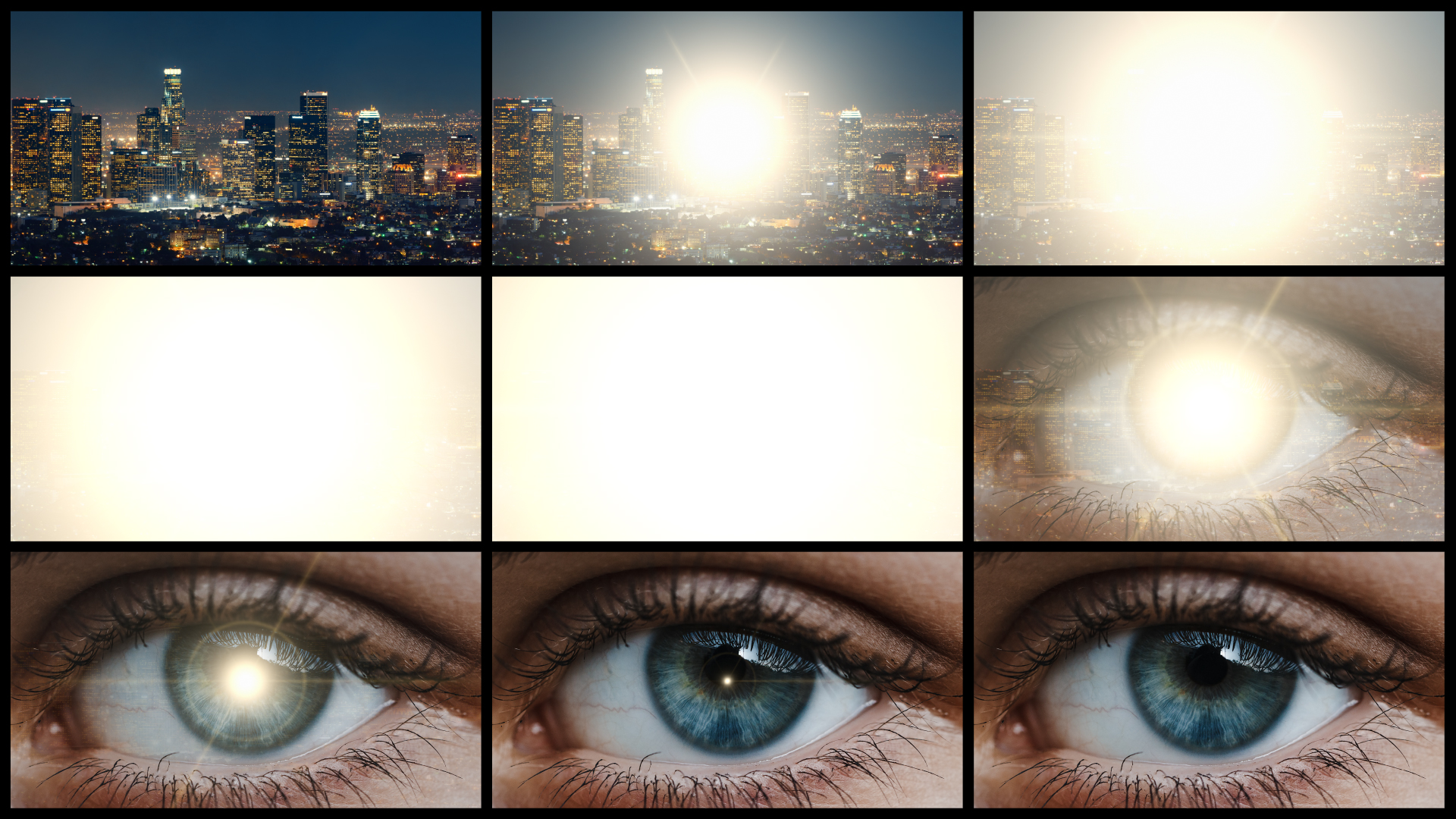
The BCC Lens Flash filter, part of the BCC Transitions group, creates a flare animation that automatically animates as your transition progresses to obscure the dissolve between clips. It offers a simplified subset of the full lens flare parameter set, oriented towards making a large bright flash as the transition progresses.
Working with the Filter
Presets and Common Controls
- BCC filters come with a library of factory installed presets plus the ability to create your own custom presets and preview them with the BCC FX Browser™.
- BCC filters also include common controls that configure global effect preferences and other host-specific effect settings.
For more information about working with presets and other common controls, Click Here.
- Layer to Reveal: This layer selection popup is not relevant when you have applied the filter as a true NLE-style transition and it will be hidden or disabled in that context. When applied as a normal “effect” as opposed to a transition, however, this menu is used to select the Incoming or Reveal layer for the transition.
- Animation: Menu controlling what drives the animation of the transition.
- Auto: Automatically generates a transition based on the transition length (when used as a transition) or the clip length (when used as a filter.)
- Percent Done: Requires the user to set keyframes to control the transition progression.
- Percent Done: When the Animation menu is changed to Percent Done then this slider can be manually keyframed to control the transition progression.
- Source Point Animation:Contains different options for how the lens flare moves across the animation.
- Start -> End: Begins the lens flare at Position Start XYand ends at Position End XY.
- End -> Start: Begins the lens flare at Position End XYand ends at Position Start XY.
- Start: The lens flare does not move across the animation. It remains static at Position Start XY.
- End: The lens flare does not move across the animation. It remains static at Position End XY.
- Position Start XY:Used to control the point of origin for the lens flare.
- Position End XY:Used to control the end point for the lens flare.
- Flare Intensity: Used to control the global scale of the effect. Smaller values will generate a smaller Lens Flare effect while larger values will yield a bigger Lens Flare
- Flare Scale: Used to control the overall intensity of the effect.
- Flare Color: Use to blend the color of the Rays with the color of the Flare.
- Flicker Amount: Used to set the amount by which the light can change from its original value – higher values yield a greater range of flickering.
- Flicker Speed: Used to set the overall speed of the light flicker – higher values yield a faster change in the flickering rate.
- Flicker Seed: Used to set the random seed for the starting point of the multiple Flare flickering.
- Ring Intensity: Used to set the brightness of the Ring. Higher values will yield a brighter result.
- Ring Radius: Used to set the radius or size of the Ring. Higher values will generate a larger Ring.
- Ring Color: Used to set the color of the Ring.
- Rays Intensity: Used to set the intensity of the Rays.
- Rays Scale: Used to set the length of the Rays.
- Rays Color: Used to set the color of the Rays.
- Rays Width: Used to set the width of the Rays.
- Rays Count: Used to set the amount of Rays.
- Rays Type: Controls the type of Rays generated. There are two options:
- Straight: Rays are straight line and parallel.
- Spreading: Rays spread from the source.
- Shimmer Amount: Used to set the amount by which the Rays will change length during the shimmer effect. Higher values will result in the Rays becoming longer as they twinkle.
- Shimmer Speed: Used to set the speed or rate of shimmer. Higher values result in faster shimmering / twinkling.
- ChromaFan Intensity: Used to set the intensity of the Chroma Fan. Lower values yield a more transparent result.
- ChromaFan Scale: Use to control the scale of the Chroma Fan. Higher values generate a larger result.
- ChromaFan Spread: Used to spread the spikes that make up the Chroma Fan apart from each other. At the highest setting, the ring will form a circle of evenly spaced multi-colored spikes.
- ChromaFan Density: Used to set the split‐prism density or amount of spikes that make up the Chroma Fan. A setting of 100 yields a totally solid multi-colored hoop.
- ChromaFan Angle: Used to control the angle of the Chroma Fan, spinning it around the light center.
- ChromaFan Radial Offset: Used to control the distance of the Chroma Fan radially away from the light center.
- ChromaFan Noise: Used to add noise to the Chroma Fan result.
- ChromaFan Color Offset: Offsets the RGB color values from each other. At a setting of zero the result is monochromatic, and at 10 the full color spectrum is used.
- ChromaFan Cycle: Used to set the number of rings that make up the Fan. Smaller values generate more smaller rings that are closer together.
- Lens Spots On: Enables the Lens Spots group.
- Lens Spot Count: Controls the amount of spots that appear on the lens.
- Lens Spots Intensity: Controls the intensity of the lens spots.
- Lens Spots Brightness: Controls the brightness of the lens spots.
- Illumination Radius: Controls how much of the image is illuminated by the lens spots.
- Radius Fall Off: Controls where on the image the lens spots fall off.
- Lens Spots Shape: Determines the shape of the lens spots. There are three options: Circle, Polygon, Orbs Texture.
- Polygon Sides: Controls the amount of sides used in the PolygonShape.
- Polygon Roundness: Controls how circular the Polygon Shape will be if it is selected in Shape.
- Outline Intensity: Controls the intensity of the orb outlines.
- Outline Thickness: Controls thickness or orb outlines.
- Outline Feathering: Controls how blurred the orb edges are at the outline edges.
- Brightness Peak: Sets the maximum brightness value for the transition.
- Contrast Peak: Sets the maximum contrast value for the transition.
- Saturation Peak: Sets the maximum saturation value for the transition.
- Flash Ease In: Controls how quickly or slowly the effect amount increases at the beginning of the transition.
- Flash Ease Mid: Controls the rate of change of the effect amount during the middle of the transition.
- Flash Ease Out: Controls how quickly or slowly the effect amount decreases at the end of the transition.
- Dissolve Duration: Controls the timing of the underlying dissolve relative to the timing of the rest of the transition.
- View Ease Curve: (Only visible/enabled in hosts that don’t support heads up display widgets for manipulating these controls directly on screen.) Enable this control to display a preview graph of the the animation curves rendered into in the composite window.
Rays Group
Chroma Fan Group
The Chroma Fan group contains controls for the generation and tuning of a small multi-colored dual split-prism arc that surrounds the light source pushing outward in a fan like direction, with an arc on either side of the light center.
Lens Spots Group
Color Group
Color settings allow you to set the brightness and contrast values of the transition at it’s peak point. Values will increase as the effect transitions in and then decrease as the new layer is revealed.
The Animation Tuning Group
These parameters control the overall timing of the transition. On hosts which permit on-screen heads up display widgets (such as AE, Premiere, and Avid) you should never need to modify these sliders directly since they can be configured in a more convenient and intuitive manner by manipulating the widgets directly in your comp/preview pane. On hosts without heads up display widgets you can use these sliders directly to fine tune your animation timing, taking advantage of the View Ease Curve option to help visualize the animation rates.