














BCC Warp
Category: BCC Warp
Effect Name: BCC Warp
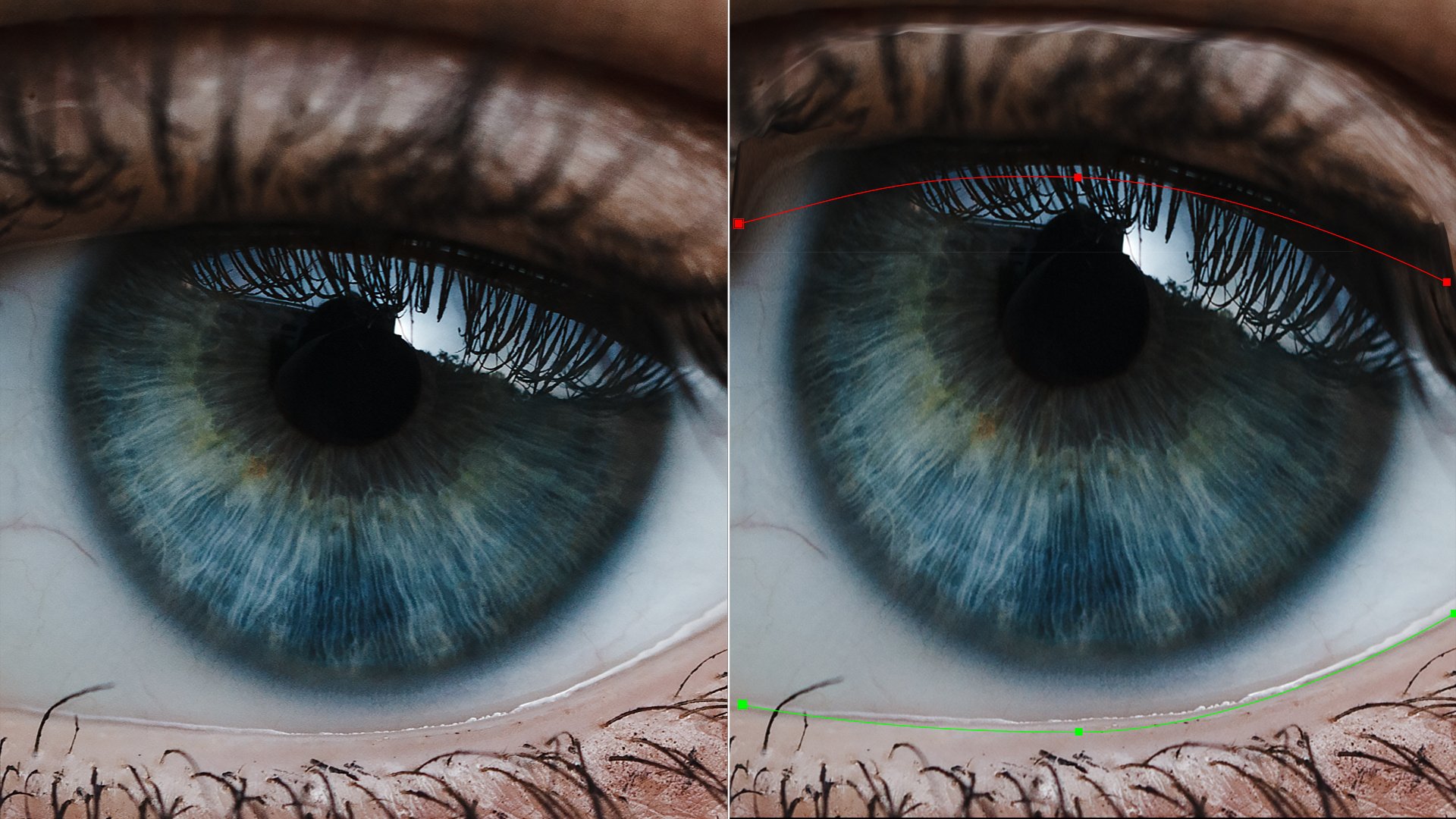
The BCC Warp filter, part of the BCC Warp category, generates static or animated image warps. The filter relies on the use of user generated pairs of Adobe After Effects spline mask shapes to define the start and stopping point for the image warp. You can use as many pairs of warp shapes as you like to warp the image. In addition, you can contain the warp to a specific region within the image via a single closed spline shape mask.
For instance, it is possible to extend or modify the smile on a persons face by first generating an open spline shape “a” that matches the smile contour and then creating a second open spline shape “b” to define the warp – the software then warps the image pixels based on the spatial relationship between the “a” and “b” spline shapes.
It is important to note that in order to generate a warp in the image, you must use a minimum of 2 open or closed spline shapes.
Working with the Filter
Presets and Common Controls
- BCC filters come with a library of factory installed presets plus the ability to create your own custom presets and preview them with the BCC FX Browser™.
- BCC filters also include common controls that configure global effect preferences and other host-specific effect settings.
For more information about working with presets and other common controls, Click Here.
- Render Mode: Determines the view from the filter in the composition window.
- Source UnWarped: Displays only the undistorted source clip when selected
- Source Warped: Displays only the distorted source clip when selected Warped
- Splines: Displays only the warped spline shapes when selected
- Use Global Warp: When enabled, the filter uses a single global warp control for all shapes. When deselected the warp is controlled by making adjustments to the After Effects Mask Expansion feature.
- Global Warp Percent: Determines the amount of warping that is applied to the image. A value of zero produces no warp and increasing the value increases the amount of the warp.
- Anti-Aliasing: Used to set the level of anti-aliasing in the morph result.
- None: No anti-aliasing is applied to the image.
- 5 Samples: Minimum level of anti-aliasing is applied to the image.
- 9 Samples: Maximum level of anti-aliasing is applied to the image.
- Accuracy: Determines the optimal performance / speed versus the accuracy of the morph. Lower values produce a less accurate morph with fewer points on the grid but increases filter performance. Higher settings produce a more accurate morph but take longer to render.
- Low: Most coarse grid setting – lowest number of grid points.
- Medium: Medium grid setting.
- High: Fine grid setting.
- Highest: Finest grid – highest number of grid points.
- Warp Area: Used to set the size of the area in the image that is ultimately affected by the warp grid. Low values will warp only a small portion of the image, while higher values will extend the warp over a larger portion of the image, but will decrease the filter’s performance.
- Smallest: Contains image warp to the smallest permissible warp field
- Small: Small size warp field
- Medium: Medium size warp field
- Large: Largest permissible warp field
- Pin Edges: Used to hold or pin the image edges. Sometimes the image morph can show tears along the edges of the image. Enable this to pin or hold the edges of the image.
- Contain Warp Shape: When a spline shape has been selected, only spline shapes that are contained within the bounds of this outer shape will have any affect on the image. If a spline shape is moved outside of the Contain Shape bounds, the shape will not generate a warped result.
- Point Match: Attempts to match points along pairs of spline shapes where possible and when there is a mismatch between the number of points along any pair of spline shapes, the filter will attempt to approximate where the missing point would be along the spline. Sometimes the image result with this feature enabled can appear unnatural – if this occurs disable the Point Match feature.
- Add Warp Grid: When enabled, overlays a grid displaying the warp field. This feature is especially useful when making adjustments to the Warp Accuracy and Warp Area settings.
- Warp Grid Color: Sets the color of the warp grid lines. Click on the color chip to select a color for the grid display.