














BCC+ Night Vision
Category: BCC Art Looks
Effect Name: BCC+ Night Vision
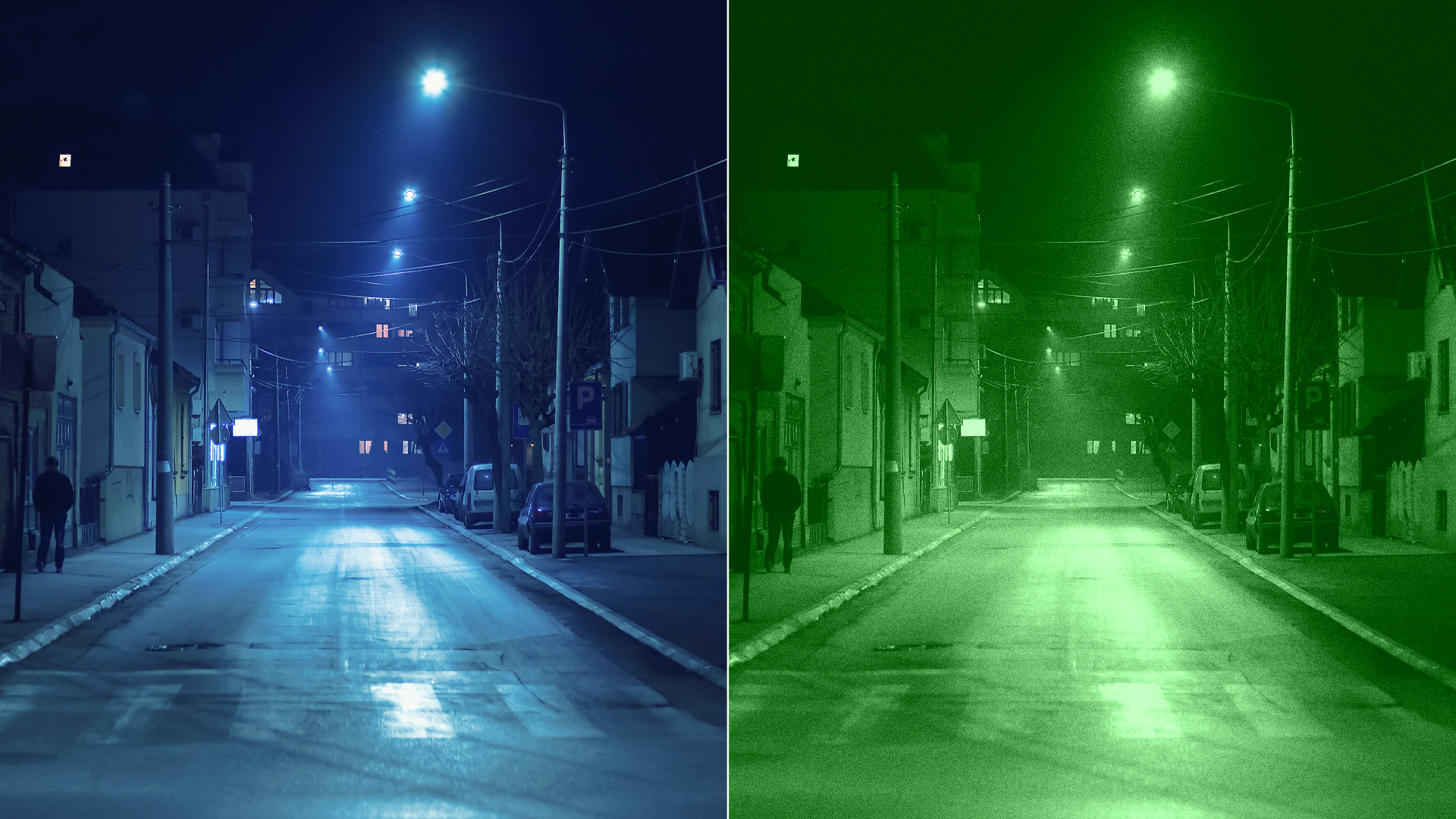
The BCC+ Night Vision filter, part of the BCC Art Looks category, creates the effect of a Night Vision lens–that green, glowy, grainy look.
Working with the Filter
FX Editor and Presets
- Use the FX Editor to load or save presets for reuse.
- To load a preset: Open the FX Editor, select a preset from the Presets panel, and click Apply to return to the host application.
- To save a custom preset: While in the FX Editor, click the Create Custom Preset icon in the parameter list, enter a preset name, and click Done. Additionally, a custom preset can be saved from the main menu bar by selecting File->Save Preset.
- To import custom presets from another drive: While in the FX Editor, select File->Import Preset from the main menu bar.
Effect Controls
Mocha Mask and Track
Continuum effects include integrated masking and matte tools that allow you to restrict the effect to specific regions of the image.
- Mocha masks: used to create custom spline masks. Mocha also includes Matte Assist ML and Matte Refine ML, which use machine learning to generate and track masks.
- Pixel Chooser: used to generate geometric shapes, gradients, or mattes based on channel, luma, or color-based selections. Additionally, an AI depth map generator, and an AI-powered face detection model allow for precise control of masks and mattes.
Note: Mocha can also be used to drive geometric parameters. See the Mocha Motion Tracker documentation for details.
For more information, see Mocha and Pixel Chooser.
Compare Mode
The Compare Mode is used to view the filtered result alongside the original source layer. Several split-screen and side-by-side display options are available.
For more information, see Compare Mode.
- View:
Allows you to set the viewer to display various outputs for the Color Shadow.
- Output: Shows the default look of the BCC Night Vision filter on the image.
- Matte: Shows the glow matte. Useful when determining the look of the glow used in the output.
- Black and White
Select the type of black and white filter to be applied to your color image.
- Normal: Converts the color image to a monochrome image.
- Red: Simulates a red filter in black and white photography.
- Green: Simulates a green filter in black and white photography.
- Blue: Simulates a blue filter in black and white photography.
- Yellow: Simulates a yellow filter in black and white photography.
- Orange: Simulates an orange filter in black and white photography.
Tint Group
The Tint parameter group contains options for adjusting the amount and color of the tinting.
- Color:Sets the color that the image will be tinted with. The color is preset to a night vision green, but feel free change it by using the color picker.
- Opacity:Sets the opacity of the tint color. Higher values will result in a more intense tint.
Glow Group
The Glow parameter group contains options for adjusting the look of the glow present in the image.
- Blend:
Determines the blend mode to be used to create the glow effect.
- Add: The glow is added to your image.
- Screen: The glow is combined with the image using a Screen blend mode. This looks kind of like the Add blend mode, but highlights are retained.
- Brightness:Sets the intensity of the glow.
- Blur:Sets the softness of the glow.
Grain Group
The Grain parameter group contains options for adding and modifying the intensity of grain noise in the image.
- Grain Size:Controls the size of the grain. Please note that you may not see an accurate representation of the grain in the viewer unless your timeline/composition is set to high quality and the viewer is set to a 1:1 pixel ratio.
- Grain Amount:Controls the intensity of the grain.
- Grain Softness:Controls the softness of the edges of the grain samples. Higher values will result in a softer, blurrier noise pattern, while lower values will result in a sharper noise pattern.
Color Correct Group
The Color Correct parameters allow you to fine tune the brightness, contrast and gamma of the image prior to any adjustments to the black and white or glow parameters.
- Brightness:Adjusts the brightness of the image. Positive values brighten, negative values darken.
- Contrast:Adjusts the contrast of the image. Positive values increase contrast, negative values decrease contrast.
- Gamma:Adjusts the gamma of the image. The gamma adjustment leaves the white and black points the same and only modifies the values in-between. Positive values lighten the midtones, negative values darken the midtones.
Matte Group
The Matte parameter group controls consist of Position, Range and Blur parameters. The white areas of the matte are the areas that will be affected by the filter, while the black areas remain unaffected. The matte is extracted based on luminance, in most cases, and is created using the Position and Range parameters.
- Position:Selects the values to be included in the matte. A higher Position value shows more white values from the original image as white values in the matte. A lower Position value shows more black values from the original image as white values in the matte.
- Range:Controls the range of values to be used for the matte. Once you’ve selected the Position, you can then add or subtract the Range of values to be included in the matte. A higher Range value includes more white values in the matte while a lower Range value includes less values in the matte.
- Blur:The matte is blurred by a quality blur.
- Mix with Original: Blends the source and filtered images. Use this parameter to animate the effect from the unfiltered to the filtered image without adjusting other settings, or to reduce the effect of the filter by mixing it with the source image.
- Default: Uses product-wide default of 16 bit half-float GPU rendering.
- 16 Bit Float: Manually force 16 bit half-float GPU rendering.
- 32 Bit Float: Manually force 32 bit full-float GPU rendering.
- Disabled: Forces CPU rendering.