














BCC+ Camera Shake
Category: BCC Lens
Effect Name: BCC+ Camera Shake
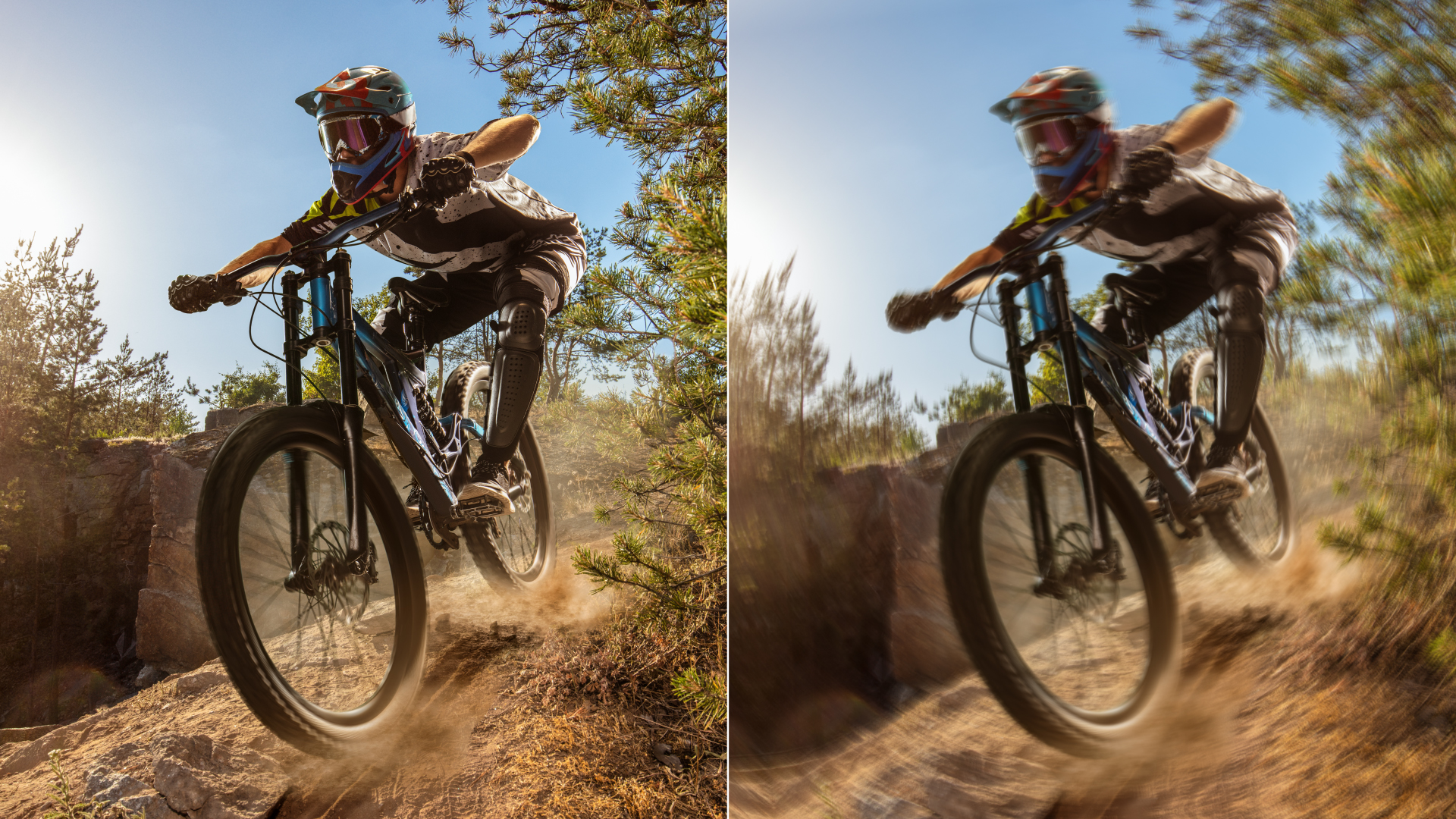
The BCC+ Camera Shake filter, part of the BCC Lens category, simulates realistic camera shake by applying random variations in amplitude, speed, scale, rotation, and optional motion blur.
Working with the Filter
FX Editor and Presets
- Use the FX Editor to load or save presets for reuse.
- To load a preset: Open the FX Editor, select a preset from the Presets panel, and click Apply to return to the host application.
- To save a custom preset: While in the FX Editor, click the Create Custom Preset icon in the parameter list, enter a preset name, and click Done. Additionally, a custom preset can be saved from the main menu bar by selecting File->Save Preset.
- To import custom presets from another drive: While in the FX Editor, select File->Import Preset from the main menu bar.
Effect Controls
Mocha Mask and Track
Continuum effects include integrated masking and matte tools that allow you to restrict the effect to specific regions of the image.
- Mocha masks: used to create custom spline masks. Mocha also includes Matte Assist ML and Matte Refine ML, which use machine learning to generate and track masks.
- Pixel Chooser: used to generate geometric shapes, gradients, or mattes based on channel, luma, or color-based selections. Additionally, an AI depth map generator, and an AI-powered face detection model allow for precise control of masks and mattes.
Note: Mocha can also be used to drive geometric parameters. See the Mocha Motion Tracker documentation for details.
For more information, see Mocha and Pixel Chooser.
Compare Mode
The Compare Mode is used to view the filtered result alongside the original source layer. Several split-screen and side-by-side display options are available.
For more information, see Compare Mode.
Beat Reactor
The Beat Reactor is an audio-driven animation system that links effect parameters to an audio track. This allows visual effects to react dynamically to sound without manual key-framing.
For more information, see Beat Reactor Documentation.
- Amplitude:Sets the overall size or intensity of the camera shake.
- Translation:Sets linear position movement of the camera shake.
- Translation X/Y:Sets linear position movement along the X and Y axis.
- Speed:Controls how fast the camera shake movement occurs.
- Scale:Determines the fluctuation amount in scale during the shake.
- Rotate:Sets the rotational variation during the shake.
- Randomize:Randomizes the shake pattern for more natural and less repetitive motion.
- Post Scale:Sets the amount of image scaling after the effect has been applied.
- Transparent: Makes the edges of the result transparent.
- Repeat: Extends edge pixels outward to create opaque edges. (Default)
- Reflect: Mirrors edge pixels back into the image.
- Wrap: Wraps the edge pixels to create opaque edges.
Motion Blur Group
- Enable:Turns Motion Blur on or off. Default is Off.
- Shutter Angle:Determines how long the simulated camera shutter remains open. Higher values create more motion blur.
- Range: 0–720°
- Default: 180°
Example: At 24fps, a 180° shutter angle creates an effective exposure of 1/48 second.
- Range: -360° to 360°
- Default: -90°
- Range: 1–256
- Default: 16
Note: Motion blur is calculated forward in time. If there is no motion beyond the final frame, the last frame may not show blur.
To correct this, extend the work range by one or two frames and move the final transform keyframes outside the visible session range.
- Default: Uses product-wide default of 16 bit half-float GPU rendering.
- 16 Bit Float: Manually force 16 bit half-float GPU rendering.
- 32 Bit Float: Manually force 32 bit full-float GPU rendering.
- Disabled: Forces CPU rendering.