













STAR WARS: The Mandalorian and Grogu
A discussion about the benefits of editing the film on set, the editorial challenges of IMAX, and getting back to the editorial roots of the original 1977 Star Wars movie.


Today on Art of the Cut we speak with Rachel Goodlett Katz, ACE, and Dylan Firshein - the editors of Star Wars: The Mandalorian and Grogu.
Dylan’s been on the show before when we discussed the TV series, The Mandalorian, for which he’s been nominated for two Emmys. He also edited on The Book of Boba Fett. Dylan was also a first assistant editor on Solo: A Star Wars Story, and The Big Short.
Rachel’s also been an editor on The Mandalorian TV series. Her other TV work includes Halt and Catch Fire, The Walking Dead, and Gossip Girl. She also edited parts 1, 2, and 3 of the Fear Street films.
I heard you edited on set. Tell me about what the value of that was and why it was necessary.
Goodlett Katz: It was really important to Jon that he wanted us to really be the hub for everyone on set. We basically were the gatekeepers for all information, and he would have us very central, so he could just shoot something and run over and say, you know, is this working?
We would literally get footage sent from Brad, our DIT, directly to us. When we started out, we had two Avids on set - one for the editor and one for an assistant editor.
Dylan and I would switch off who would be on set and the other person would still be on the lot, but in the edit room. So we would have days on, days off. We’re always involved in essentially everything that was being shot.
We would show up at 6:30 a.m. and by the end of the day, people would show up from the A.D.s to props to camera to the puppeteers and discuss with us what was needed for the next day or what we had already shot and how those things would line up. It became a very efficient and cohesive way to work. And it was new for everybody on set.
When we initially got there, they’d put us off in a corner, then little by little we got closer and closer to video village.
Firshein: The mornings would often start with someone at 6:30 or 6:45 walking in saying, “Okay, we’re about to do this. Should we take a look at what happened yesterday? We want to see where we left off with the sequence.”
So it was great to be able to be there and get to know all these people - many of whom were on the TV show and we didn’t necessarily have access to in that same way.
So putting a name to the face and really feeling like part of that crew was nice. When “wrap” came, it felt really amazing in a way that usually editorial doesn’t get to feel that way.
Goodlett Katz: Editorial was so important to Jon. He invited us to be a part of the production in a way that just isn’t typical. He asked people to collaborate creatively in a way that I think is pretty rare, and it speaks to a unique experience for us.
Firshein: He comes from that improv world, and so everything is “Yes, and…” He’s looking for any way to plus a scene or performance.
Goodlett Katz: Honestly, we tried to really incorporate that into how we ran the edit room, the way that we worked with our assistants, the way that we would approach scenes.
I think when you have two people editing, the majority of editors say, “Okay, I’m going to cut this scene and I’m going to do this act or we’re going to divide things up that way.” But that’s just not how we worked. We basically had our hands and everything.
Firshein: A lot of that came out of being on set together. I might start a scene one day and then Rachel comes in the next day. She’s continuing where we left off. Everybody has their hands in it.
And again, knowing everything we were able to then as the hub, you know, as this gateway, let other departments know, oh, you know, hey, this this is changing or this is happening.
And it was very important, especially dealing with visual effects. We could all be on the same page very quickly.
How were you getting footage while you were on set?
Goodlett Katz: We used this thing called Q-take. Our DIT would - essentially as soon as something was shot - it would go straight to the Q-Take drive, then our assistants - who were typically on set with us - would pull it in the Avid. We would have it within a minute at most.
We would work with the very low res files that day to assemble stuff, then, the next day, we would get the high res dailies and the assistants would over-cut what we had done, so we would have a basis to start with. Then we’d work from there.
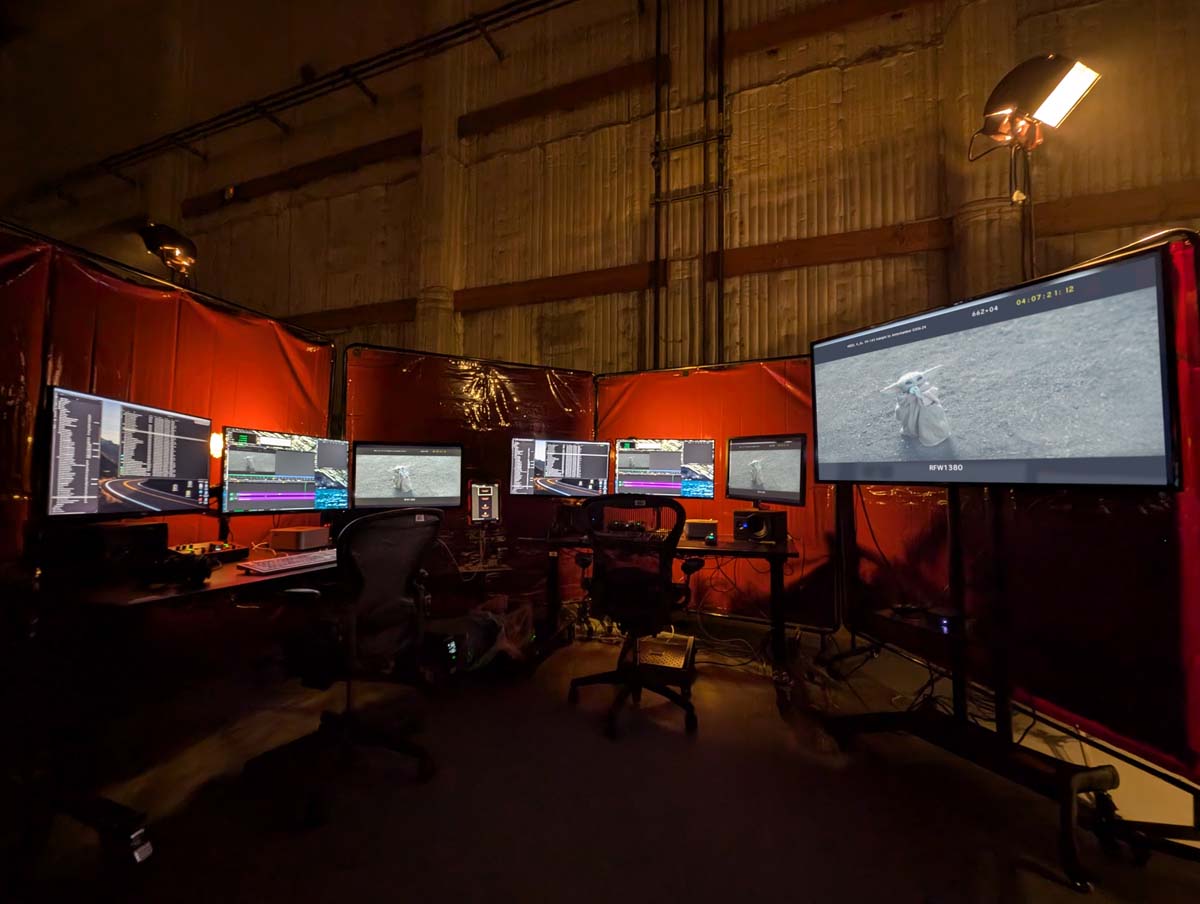
On-set editing set-up
And since you were on set and the other editor was near set, were you working off a Nexis where you could see what was being cut on the other system?
Firshein: We were all on a Nexis. When we were on set we were actually “Jumping” into our systems. In the cutting room, I could always see what was going on on set. I’d have access to the exact same bin even if I was up in the cutting room so I could see what’s happening.
We were always aware. And when there was lunch or a break, we’d end up back together, being able to say, “Oh, this is going on.” We’d be able to keep everybody in the loop.
Goodlett Katz: We would move from stage to stage, so being able to Jump into a solid system was super helpful. Our Avids were set up on wheels.
They would always make space for us, which was awesome, but we would run into situations where we’d have to move the whole set-up because a crane was coming through. So we had to have these intense rolling tables to move our system and just be ready to adjust on the fly. We were always jumping in…
… using something like Jump Desktop? Is that why you’re saying “jumping?”
Goodlett Katz: Yeah, exactly. Jump desktop.
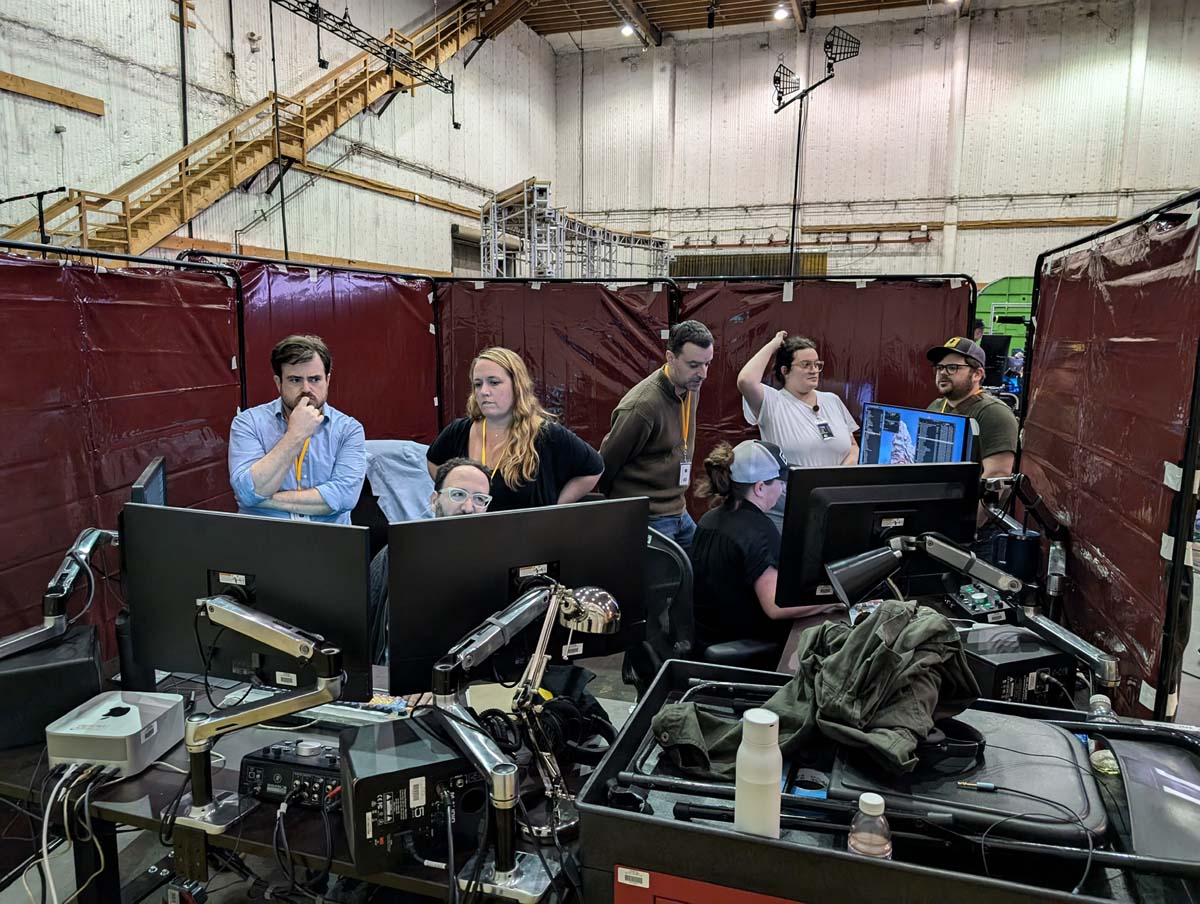
Prepping on-set editorial. From left: Chris Hurte, Zach Fine, Rachel Goodlett Katz, Dave Matusek, Leah Halcomb, Lauren Welch, Ryan Clay
The other technical question I have is about IMAX. How does that affect anything editorially because you’re dealing with these different frame shapes and sizes of screens?
Goodlett Katz: It was very complicated to set up. We had to have an Avid timeline that would free us up to be able to see all the different frames, all the different aspect ratios… even more so because it’s a lot of heavy VFX. Every frame was bespoke.
We would have the 1:43 IMAX frame, then within that, when you have 1.90, when you have 2.40, you need to be able to quickly show Jon or whomever is coming in to check it out: what are those different frames?
We had layers in our timeline to be able to click on and off, how to see those things. In the beginning, when we did it - when we were sort of getting the background plates - essentially it wasn’t as complicated, but as we moved and started to get the full image, we really had to be able to quickly see what we were actually going to see.
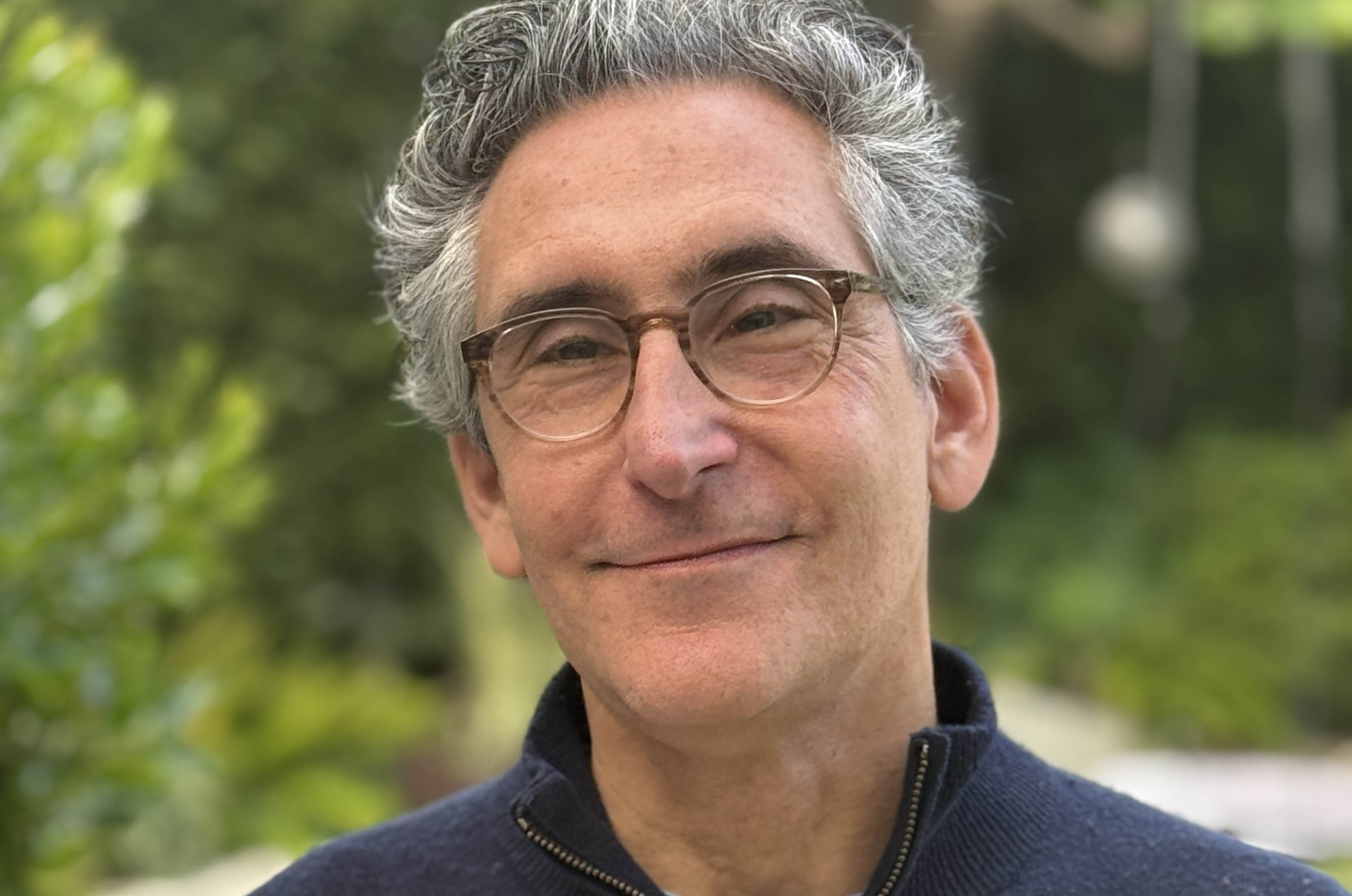
Editor Dylan Firshein
Firshein: There wasn’t just a center extraction. Everything - like Rachel said - was bespoke. Particularly when you’re going for something from 1.43 to 2.39 it requires some pan and scan to make sure you’re getting the right part of the image and everything’s working within the frame.
One of the nice things that we had on set for Jon was Apple Vision Pro to see what a frame might look like.
So at least he had a basic version of what that was going to be. In addition to that, Lucasfilm and ILM figured out another way to kind of have their own software and hardware – Hyperdrive - which allowed us to stream out of the Avid different formats so we could see, okay, this is how this is going to look in 1.43.
This is how this is going to look in 1.90. It’s very different to see it that way versus as a pillar box image on a 16:9 television screen.
So it really gave us some freedom and a chance to make sure it was right before we ended up in the DI when things were going to be much tougher to deal with.
Goodlett Katz: Yeah, because you could actually put on the AVP - the Apple Vision Pro - and essentially go into an IMAX theater. Literally, you see the seats, so you could feel what it feels like to actually to see that image. It really helped us discover certain things like headroom in an IMAX theater.
You have so much that you’re looking at. We discovered that it was better to give characters more headroom so that you’re not having to move your head so far up to be able to see what’s on the screen. We could adjust the framing in the Avid so that you could see it in IMAX the way that Jon wanted it to be.
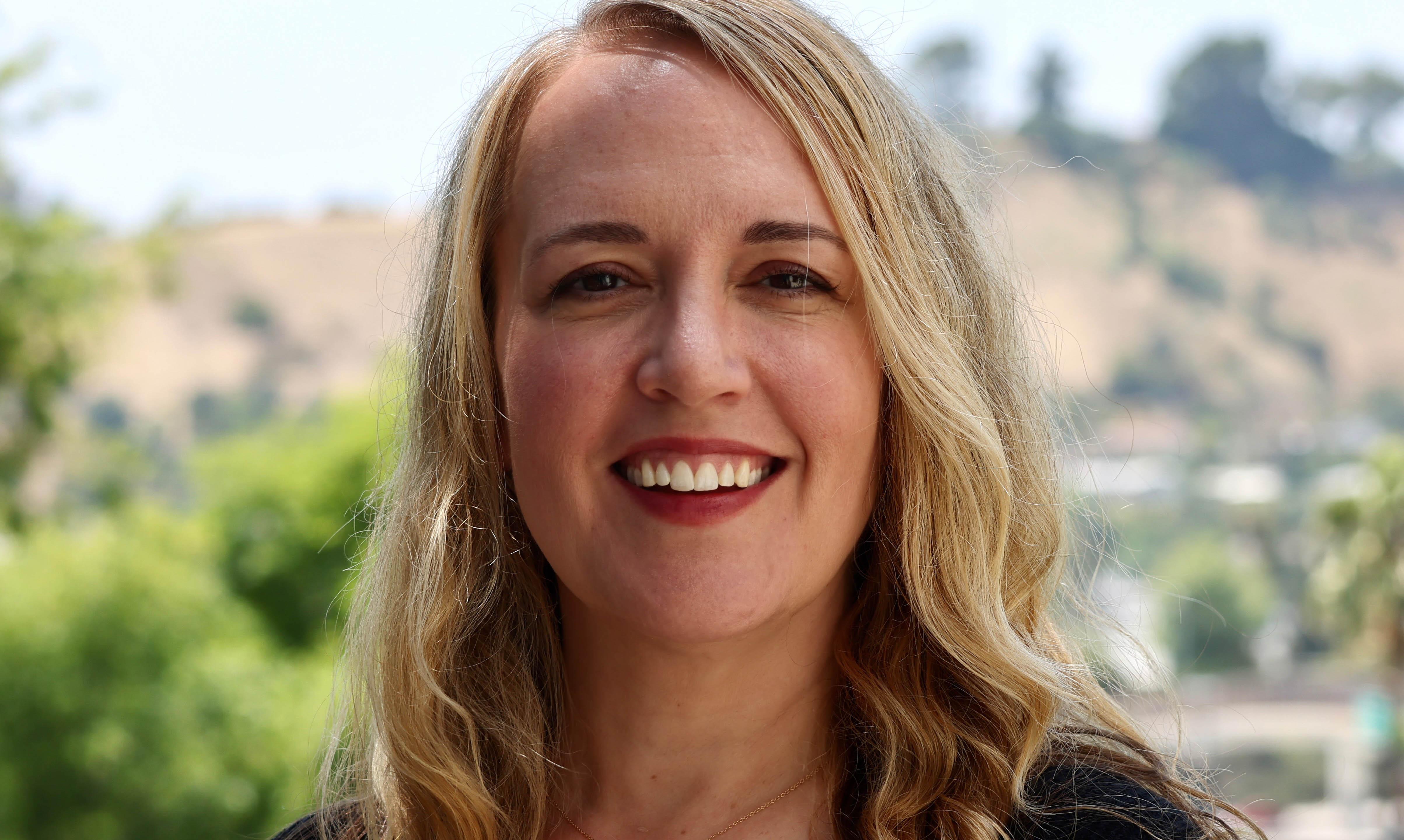
Editor Rachel Goodlett Katz, ACE
This is a team that’s been together for a while. Talk to me about the value of that and the creative solutions that allows.
Firshein: It really allowed us to hit the ground running. We were coming out of the writers strike and the actors strike. It happened very quickly, so we were able to immediately jump in with assistant editors and editors like us. We had music that we could pull from, so we knew the tone.
We knew the visual effects guys. The previs guys – The Third Floor - and our storyboard artists, led by Dave Lowery, because we immediately jumped in and started doing an animatic using Dave’s storyboards and a mix of previs.
That kind of becomes the template for everything, the blueprint, because as scenes started coming in as, the stunt team started working. They gave us footage that we would drop in first for, sequences. Same for puppets.
They might be doing tests, so we could use some of those same exact scenes that they were doing tests on as part of our animatic. So there was no learning curve.
Everybody just jumped in. We could pull directly from projects that we had started back on the Mandalorian TV show, because even back then, we were treating it like a movie.
Goodlett Katz: We all had a second hand with each other from our A.D.s – Kim Richards and Sara Olivieri - to our AEs. People that knew the process. We just were much more efficient. Dave Lowery is where everything began.
Dave Lowery and his team draw every single frame. As editors, we take those frames and put sound and we put music. We create an animatic that feels like the movie. It’s the way that Jon can see everything from the beginning. We knew Dave, and we knew how he liked to work. It just made things seamless for us.
And the stuff that we did have to figure out, we already had a leg up, because we’re not piling on. We had to figure out how to work on set, but all of our AEs are just so technically proficient that they could just jump in and figure that stuff out.
So there was no drama, which is the perfect way to work. We were given a lot of time. We’ve been on this for two years? Which is great, but there were so many visual effects shots in the movie and we shot for a long time. Even with that time, we were just much faster than we would have been had we started from scratch.
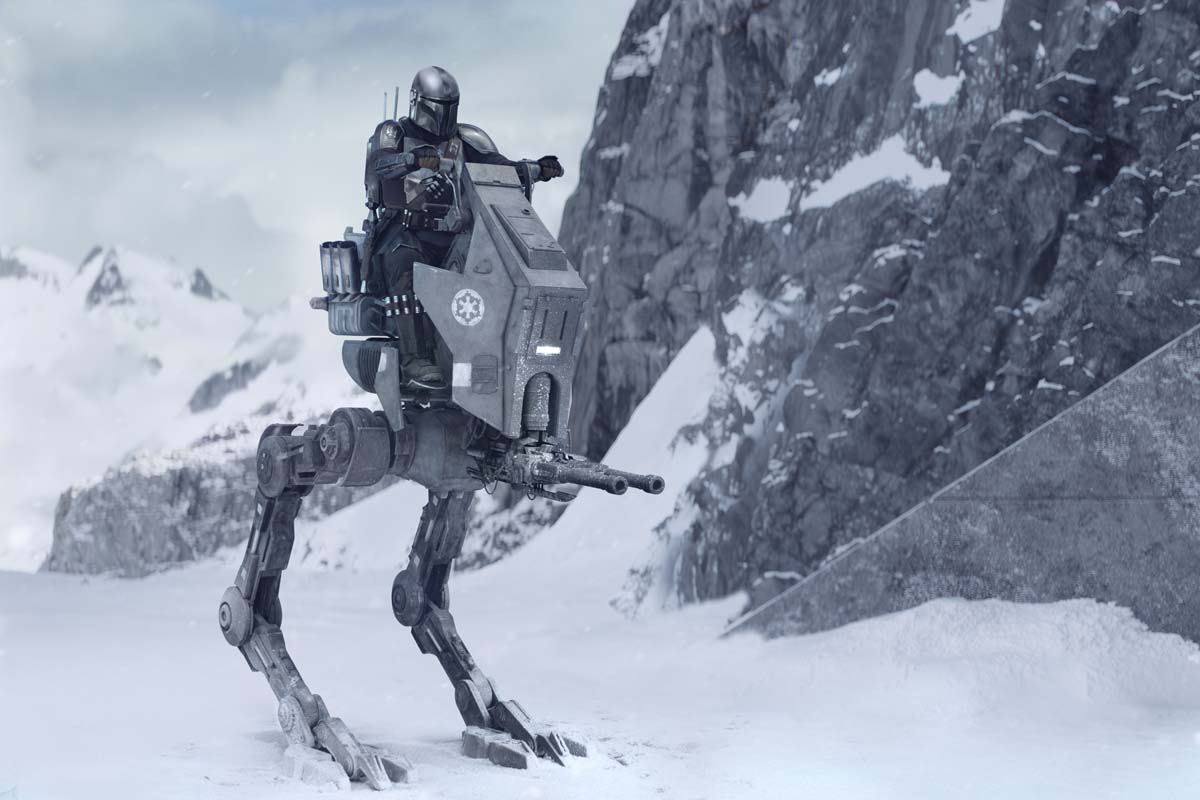
Copyright: © 2026 Lucasfilm Ltd™. All Rights Reserved.
Let’s talk about the evolution of some of the scenes that are so visually effects heavy. It sounds like your “coverage” is almost in the storyboard phase where you would say, “Oh, I think there should be a close up here” or “we need an angle” then it would be drawn instead of having to spend a ton of money on visual effects at that point.
Goodlett Katz: Well, I think it’s a little bit of both. So we would do storyboards, then we had previs that would come in, and stuntvis was very critical. So JJ and team would essentially create a pre-visualization for us doing the stunts, so we would cut those in.
It’s interesting when you’re working on something that’s so visual effects heavy: you have to get everybody on the same page in terms of what it looks like, because everybody has their imagination of what it should be. Jon was really good in his direction, pulling from movies. We would literally pull shots from different movies to kind of help tell the story.
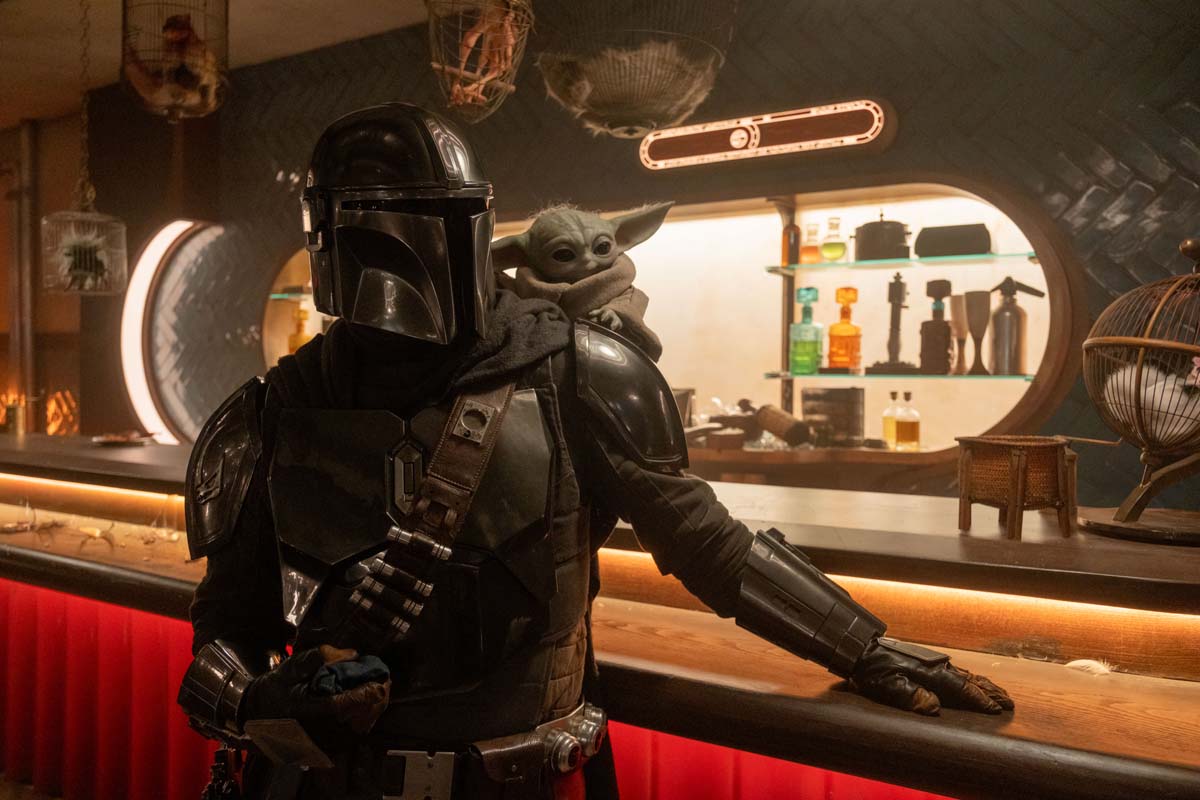
In the Salt Bar scene, for example, he had us look at Hard Boiled (1992). There’s a scene in that movie with all the birds, so that was really an inspiration that starts very early on in the storyboards, but it evolves into something that people can actually see. He would have us pull examples from across the board, like the reveal of Embo - the one with the hubcap-like head.
There’s this shot of Mando on the ground and it pulls up and finds Embo which was a cool reveal in Game of Thrones. We’re constantly inspired - and encouraged to be inspired - by different shots and movies.
Firshein: Jon is just an encyclopedia of movies. His memory for that is incredible. Another one is when Grogu is swimming up to the cabin. That’s Apocalypse Now.
That was his inspiration. Or when Mando was making his run through the forest. We called it The Platoon run because he was pulling from Willem Dafoe and Tom Berenger’s characters running. It was a great way to have a shorthand and get to what he was hoping for.
Goodlett Katz: It’s a pretty awesome technique, and actually that is a George Lucas technique.
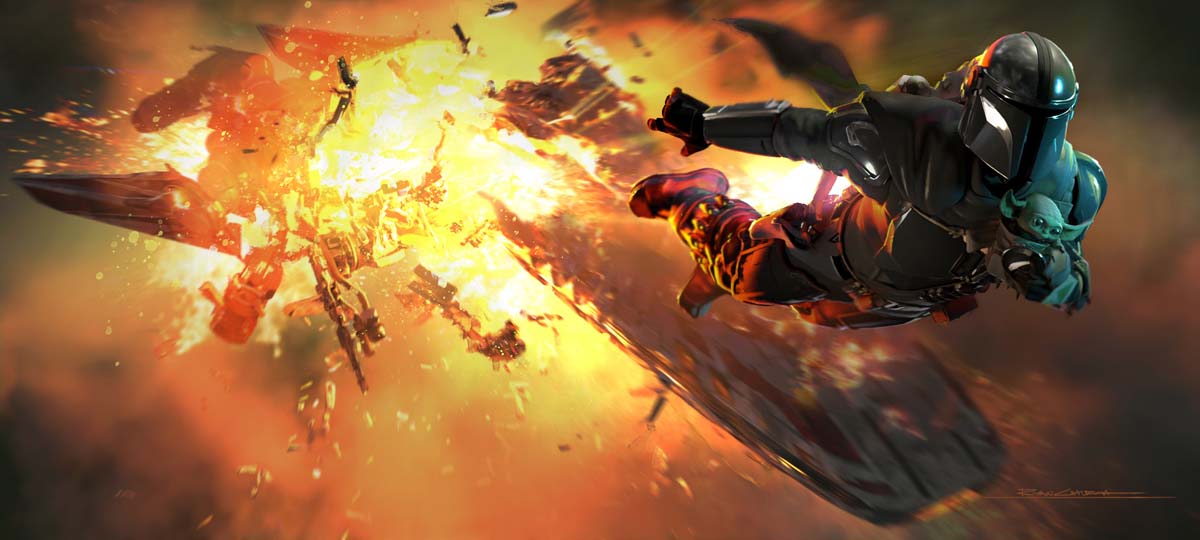
Copyright: © 2026 Lucasfilm Ltd™. All Rights Reserved.
He did it with Star Wars, using World War II dogfighting footage…
Firshein: Exactly. World War II footage of Dambusters and Battle of Britain.
Goodlett Katz: It’s just a great way to communicate to a ton of departments who all have different minds and different imaginations to say, “This is what I’m thinking.”
We worked really closely with Hal Hickel in the animation stage. If you can use stuff that’s very specific, it takes a lot of the guesswork out.
Firshein: With Hal - when it came to the end fight between the Hutts we pulled footage of sea lions and walruses fighting, intercut with sumo wrestlers. At least they could see, “Oh, that’s the movement that Jon likes.”
So it really gave us a big leg up in terms of feeling how a scene could cut together, how we intercut between what’s going on with this sea lion fight and the fight with Embo that Mando is having, as well as Grogu using the force powers with the dog. It was great to be able to have all that.
Goodlett Katz: When you look at where we started, and getting it to where it goes, it’s pretty astounding. You have to ask people to imagine a lot, so if you can take some of that out in the early stages with what we can do, it can help a lot.
Firshein: It just gave the animators such a leg up to know that this is the type of thing we’re looking for. If they had to come with us from the start, it’s that much longer that we’re waiting to get even to that point. By using these pieces, we were able to just take many steps ahead.
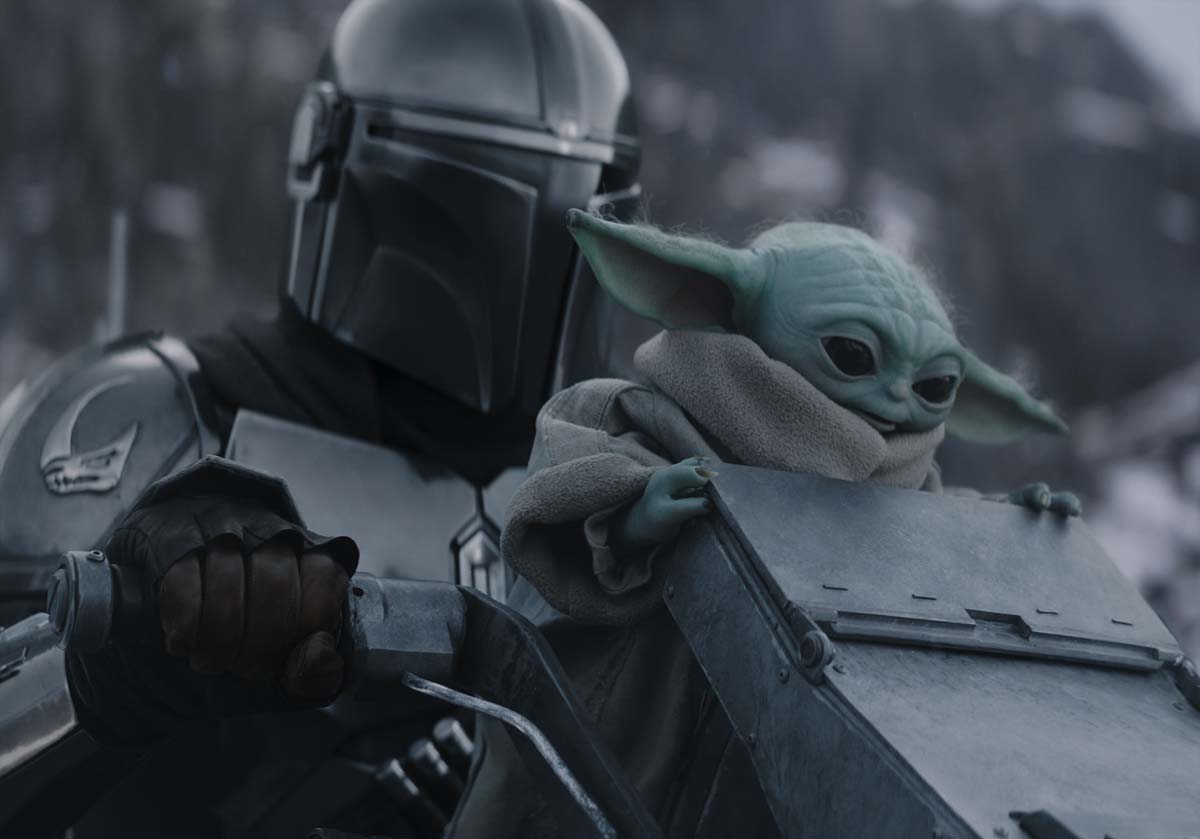
Copyright: © 2026 Lucasfilm Ltd™. All Rights Reserved.
You mentioned score earlier. Talk to me about that temp score, especially over the credits at the top of the film - what you used and what you were able to use. Did you use something outside of the Star Wars universe or outside of the Mandalorian universe?
Goodlett Katz: When we temped, we stuck to the seasons of The Mandalorian.
Firshein: We were very fortunate to have this huge library of pieces that had been done for the show. I think there were 1 or 2 places where we had to use something else, mostly because the sequences were just longer.
We just needed more. So in those cases we needed to reach out to something else. But generally speaking, we stuck in that world of [composer Ludwig Göransson]’s music. And Joseph Shirley - who had done the music for Boba Fett and for Season 3.
Goodlett Katz: …So we had some good stuff to temp from. When Ludwig came in he has his own rhythms. He established the sound - the music for the show. He had a real insight into sequences. He’d say, “I feel like we could really open this up here and just let the music shine.”
The credit sequence was an example. “Let’s just let this be a place to kind of open up and feel the theme.” He did that in a couple other places, too, where he said, “I feel like this could be a musical moment when the Razor Crest takes off, leaving Navarro.
He said, “I really want this to have some weight.” so we would open up those scenes based on his initial instincts about them. His score was incredible. I was happy to give some space for that.
Firshein: It’s that “Yes and…” that Jon believes in. We’re sitting there having this music spotting session, and to have the composer say, “I think we could probably do more here.” So we say, “Let’s open this up and give you runway so you can do your thing. I don’t know if I’ve had any experiences quite like that.
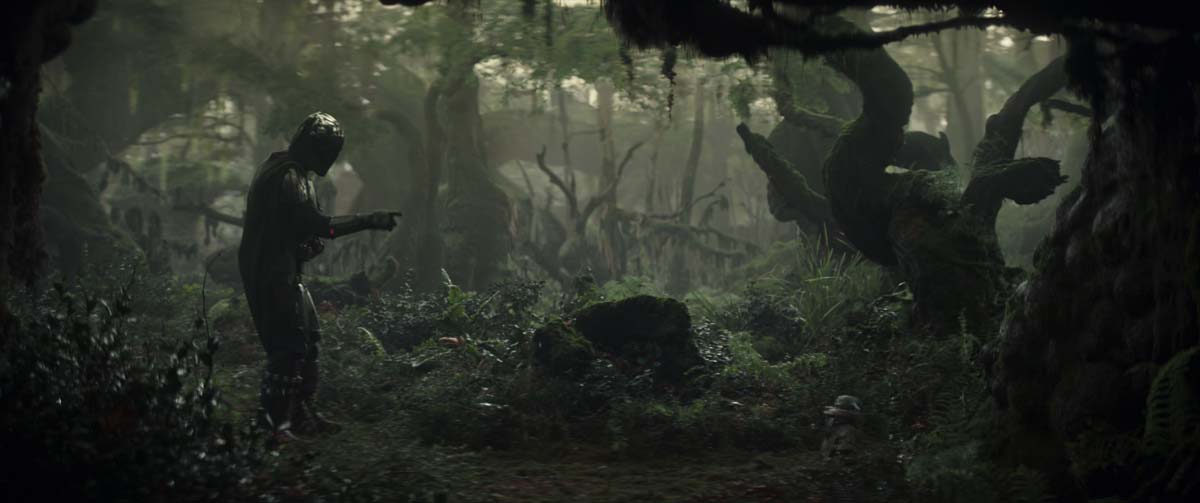
Copyright: © 2026 Lucasfilm Ltd™. All Rights Reserved.
There was another interesting place in the music – to jump to near the end of the movie - which is the fight or chase in the swamp. That was very moody music. It was not action music. Mando’s being chased through the swamp, but if I remember correctly, it was very different. Can you talk about the creative choices and kind of how those were shaped? Was it more you guys picking temp that the composer followed or the composer saying, “I don’t want to do action. I want to do THIS!”?
Goodlett Katz: Good call! From the moment that Mando landed at the end, and sees the Anzellans ship, the tone shifts. I think we actually temped that with emotional music because he’s got to leave Grogu.
For the temp when he goes to fight in the Platoon shots that we were talking about we had action music there. Ludwig did the opposite! When I heard it for the first time, it was pretty stunning. We just hadn’t thought of it in that way.
The score gave it this operatic quality. It’s like the Last Sacrifice. I remember listening to his version for the first time, and when it comes to the part when Grogu comes up and eats the scorpion there was something about the way that he built that arc that helped our storytelling there. It really lifted the moment of Grogu saving him.
That score moment was a big surprise because you live with something as temp for so long. You think, ”This is how it supposed to be.” Then you get this composer coming in from the outside and he has this totally different view that just flips it on its end, which is exciting for me.
Does it help you or hurt you editorially to have a main character who is almost always wearing a mask or a helmet?
Firshein: Well, I think it’s a little bit of both! There are definitely moments where you wish, “I’d love to know what he’s thinking.” But the one thing that we found - in the series, and I think you see it here, too - is that the audience puts what they think onto his helmet.
So as long as you cut away to him, you give the audience a chance to decide what he’s feeling. Obviously you don’t get the face, but you get what [Brendan Wayne, the Mandalorian suit performer] gave to the performance in terms of a shrug, or the way he leaned.
There were all these little kind of micro-movements that he was doing that can also help tell that same story that - although it’s not quite what a face can give you – you still get quite a lot from it.
Goodlett Katz: But the totally awesome aspect of it is that if you need to fix something storywise, you’re not worried about lip sync. So that’s pretty great. You can put stuff that he didn’t say in his mouth. It can be really helpful.
Jon had established how he wanted the Mandalorian to move or not move, and he inherently had a stillness to him - that sort of cowboy stillness - so I had to adapt pretty quickly in the way that he likes for him to move. He also likes for a lot of his dialogue to be “on his face.”
If you’re working with someone where you actually can see their mouth, I think you take dialogue in differently if it’s behind their head - if you can come back to their face and see them saying their dialogue.
So we have a tendency - when he is talking - to put his dialogue on his face because it helps you register it because you’re already trying to gather emotion from it.
There are certain things that we kind of had to learn in terms of selling a performance with a faceless person using just the cutting pattern.
We have a lot of puppets too. But it can be really great in terms of helping the story because you can have them say what they need to say, but it can be a challenge to get emotion across.
Let’s talk about the use of wipes, both creatively and as part of kind of the mythos of the franchise. Is there any, rule of thumb with them? How do you decide to use a wipe as a transition in one spot and not another. When do you choose the heart wipe or the star wipe?
Firshein: Video Toaster!
Anybody use a Kiki wipe?
Goodlett Katz: It was an interesting challenge with this movie because of the IMAX. Sometimes we would go from a 2.39 image to a 1.43. The challenge came with this movie, at least for me, in terms of making sure they felt okay going from one ratio to the other.
But in terms of story, we used them because Star Wars uses them. We would use them when we were jumping in time.
Firshein: In terms of which type of wipe, it usually followed what was going on on screen. Were the characters moving right to left? Then the wipe might follow that person out so we can get it to feel as natural as possible.
Goodlett Katz: We used a circle wipe a couple times for focus, which I think can be really cool. At the very end we circle wiped into Grogu’s face, which I think is fun. I think it was just what felt appealing visually.
Did you end up moving or deleting any entire scenes, or was that stuff resolved during the storyboarding phase?
Goodlett Katz: We deleted a lot. Early in the process, trying to figure out the flow of the movie. There was a lot of extra stuff with Grogu and what we call “Grogu’s World” - the period in the movie where he is really sort of by himself.
We had a lot of stuff in that section, and we moved stuff around. We cut stuff out as the movie came together, for just the emotional flow of it.
Jon had his own vision for it and wants for it, and he would get us to keep it moving, then slow down for Grogu’s world.
Firshein: By the time we got to the point we were showing Jon the editor’s cut, he had seen a lot of those scenes already because we had been there on set with him, so he had a general idea of what it was.
We might have even had a second or third pass with him on some of the scenes, so by the time he was seeing it as a full piece, as we started the director’s cut, he didn’t have to have that moment of feeling like so much new stuff was coming at him.
He immediately just said, “Well, this part isn’t working.” We were able to quickly get rid of these bigger chunks, like with Grogu’s world, or any other parts, because he’d already seen that stuff. We knew what we needed to jump into. That also played into what visual effects had to spend their time on so they weren’t wasting time or money.
Goodlett Katz: When we were on set, we’d be shooting something and he would realize, “This is not the ideal version of this scene.” I think his ability to really see that stuff while they’re shooting, then pop over to us and see how it’s cutting was really pretty special.
He was already in a place where he was getting us to massage those scenes to make them work as he was shooting. You don’t always get that time or that flexibility. I think that was a pretty great aspect of the process.
I’m always interested - because it happens to every single movie, almost without exception - you’ve got great writers, you’ve got a world-class development team that’s focusing on the script and getting it great before you start shooting it, then the movie, once it’s shot, takes on this other characteristic that then you’re able to see in context and things have to change, even though you thought the script was perfect.
If there were scenes you thought you should have cut out, they would have been cut out, but now you’re realizing something different as you’re watching it. And what’s the process of that? How do you think that changes through those different phases of moviemaking?
Goodlett Katz: Well, it’s interesting because I really do feel like - unlike a lot of projects that I’ve worked on - so much of that was happening all along the way because Jon wrote it, he directed it,
Firshein: …and even back at the animatic and storyboard, there were parts where he said, “This isn’t working the way I envisioned it working. Let me switch this around at this point.” So there were always moments along the way that he was adjusting.
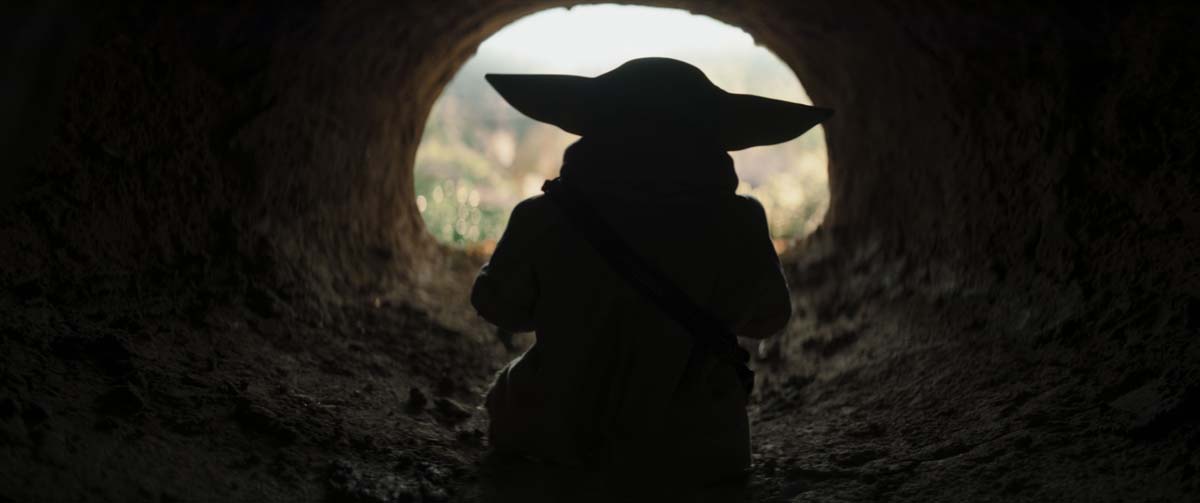
Copyright: © 2026 Lucasfilm Ltd™. All Rights Reserved.
Goodlett Katz: …which was cool. And because he invited us to really collaborate and be a part of that process, I think that he opened us up to really seeing the movie and the story, and to being open to our own ideas about it.
The thing that we were discovering as we went was just how powerful Rotta was to the story, and I think that was one thing that - when we showed the editors cut, when you could see it in its entirety - I think Jon was really pleasantly surprised at how much Rotta was so central to the emotional arc of the story.
I was really finding places that we could just feel him more like in the end, when he fights his aunt and uncle and then saving Grogu and Grogu saving him. I think that was a really cool discovery that happened along the way.
Firshein: We had the vision. We had the script. You have your starting point for where things are, but it’s always going to change. Actors bring something, the D.P. brings something. Everything comes together. Jon used to say, “I’m always smarter in the cutting room than I was on set.”
Goodlett Katz: He is a director who loves the edit room. Even though we were on set, it’s just so chaotic. So much is coming at you all the time, so when you get to the edit room, it’s this nice quiet space to figure stuff out. But that’s why he’s awesome to cut for, because I think he truly appreciates what we bring to it.
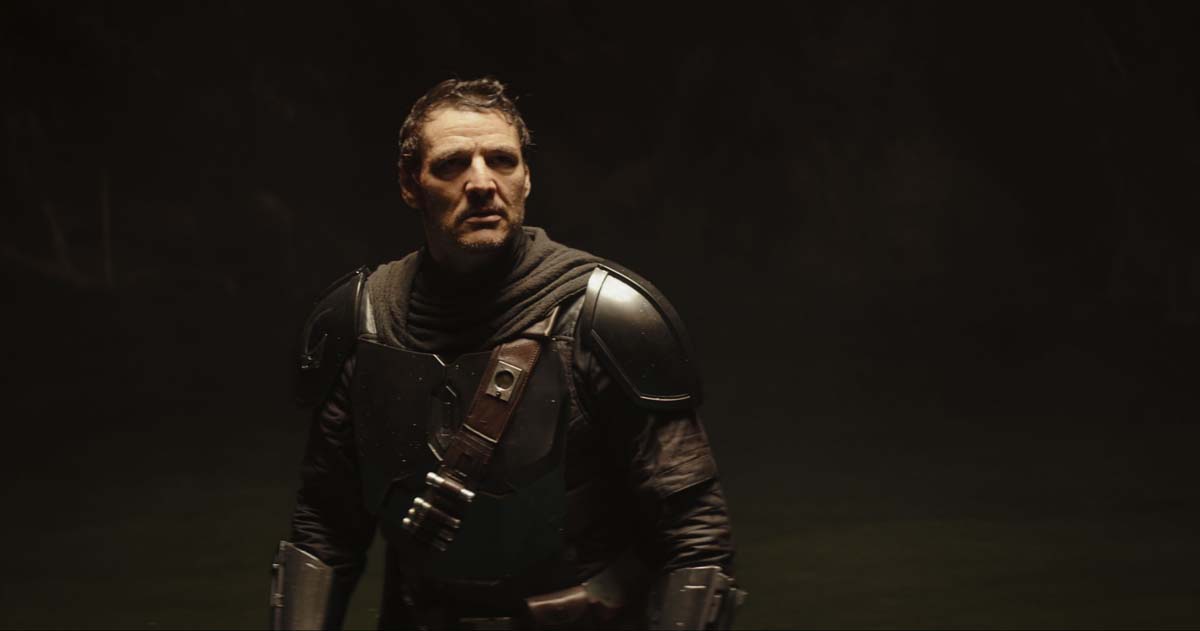
Copyright: © 2026 Lucasfilm Ltd™. All Rights Reserved.
I wanted to talk a little bit about the bar fight scene or cutting fight scenes in general - just how they evolve. What do they start with? Do they always start with the stuntvis? Then what happens as you start cutting with that stuntvis, then you start getting final footage?
Goodlett Katz: We had stuntvis. For example, the oner through the AT-AT, that was pretty awesome. The stunt teams shot it, then we put it into the cut. That would live as our shot until we actually got the real footage.
Speaking of the collaboration and Jon’s philosophy of “Yes and…” the bar scene was a scene that we had cut together and he wasn’t loving it. We cut different versions.
Eventually, we gave the scene to our assistant editors and said, “I want each one of you to take a whack at this. What would you do? Start from scratch, do your thing.”
So they all did, and we got it back. We culled the great moments from each one of their cuts, and we put it together with our own, so it’s this really great scene that is pulled from a collaboration from all of us.
They had fresh eyes on it and they got to do cool stuff. Then we got to put it in front of Jon, who loved it!
Firshein: And he loved the fact that it came from everybody.
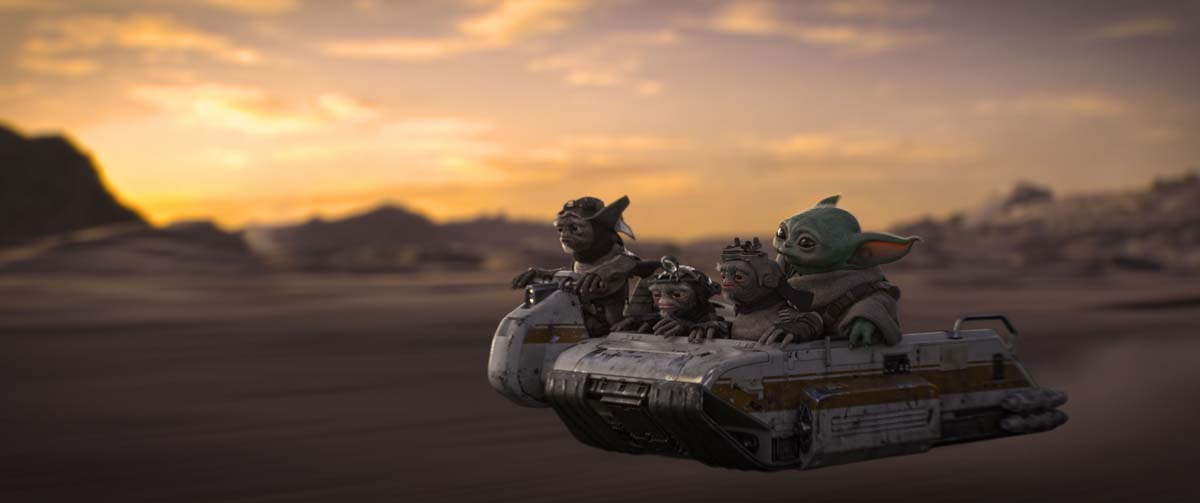
Copyright: © 2026 Lucasfilm Ltd™. All Rights Reserved.
Sounds like Jon would like the fact that it was more collaborative.
Firshein: Yes, exactly. Back to stuntvis, it’s not exactly stuntvis per se, but in terms of cutting with these types of things in the Dejarik fight - which is the fight with all the creatures - the stunt guys wore different colored tracksuits.
Goodlett Katz: Pajamas…
Firshein: They looked silly, obviously, but the camera was there recording these actions: Mando jumping on top of one of the guys with the stick pulling him back. Those shots are there in the movie. They’ve just been completely replaced, except for Mando, so you’re really seeing the work that he did.
Jon really loves it because you’re getting the real physics, and that’s something that CG has a really rough time getting in many cases, but here it’s built right into the shot because he landed on that thing or when he hit the ground. When he’s pulling back, he’s got something that he’s really pulling against.
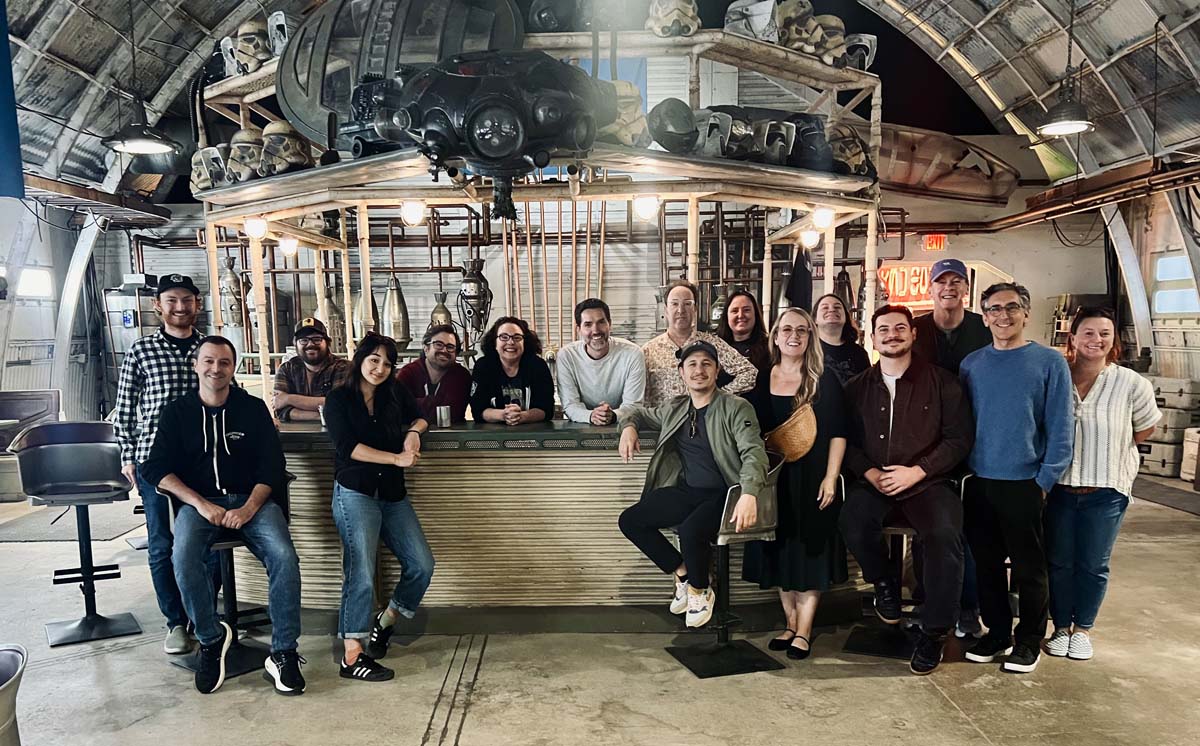
Editorial, Post and VFX crew on Adelphi Bar set. From left: Hawkins DuBois, Dave Matusek, Ryan Clay, Alyssa Mendoza, Chris Hurte, Jude Babcock, Steve Jacks, Zach Fine, Justin Van Der Lek, Tara Molesworth, Rachel Goodlett Katz, Lauren Welch, Grant Ward, Brett Schlaman, Dylan Firshein, Leah Halcomb
Sound effects can often change the rhythm of the picture cuts, but I would think that would be very true in Star Wars, with the completely unique sonic environment that you’re dealing with and rhythms of guns and lasers and all that stuff. Talk to me about cutting the scenes without any sound, getting them back from maybe an assistant editor with sound and seeing how they change. Does it change the rhythm?
Goodlett Katz: First of all, our assistant editors were so good at temp sound.
Firshein: We have this great Star Wars library from Skywalker, so we have lasers … granted they may not be the right ones.
That’s where Matt Wood comes in after the fact and says “No, no, no!” or Dave Acord, “No, no! That’s not your laser! That’s this laser!” That kind of stuff we definitely didn’t necessarily do right, but the story points we get.
Goodlett Katz: Our AE’s did some really great temp sound work, because they’d come off the series, so they already were super fast and super organized and creative with all that stuff.
Through that process, we worked for a while with the temp sound and got it into a good place, and then David Acord and Matt Wood created all the creature sounds in the Dejarik fight, which was pretty incredible.
Firshein: That was one of the first pieces that they took, and it was great because it’s one of those things where it took some back and forth of “What’s this character sound? What’s this roar like? What’s this one doing?”
And to be able to avoid having that kind of thing happen on the mix stage at the end when it’s expensive and painful to fix is great. We had all that stuff in place early so the director and we are used to the sound of it.
Goodlett Katz: There is such a thing as “temp love” that a director faces, so the earlier we could get that stuff in, the better, because then Jon does live with it, so when he gets to the stage he’s not having organ rejection.
When we have their sound, it makes it feel bigger. I remember getting in the Skywalker sound for the AT-AT as he’s riding the ATRT underneath the legs and I thought, “Oh my! Like when the lasers hit the snow? It’s so fun to sit with the movie with those sounds. It was pretty awesome.
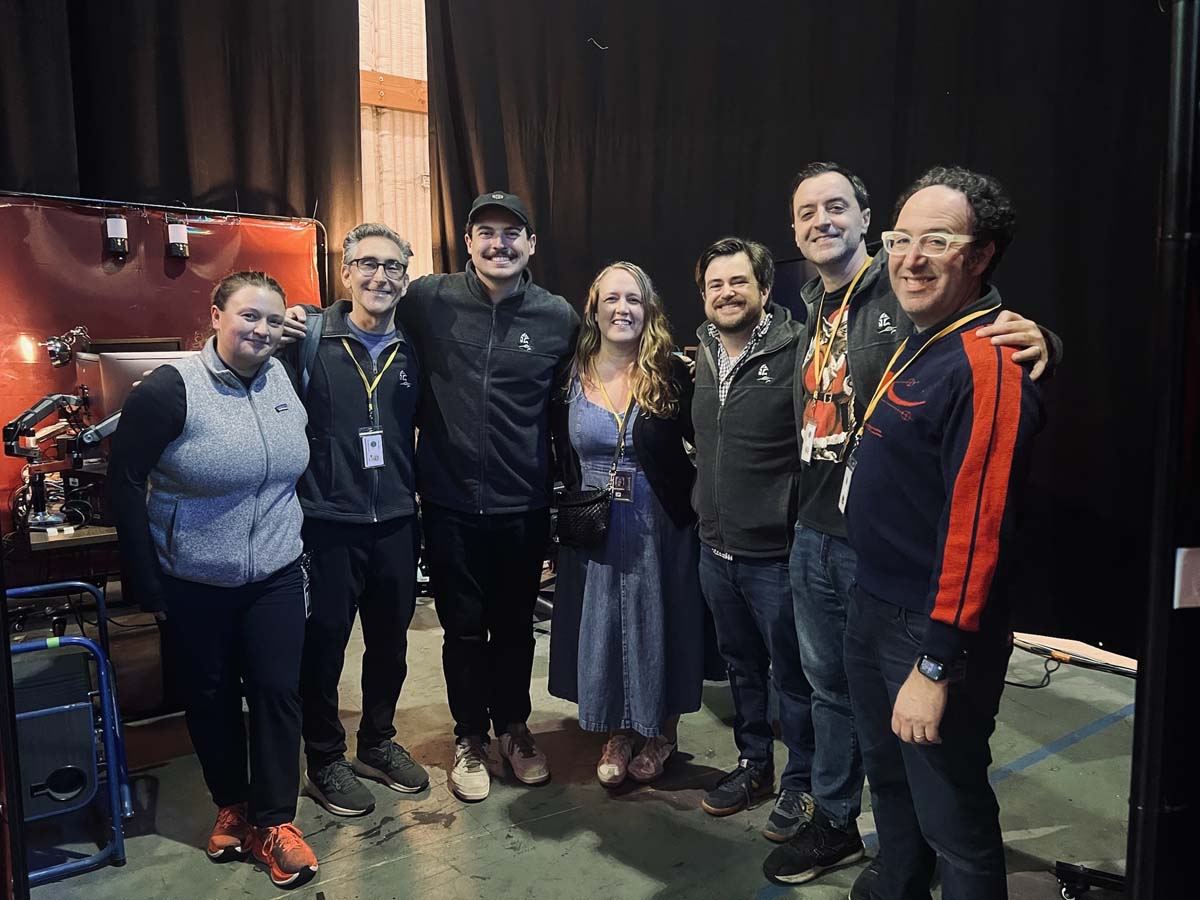
Editorial crew on-set. From left: Leah Halcomb, Dylan Firshein, Grant Ward, Rachel Goodlett Katz, Chris Hurte, Dave Matusek, Zach Fine
You mentioned how much your assistant editors helped with the sound design and how creative and organized they were. I want to give them a shout out by name.
Goodlett Katz: Oh, yes. David Matusek, Leah Halcomb, Chris Hurte, Zac Fine, and Grant Ward, who became our apprentice editor on this. He was our PA, and he got moved up to an apprentice. They’re all the best.
Not only were they super fast and adaptable. They’re also just fun. Dylan and I would do every other day on set and one in the edit room, the AEs would switch off, too. It’s great to have people that you can be with for 12 plus hours a day.
Technical stuff happens, so being able to roll in a chill way is so critical in those high pressure situations.
Firshein: We also want to mention our VFX editors, Steve Jacks, Erica Robbins, and Mike Struck.
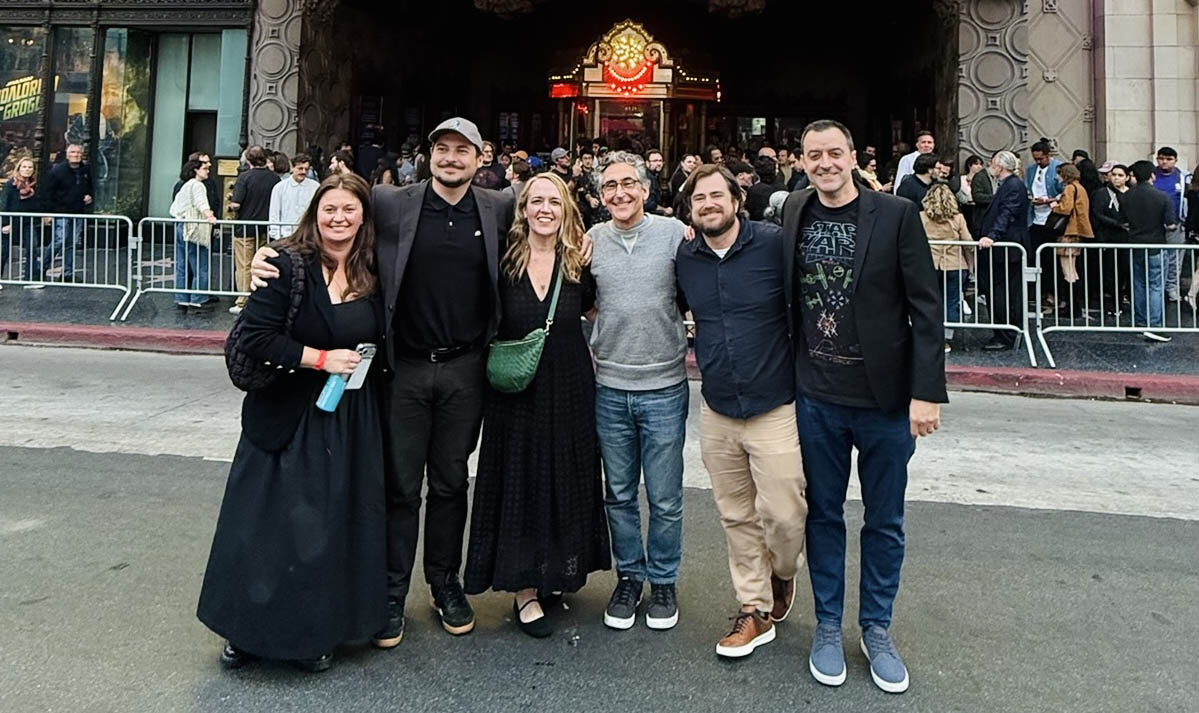
Editorial team at the cast and crew screening at El Capitan Theater, Hollywood. From left: Leah Halcomb, Grant Ward, Rachel Goodlett Katz, Dylan Firshein, Chris Hurte, Dave Matusek
When you’re doing an interview for a new assistant editor, are you thinking, “This one’s got less technical experience, but I can totally see how it’ll be more fun hanging out with him or her.
Goodlett Katz: Honestly, that’s a big part of it. It’s honestly a huge part of being an editor. You want your director to want to be in a room with you for eight, ten hours a day.
You need somebody that you can relate to, collaborate with. That’s hugely important. Being able to have somebody that you enjoy being around is critical.
When it came to visual effects, John Knoll was saying he had the least amount of “final omits” (VFX that went unused in the final movie) on this movie, which is huge. I think it’s because we understood when Jon wasn’t feeling something.
We could predict when we should hold off sending the scene to visual effects because I’m not sure this is going to survive. Just being that open and having that line of communications with our VFX producers Abby and Justin and John Knoll - being able to just call them at any second and say, “Hey, we’re having this feeling…” and having that trust.
With the director, you’re trying to make the best, most efficient movie you can, and we just had to learn to read his mind. You could sort of feel that he’s going to come in the next day and say, “I don’t want to use this scene or let’s do this.”
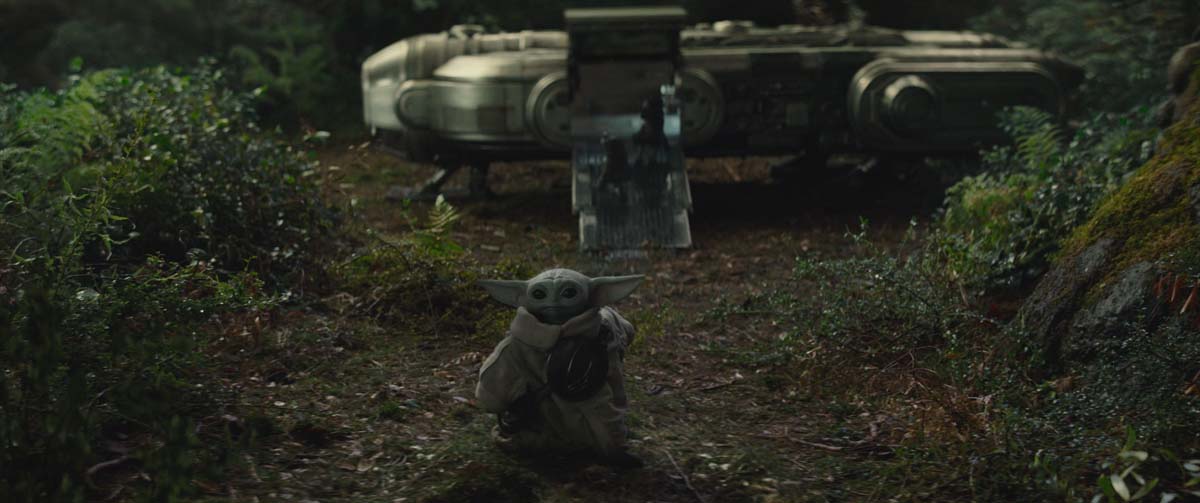
Copyright: © 2026 Lucasfilm Ltd™. All Rights Reserved.
I want to get back to some of the craft. There’s a scene where Mando is injured in the swamp, and there’s a long section with no dialogue as he’s healing. How do you determine how long a scene should go… like Mando healing that thing?
Goodlett Katz: That’s difficult because that scene was much longer than it now plays. It’s a lot of trial and error. It’s playing it as it was scripted, realizing it’s too long. There were certain parts that he wasn’t feeling, so we’re just constantly moving stuff around and seeing where things land up until the very last minute.
Firshein: So much changed for that one. We’d gotten it to a point, then Ludwig came in with the cue that now covers that section, and that changed it completely.
We had our temp in there to try to tell the story, but once we heard that, it was a way for us to say, “Oh, we don’t need this. Actually the music’s helping us here, so we can lose this shot, but keep this thing.” It allowed us to consolidate things to tell the right story.
Goodlett Katz: Everything had to connect to something else. It’s slow, but it had to have momentum. For example, when Grogu comes through the tree log and sees the fireflies. He’s fighting off the fireflies and then he sees Gatori and makes that connection.
Those two were separate at a certain point. That moment with the fireflies is so sweet and so fun, but it has momentum because that’s when we discover Gatori.
For each one of those moments, you want it to have emotional weight, but you also want to keep it moving, so I think that was pretty critical in terms of figuring out the rhythm for it.
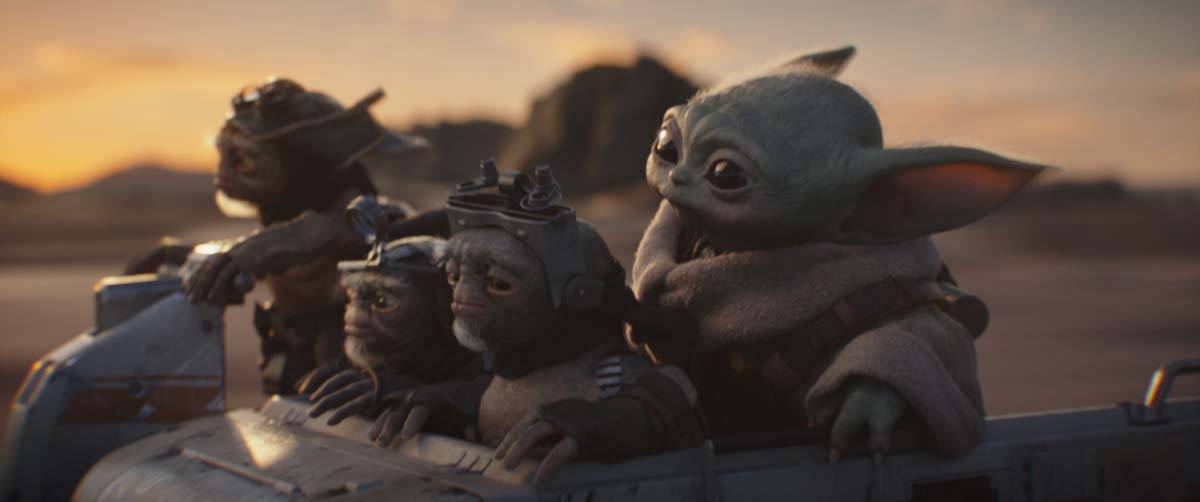
Copyright: © 2026 Lucasfilm Ltd™. All Rights Reserved.
When you’ve got a scene like that, you definitely don’t want it to run too long, but you want it to run long enough that the audience is emotionally invested.
Firshein: If it’s too short, what’s the point?
Goodlett Katz: Yes. What was the point? And we had to keep up that tension, too. There were people looking for them, so that had to exist.
We needed to be able to have that tension create the next moment where he’s building the hut.
We’re not saying it, we’re showing it. He’s discovering how to take care of Mando, so I think that gives it its inherent rhythm.
There are also the differences in tone, so that even though you’ve still got Grogu taking care of Mando, there’s the sad or dramatic stuff, but there’s also the funny stuff of Grogu trying to get Mando into the hut and everybody laughs. The emotional changes help with how the scene plays.
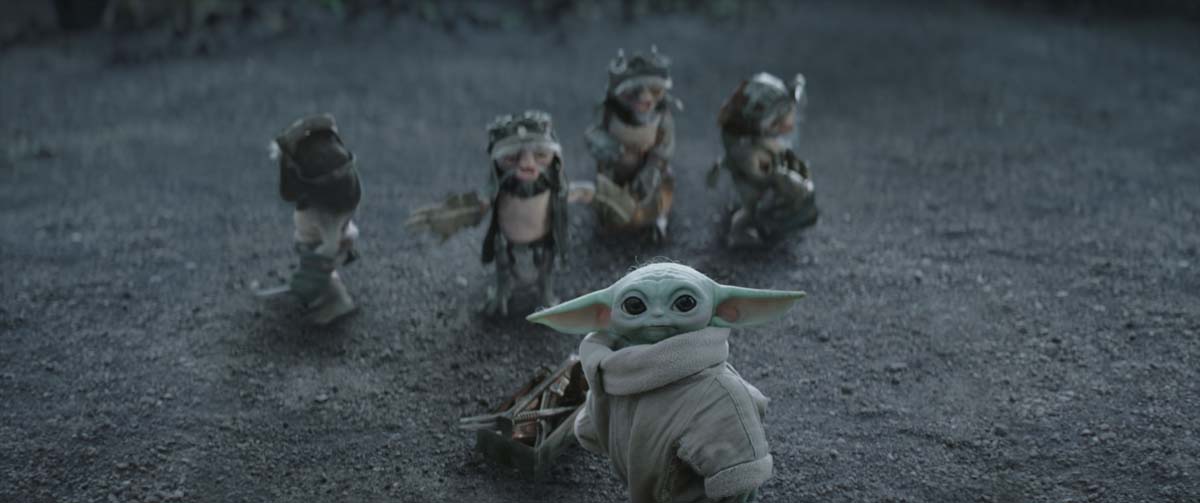
Copyright: © 2026 Lucasfilm Ltd™. All Rights Reserved.
Goodlett Katz: That’s Jon for you, always with humor. Always finding the funny…
Firshein: …but also the heart. That was a big goal for him right from the start. He wanted for people to go on a ride and to have fun, but also to care. That little sequence really encapsulates it.
Goodlett Katz: The very beginning of that sequence when Mando lands at the little Anzellan ship, audiences laugh because he’s not going to fit in that thing. Then the turn happens when Mando realizes he’s got a send Grogu.
He can’t go with them. It’s always walking that line of “I’m crying! Oh no, I’m laughing!” I think that’s Jon’s Superpower. Then for us trying to harness that, to understand the rhythm of that and the timing of that, how you walk that line.
That’s a great place to end this interview: on the rhythm and the ability to change between the heart and the comedy. I want to thank you both for being on Art of the Cut. Congratulations on a really fun movie.
Firshein: Thank you.
Goodlett Katz: Thank you so much. Really appreciate it.
Copyright: © 2026 Lucasfilm Ltd™. All Rights Reserved.
 October 5, 2026
The Whisper Man
Chris has been on Art of the Cut before for The Menu, The Many Saints of Newark, A Quiet Place, and Assassin’s Creed. He has ...
Read more September 23, 2026
Sean Combs: The Reckoning
Charles Divak has been on Art of the Cut in the past for Chimp Crazy, for which he was nominated for an Emmy and won ...
Read more September 3, 2026
The Dog Stars
There's nothing like The Dog Stars in his filmography. That's a testament to him - that he is constantly interested in different stories and different ...
Read more
Subscribe to our newsletter
Get all the latest news, blog posts and product updates from Boris FX, delivered directly to your inbox.
Welcome!
Thanks for opting-in to our newsletter. You'll receive an email momentarily with your confirmation.