












KPop Demon Hunters
The Oscar-winning Best Animated film KPop Demon Hunters was edited by Nathan Schauf, who discusses the evolving state of the edit through its many stages, creating space in music for story, and finding the right spots to take the foot off the pedal for a moment.


Today on Art of the Cut we speak with editor Nathan Schauf about his ACE Eddie and Annie award-winning work on the Oscar-winning Best Animated Film KPOP Demon Hunters, available now on Netflix.
Nathan’s other work includes Overwatch: Origin Stories, World of Warcraft: Harbingers, and additional editing on Penguins of Madagascar among many other projects.
Congratulations on your ACE Eddie win and an Annie. Correct?
Yeah. Back to back. Same place, six days apart.
Let’s talk about the “How It’s Done” song at the top of the movie. Not only do you have to manufacture the pace of the editing - which is kind of anime paced, super exciting, action-packed - but you’re also controlling the pace of what happens inside of each individual shot.
Exactly. Before we had that final song, we had a demo that was close to the same tempo as the finished song. That was actually one of the first sequences I had worked on. It wasn’t the very first, but it was definitely in the top 5 or 6.
So what usually happens in animation is that the Avid is just a blank canvas, then a storyboard artist will pitch the directors a sequence - in this case “How it’s Done,” or “The Airplane Sequence.”
The storyboard artists will draw black and white storyboards in Photoshop. For that sequence we had so many different revisions and so many different ways we were going to start it. There’s thousands of storyboards that I had to cut.
Within each individual shot, there could be - depending on how long the shot is - 10 to 16 storyboards. We’re talking about storyboards that are on screen for sometimes less than 2 or 3 frames. In a slower sequence where they’re just talking, I may hold on a board for a second or two, but in such a jam-packed, high-tempo and high-paced sequence, like the airplane flight it was frenetic cutting of just crazy amounts of little tiny cuts within all those shots.
Editing a sequence like that was super fun and a huge challenge because not only was it an action sequence, it was also a big musical number where they’re changing locations.
They start on the plane, then they’re falling through the sky, then they get down to the stage and you’re learning the story of these girls and seeing them fight demons for the first time.
One of the hardest things to do in cutting music - especially in animation - is providing time within the music for story points.
It’s just really, really fine-tuning to make sure it’s not just a music video type of thing - that we’re actually getting into the story. Finding those pockets of space to have dialogue within a song was very, very challenging, not just for that one, but for all the songs in general.

Did you find yourself doing music editing to provide that space?
Yeah, 100%. One of the best things that I had on this feature was an in-house sound editor, Oren Yaacoby. Once we were done with the demo, we’d actually start getting the first couple of versions of what the song was going to be, because none of these songs were done before the movie started. We had some demos.
So the entire time we were changing the story, the songs would also have to change, and vice versa. So having Oren in-house was great. We knew we’re going to be getting the latest version of the song in a couple days, so Oren would pair it to my current cut and say, “It’s longer or shorter in these places,” so we’d work together.
He’d say, “The song is 50 frames longer in this one section of this part of the song. Would you prefer I take away from here or add there?” Usually I would say, “Just send it back to me with black spaces where the new parts of the song are,” then I would cut it together and I’d have to have a discussion about why they added the time in the music?
I’d say, “It’s breaking up this dialogue we need in this section, so we either have to move all this dialogue to a later part, which might change all the choreography and how we got from A to B to C to D, or you guys might not be able to extend the song that much…”
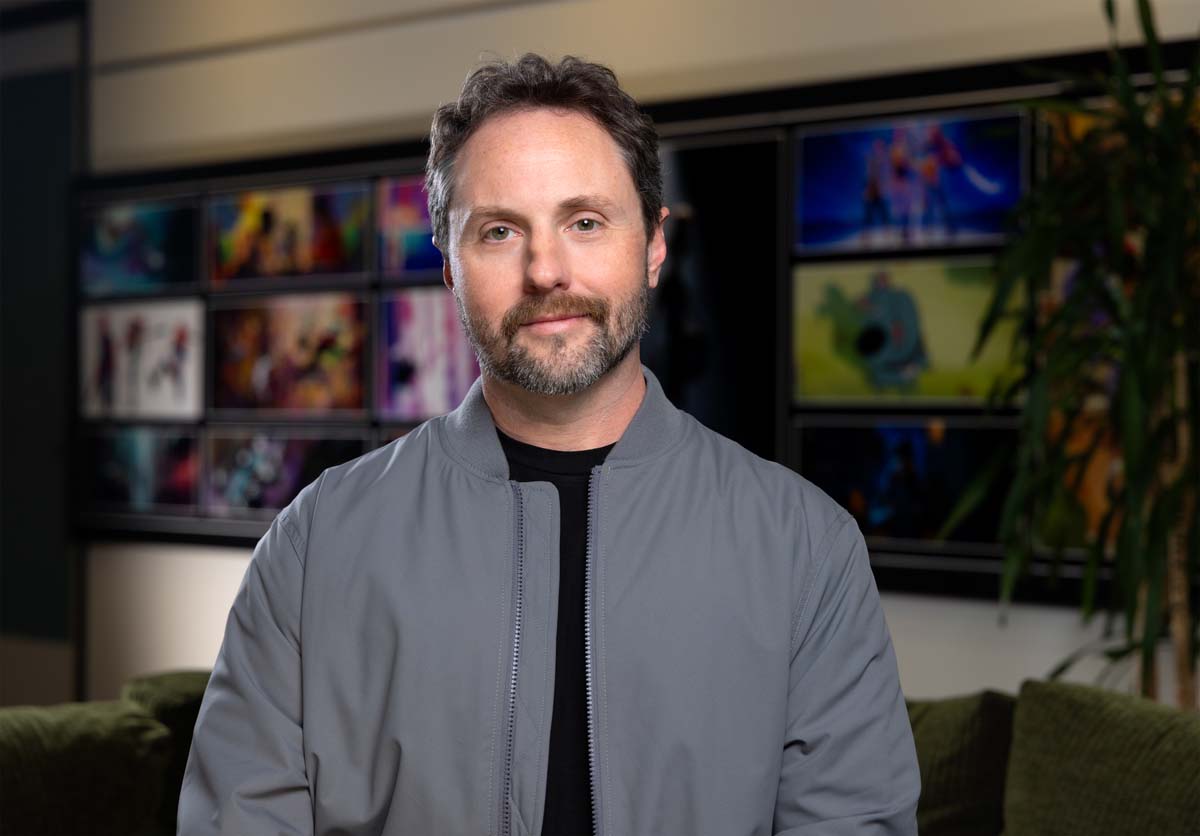
Editor Nathan Schauff
So it was a very back-and-forth between the directors, myself, everyone on the music team, and the music editors, and our music producers. So it was never just, “Here’s the song, make it work.” It was always just back and forth the entire time.
So if there’s something not working with the movie, we have to pivot and try to change that, which then can, in turn, start this whole process over and over again.
Now we have to re-conceive what they’re saying or what their motivations are in the scene or the information we need to get across to the audience. Because we had to change that - maybe now what they’re singing - the actual lyrics to the songs don’t really line up with that either.
It was constantly going back and forth and back and forth. So everything was just microscopic to make sure every detail was hitting when it could at the right point, at the pace we wanted it to. It was a lot of fun, but it was definitely one of the biggest challenges I’ve ever done in my career.
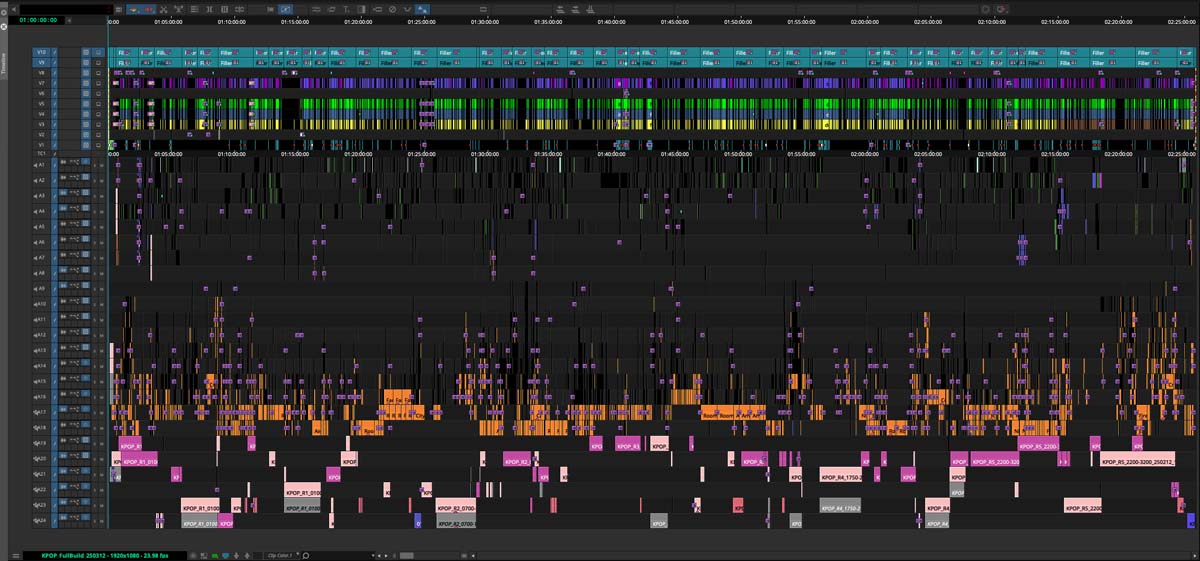
KPOP Avid timeline screenshot
With a movie with this much action and pace to it, you definitely found places to create some dynamics of both volume and speed. Juni, the main villain/demon, when he arrives, the pace changes. You’ve come out of this crazy “How it’s Done” music piece, and now you’re coming into - for a moment - a little breath.
Exactly. That was something that I talked to the directors - Chris Appelhans and Maggie Kang - a lot about. I said, “We are explosive off the bat in this movie. We can’t always be at 11. We’ve just done this amazing opening. We know what the girls are. We know what they do.
The audience needs a break because so much of this movie is quick and high action and high pace and quick, snappy dialogue.” I was always very careful to make sure that we weren’t exhausting the audience.
That scene moved around a couple times. We tried it in a couple different locations, but the thing about KPOP was that when we would try things, the movie would reject them. If we tried to move a sequence, the movie would say, “No, it doesn’t feel good there.” We’d know right away.

When the movie rejected it, did it reject it using the voice of the main demon guy?
It did! We heard Gwi-ma in our heads: “We cannot do this!” Exactly!
It just made sense when we needed to take breaks. We would feel it in the editing room. We’d think, “Am I getting lost in action fatigue? Am I getting lost in dialogue fatigue? Am I confused about who this is or what’s going on?”
I’m really proud of reel one. The last shot in reel one is when Rumi’s on the roof and she’s lost her voice and she is on the roof and she screams and the honmoon goes out across the city. I really think we set up everything really well throughout reel one.
That sequence is also a funny sequence. There’re a lot of good gags. We had some humor with the girls in some other places and it was a good time and everything, but it’s always nice when you can kind of sit and land a joke and have the audience kind of laugh, and if they’re laughing, they don’t miss a line of dialogue.
Having something nice and slow was just great. But it was also a great division between their two worlds. You saw how dark and slow and not fun the world that these demons live in, compared to all the bombastic energy and lights and colors you see of the girls world. So it really helped having them back-to-back like that.

Also in that sequence, there’s a really quick flashback as Jinu remembers his family. Talk to me about deciding how long that flashback should be… because it’s short.
It’s very short. A lot of the things in this movie are very short. So if you blink, you miss them. And for me, I really don’t like to give away that much to the audience.
I always want the audience to be asking questions. It’s kind of just a “flashback appetizer.” Like, “More information will be coming, but you don’t get to know what it is right now.”
This movie has so much information. And, unless you come from Korea or a Korean lineage or a Korean background, most people aren’t going to know a lot of the history.
So when we do go into more heavy Korean folklore I always wanted to make sure that people had time to really ingest it and find ways to keep the audience interested. Having them ask questions instead of someone just delivering information.
That’s kind of a pace-killer when you’re in the middle of a sequence. You’ve got this quick little burst of information, then your brain remembers what it saw later without having to sit down and process a bunch of stuff.

I watched the film twice. The first time I didn’t register that little flashback, but then I watched it the second time and I saw, “There’s a little flashback that looks like all the flashbacks that are later.”
How do you indicate some of the big fast snap-zoom type moves, like in the “Golden” song?
A lot of effects in Avid. We do so much comping with the tools that we have in Avid. We will use every tool that we can basically: Animatte, picture-in-picture, 3D warp, everything. We want to provide as much dynamic camera moves as I can.
Even slow cameras, like when you’re cutting storyboards and you’re just on a maybe two different boards of someone acting very solemnly or sadly or intently, if you’re just on that board for a couple seconds the dialogue’s interesting, but it’s amazing what a very, very small push-in will do when you just have storyboards and nothing else is moving to really impact the emotionality of the sequence, so any time I think there should be a camera move that I’m able to accomplish and I have it, I will always put it on the storyboards just because I wanted to get as close as I can to it before production takes it over, and we actually have the 3D spaces and the actual cameras moving around because it’s all feel.
When you have the storyboards, we can draw a motion on the storyboards, but anything that I can do on my own to push the emotionality, I always try to do that kind of stuff.
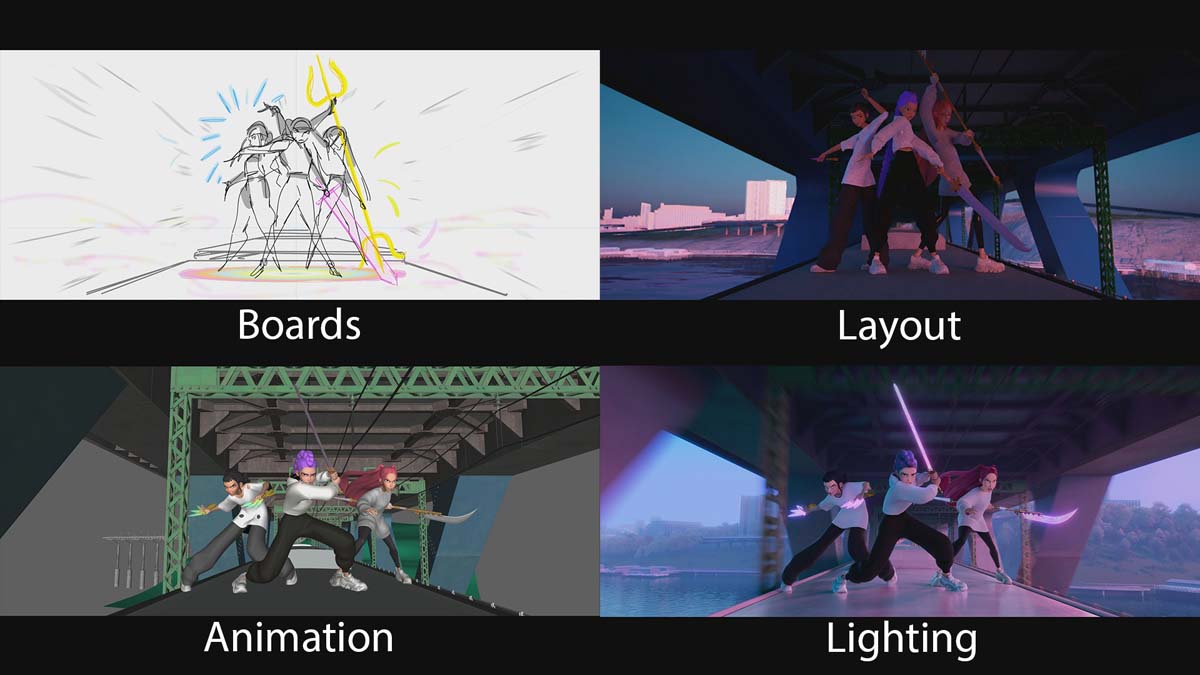
Progression from storyboard to layout, animation and final lighting
It’s not just camera moves. It can be simple stuff like making vignettes on a flashback or doing little white flashes when they have flashbacks, or if a sequence is really going crazy - like when she’s on stage and the whole entire world sees her for who she really is - adding inverted color panels to make it more crazy. Anything that I can that Avid has that lets me enhance panels in any way, I always do that.
Some of the storyboard layers we have are like eight layers in the Avid of crazy stuff. My team needs to be very, very technical and know all the features that Avid has to offer, because if I assign a task to one of my other editors, they know the way I work, and they’re all very good editors as well and use all the same tricks.
So we have that same type of camera language and things throughout every sequence. So one sequence wouldn’t just play kind of flat, and the other one has all these bells and whistles in it. We always try to make sure everything has what it needs.
So the whole movie looks the same. Obviously most sequences are drawn by different storyboard artist, but either way, the feel of the editing and the way we do things I like to keep it consistent across the entire movie. If a few small things don’t feel right, a lot of people would be say, “It was good, but something just felt a little off” so, I really like to have consistent editing language throughout the whole thing.

I just saw a bunch of the storyboards from Hoppers, and some of them looked very different from different artists. Does that throw you when you’re looking at very different storyboards?
For me? No. Just because I’ve been doing it for so long. When I open a sequence, I know who drew it: these are Stephen Neary boards or these are Alexandra Chu boards or these are Maggie boards. The one thing we tried to avoid is that we don’t want to switch between different storyboard artist or drawing styles within a sequence, because sometimes that’s really hard for the audience and not just the audience, and that’s really jarring.
One of the most amazing abilities I’ve seen throughout my career is story artists who can draw and other people’s styles, because a lot of times these storyboard artists aren’t on the film for the entire time. The head of story is, and maybe a couple others are.
So if we have a big sequence drawn by one, then we insert a 22 second section from someone whose style is completely different, maybe that’ll work because it’s such a long section, but if you’re switching every other shot to a different styles of drawing, we really try to avoid that, at least within a sequence.
We were talking about the differences between regular editors and animation editors. One of the differences is - I think, and correct me if I’m wrong in your opinion – is that I might decide to cut between two separately shot scenes, but isn’t intercutting something you are choosing to do much earlier in the process?
Yes and no. We’ll cut a sequence together, and a lot of the times we just review these sequences on their own because we’re building them one by one. Sometimes sequences are written to be intercut, but sometimes intercutting will happen in the edit room. Sometimes, we’ll say, “This sequence is good, but it’s just kind of slow.
But everything that we have in it, we need to have happen.” So then we think, “What if we intercut it with this sequence? On their own they’re not that great, but if we intercut them and maybe cut it so that it seems like they’re actually talking to each other in a different sequence, that’s a really fun way to do it.”

One of the things that happens the most is you could write your movie and have all your sequences edited in order, but that never happens in an animated movie. We go from sequence 100 to 400 to 300 to 500, 600, 700, 800 to 1200, then back to 900.
We’re always rearranging or writing new sequences, so if you look at it on paper, you think, “Oh my God! Who came up with this plan?
It doesn’t look very cohesive, but it’s all based on the story and how it feels, so a lot of times I’ll be in the pitches where the directors pitch back to the storyboard artist, then the storyboard artist will then in turn pitch back to the directors and they’ll get notes.
There are a couple repetitions of that before it even comes to edit, so I’m already seeing what they’re doing.
Then I will bring up to the directors in the meeting if there’s an opportunity where I think we might need to intercut.
They’ll say, “Let’s get everything into the edit first and let’s try it the way it’s planned. Or they might say, “Oh my God! You’re right! That’s a great idea!” While the storyboard artist is still boarding that sequence, I am able to say, “Hey, can you also draw these insert shots” or whatever we need?
The term on my current film uses is: “it’s always just wet cement.” It’s never actually dry. These things are always evolving and always changing.
It’s not just in storyboards. Once I get it into production and have previs or what we call “sandbox” or “layout,” when you actually get the 3D environments and “camera language.”

I can do a whip pan in three frames while I’m in storyboards, but when we’re actually in the 3D model that’s been built that might take eight frames, so I do a lot of constant adjusting of time and space once we actually start to get the shots in production.
Then, even in animation, I’ll still be tweaking things because the layout might have had a certain length, but then an animator might try some new action, so I’ll extend that shot or sometimes I’ll trim that shot.
Then sometimes animation will want to extend a shot, but I’ll have to tell them no - which I hate doing - because it’s not based on the length of the shot or the action on the shot where we’re cutting, it’s based on the dialogue, so in those instances, I always say, “Hey, if this is a dialogue-heavy scene, you’re not going to get a lot of extensions unless there’s a natural break for us to do something that the animation would need to be extended for.”
So it’s usually in action sequences where shots really get pushed and pulled all throughout the pipeline - all the way until lighting.
When it’s really, “on top of each other dialogue,” I’m usually very, very protective over the cut because the dialogue is driving the cutting and not the action type of situation, so it’s just like I said: it’s always wet cement. It’s always moving through all the departments, and we’re never really done until they say, “Hey, you have to be done.”
On Jonah we had a sign over the producer’s door that said, “No film is ever completed. It’s just abandoned.” It’s a classic old saw that everyone knows.
Yeah, exactly. That’s very true. We’d still be working on it if we could.

When I started talking about intercutting, one of the places I was thinking about was when Celine and Rumi’s are talking about her history about what happened to her mom.
Celine was in a band called the Sunlight Sisters, which was the prior iteration of Huntrix. More like a 90s-type version of it. Basically, she was Rumi’s mom’s best friend in the group and became her guardian after Rumi’s mom was no longer in the picture.
We had a lot of sequences where we tried to give more to Celine’s story and make her more involved in many different ways in the beginning, in the middle and the end.
It goes back to what I mentioned earlier: the movie would just reject it. It would just seem like we’re just trying to wedge this in here and it doesn’t seem to fit with the rest of the movie. It’s a lot of information. It was good information to know about the characters, but it wasn’t ever really necessary for the story we were telling right now.
The good thing about that is there is a lot more story to tell if we make more of these, but it was just really hard to figure out how much they actually needed to know. So when we decided on upon that flashback, we just needed to make it a little more about Rumi.
Anytime we tried to make Celine more than that, we were having to add more and more and more to the movie, then our runtime would get too long, then we’d realize that we’d lost focus of what we were doing, so at the very beginning of the movie, the way we do some of the exposition is kind of do it really fast.
Her mom died when she was young, but Celine - who was a Sunlight Sister with her mom - raised her and made her the superstar. So we just give you only the bits of information you really need to know.

But it really helped having Celine be so stern, because any time we needed to remember why Rumi was trying so hard, it was because that was just burned into her brain: “Nothing can change until your patterns are gone.”
So we finally realized that that’s all we really needed: “Let’s make the flashback just more about Rumi. Focus what she’s feeling, and just keep the minimum amount of Celine we needed.
A lot of the stuff we had was really great! It was really cool and it was fun, and it really expanded her story and their story, but there just wasn’t time and the movie didn’t need it.
I’ve talked to many editors about the misconception that an editor’s job is to leave the bad stuff on the cutting room floor, but so often you’re leaving the good stuff on the cutting room floor.
I can’t tell you how many times I was just absolutely in love with a sequence or a part of a sequence, then I’d come in and find out that we’re cutting that entire sequence. I’d ask, “Why?!” And they’d say, “…because this, this, this.” And I’d say, “That makes sense.” There goes weeks, months… however long I’ve been working on it, just gone.
But it’s never really gone because four months later they might say, “I really missed that thing we had…” And I’d say, “Let’s watch it.” So I pull it up and say, “It was really great on its own, but here’s why it wasn’t working, and here’s why I think we could take what it was doing and use that somewhere else.”

Many of our edit sessions, I would play them stuff, and at least half of them would always turn into just brainstorming and story meetings and really trying to figure out what we wanted to do, because we were moving at such a fast pace, because we also worked through two strikes.
The writer’s strike and the actor’s strike. So when we were finally able to have writers and actors again, we were running out of time. So when we liked an idea, we wanted to make sure it was fully thought out. Then Chris or Maggie or both of them would go off and try to write something that night.
I’d roughly throw an edit together with a Chyron that’s just text that says, “awesome Rumi thing happens here.” So we’d try to do a really quick rough cut just to see: is this worth trying? Is this not worth trying?
There is a couple really, really big sequences that we had for a long time that were fun on their own, and really hard to cut from the movie, but as an editor, nothing’s sacred to me. “If it doesn’t work, we don’t want it. See you later.” Maybe I’ll come back. Maybe I’ll see you again one day, but probably not.

The other thing you mentioned was the pace of the dialogue: how you were very protective of the rhythms that you’d created in dialogue scenes. The rhythms in this movie are really tight. The girls are on top of each other and they’re fast-paced. One of the dialogue scenes that I loved was the doctor visit. When they go to a healer. Talk to me about the pace and rhythm of that and how you paced the big in-your-face movements of the doctor. How did those scenes evolve through storyboards and into layout and animation?
That was one of the first sequences that went into production. The opening of that changed a couple times. I think the very first pass, they were just kind of standing in front of the door.
So when they’re standing in front of the office and they go in, that always happened. But before that happened, we needed a little tease that something else is happening subconsciously.
We also have to show that they’re megastars, so we thought, what if they’re walking through the market and they’re all hiding - like famous people have to walk around. Zoe, is always very bubbly.
She walks straight down an alleyway, but there’s a really quick little flier in the foreground on the bottom right of your screen, and you can hear someone say, “Who are the Saja Boys?” It’s a really little subconscious tease that we just threw in there to say, “Here are the girls that are hiding from all the fans - which give them all their energy - but there’s a little tease of “Wait, what is going on?” that’s about to be the biggest thing ever! So then when we went into Healer Han’s office.

We had already had the dinner sequence, so we got to see them a little vulnerable and a little slowed down, but the most fun thing about this was that you got to know more about Mira and Zoe as characters.
It was really fun to play with camera language and the personalities based on how we were cutting, because Mira is very strong and guarded, so having this doctor just go right up in her face, then she ends up scaring him. A lot of really fun things.
They’re just in this little box of an office and they’re all sitting to one side, with Rumi on another, then the doctor’s in the middle.
We have this little triangle that we’re trying to get around. It was a lot of fun being able to cut in on funny gags or hide Mira behind magazines, or have the doctor just come right in camera and then pop out.
The other thing we wanted was for it to be silly. We wanted it to be fun. We always wanted to make sure that the girls were fun and the dialogue was fun, and the movie was fun.
I was really glad that sequence was one of the first ones to go into animation, because that was the first time we really got to see the mannerisms of the girls, which really helps.
It kind of goes back and forth in that sequence where one of the characters might motivate a cut or a camera move, but then other times it doesn’t happen. The camera - which is very symbolic of the characters themself - which is a lot of fun to do, but it’s very hard to do.
I think that sequence came out really great because it’s quick cut and it’s in a small space. We also really wanted to kind of make it feel like when you’re in a doctor’s office: you’re kind of on your guard when you’re at a doctor’s office, so when you’re not the one that the doctor’s supposed to be examining, then he starts examining you, it made a lot of their insecurities come out.

When you’ve cut something in storyboards - and edited it in a certain way for pace - then you get it back from layout, what can change at that point? For example, when the doctor dives into the camera at Rumi, the pace of the movement is wrong.
Exactly. Everything can still change. So I will do the same thing to layout that I do with storyboards. I will put a camera move on top of a camera move that they have built in, or I’ll cut out a character and paste it onto a frame with another character and explain, “This needs to be a two shot,” or I will speed-ramp the shot to make the camera as fast as it needs to feel.
They’ll show it to the directors and then they’ll send it to edit, then I’ll massage it. We just don’t get one shot, especially in the previs sandbox.
They can send us dozens and dozens and dozens of versions of a shot because it’s a lot easier to render through their tools, so a lot of times the way we boarded it isn’t at all the way it looks after it goes through layout, because once we’re in the 3D space, we can better experiment: “What if we came through here and went around the corner?” Or, “What if we shot from top down?” It gives us all these new options that we never had before.

If the storyboards are working and everything is cutting and it’s feeling good, we always know, “Hey, this is great, for now. It’s doing what it needs to do in story.” A lot of times - when these sequences are boarded - the models aren’t done yet.
They have a rough idea of what they’re going to look like, but everything’s being made at the same time. One of the things that I love when we get to that phase is all the new options I get.
How do we get to make it better now that we can move the camera wherever we want? We can do all these things. This is what the shots are going to look like
In the first round – storyboards - I will cut and I will manipulate and I will do everything I can that I can do, but there’s only so many tools that I have to work with. It’s not like I’m in Maya (a 3D animation program) and I can go in there and actually change the camera or anything, but we get it as close as we can.
Then, of course, we call on all those people from all those departments and say, “Hey, here’s what we’re thinking. Here’s what we kind of want.” Then we’ll walk them through everything.
A lot of times shots are combined or we make more shots. Nothing is sacred. It’s all wet cement, as long as it’s making it better. We’re always going to say, “Is this making it better?” A lot of the time I’ll ask, “Is this just a lateral change, or are we just changing it to change it because we can? Or is what we had better?” In animation, a lot of times we’ll have a sequence that’s playing great, but then we’ll come up with an idea and that idea will bloom into another idea.
And because we have that idea now, we’re going to do another idea. Then we do all this, and we watch the sequence back and we’ll ask, “What did we just watch? The sequence isn’t doing anything that we need it to do anymore!”

Part of my job is to say, “We started adding more and more things for this one little idea. If we don’t care about this idea anymore, we can just go back to what we had. The sequence was great.” So it’s a lot of trial and error, trial and error.
I always think of dominoes. Every sequence is a domino. You need this one to hit this one, so they’re all going to go down at the end. Sometimes when you take too many things out of a sequence, the domino doesn’t hit the next one anymore, so then you’re at a junction where you have to ask, “Are we just going to keep adding to this to make it work again? Or should we just go back to what we had and realize that that was actually working really well?” Maybe we just need a better line written, or maybe we should just try to find a joke, an animation.
So it’s just having a lot of conversations about what we actually need and what we don’t need. “Is this better? Is it lateral?” It’s always going to be changing. You can’t say, “This sequence is done in storyboards. It’s got all the production dialogue. It’s playing great.
This is the movie.” No, that is not the movie at all. It’s going to change so many more times before that sequence is done. Usually - once it’s approved in animation - the shot will be locked for time at that point, because after that, the story, the animation and the camera and all that is done. Then it goes to simulation effects, lighting and stuff like that.
A lot of those things are more technical, but there have been many times where we’ve got a shot in lighting and they’ll say, “Oh my God! That looks so gorgeous on the sunset! Why don’t we extend the shot a little bit more?
Now that we see it fully rendered, it would be nice to hang for another beat or second.” So it’s never off the plate to change the length of the shot until they basically say, you can’t change anything at this point.

In the “Soda Pop” song it has some editing that - in a live action shot - the editing would probably involve dropping frames. Like in a fight scene on a punch, an editor will cut out a frame or 2 or 3 to make the action pop. You don’t notice that there’s an edit. You just get to the “hit” in a really poppy way. Did you do that? Did you cut frames, and at what point in the process did you cut them? Or speed ramps is another way, on a snappy move of a dance choreography.
That was the first sequence I ever cut on the movie. I think that’s why I got the job, actually. It was a different song back then. It was a demo of what became “Soda Pop.” It was the same vibes, pretty much the same tempo.
The biggest difference between what you’re saying and animation is that if we decide to speed ramp a shot, then someone in layout has to do that. They actually make the camera move or action that speed. So everything that’s done like that is actually how it is.
There are two different types of animation throughout the entire movie. Sometimes they’re animating on “ones” where every frame is animated, and other times they’re animating on “twos” where every other frame is animated - to give it more of that kind of pop feel.
So with “Soda Pop” - it’s such a pop song, and a lot of K-pop is made of these huge, amazing studios that produce all this stuff - so it’s very precise and it’s very clean. Everything’s perfect, so I wanted those cut points to just be as poppy as can be.
A lot of the times - if I was cutting directly on the beat - sometimes to make it really pop, the cut might actually happen a frame before the beat hits just so you actually hear it and see it almost at the same time, because you kind of hear faster than you see a lot of the time. Being able to do that.
Then the choreography was a whole other thing. That was a whole other layer we had on top in the animation. We weren’t just animating and doing all these songs.
We had people helping us out with choreography. We’d have to obviously get that in the animation. When you’re animating a choreographed dance in an animated movie, you can’t just have them dancing.
You still need to have the emotions and everything they’re doing on their face and the subtle things. Cutting in that sequence was very different. When you’re on the boys, it’s very precise. It’s very on the beat most of the time.
You see how the audience is reacting to them, and then you see the girls and how they’re thinking, “What the hell? Who are these people?” We actually stay on that three shot of them for a decent amount of time compared to how we’re cutting throughout the rest of the song, just to show that they’re not having any fun.

Every sequence was very unique in how I would cut it, because every sequence had a different prerogative. What do we need out of this sequence? That one had to be ultra-precise. Everything’s happening on the beat.
When they pop their arms up and stuff, those are also to the beat. I had to cut the same way that they
were dancing a lot of the time. it was just back and forth.
We get all types of different cameras and all types of different stuff from animation layout, and just try 100 things to see what felt like it should be cutting at the right time and who we should be cutting too. In that song pretty much everybody sings and there’s a rap.
Every sequence was a challenge, especially the music ones, knowing when to really go faster or not. With that one, it kind of ramps up as the song ramps up at the end, because it builds up to the little crescendo at the end. It was just a lot of departments all working in tandem to make sure that everything felt right. Even in animation, the cameras would still change.
Sometimes we would get 6 to 10 camera choices for one shot. Sometimes I’d say, “Maybe we just cut to six different angles where this one shot used to be.” It all goes back to the movie rejecting it.
We would all watch something - Chris and Meg and I would just say, “It’s not really working.” Or I’d turn around and say, “Shit, that was good!” And “Shit that was good” always wins.

Since you have choreography, how does that work at the storyboard phase?
The storyboards aren’t that animated. There’s only a couple poses per shot, so the choreography for that is kind of close to the idea of what it is. Storyboards are always about, “Is the idea getting through? Are you feeling what they’re supposed to do for that?” It doesn’t have to be an exact science.
A lot of the action changes after storyboards. We know they get from A to B to C to D, but it’s really not until animation where we really start blocking out the actual things that they’re going to do.
We had people in Korea doing the choreography. They would have done three different versions of the “Soda Pop” choreography.
We’d watch all three and say, “We like the first part of this one, then we like the second part of that one.” Or maybe we like the third part of that one. Then we’d ask, “Can you make all those one?” It was never like, “Here’s your choreography.”
Then we’d give that to animation and that’s when they’d actually animate it. So the characters in rough layout are still just roughly blocked to where they need to be.
They’re not doing the full dance and everything. We weren’t able to animate those dances until we absolutely loved the choreography.
But I was cutting the choreography into the sequence to make sure that the cutting and the dancing and everything would still work, to give them an idea of where everything was happening.
It was just a massive collaboration between so many countries and continents to try to get all this right. Plus, we have to have the song first! And the songs are always changing, so then we have to change the choreography. So you can see this kind of infinity loop of changes.
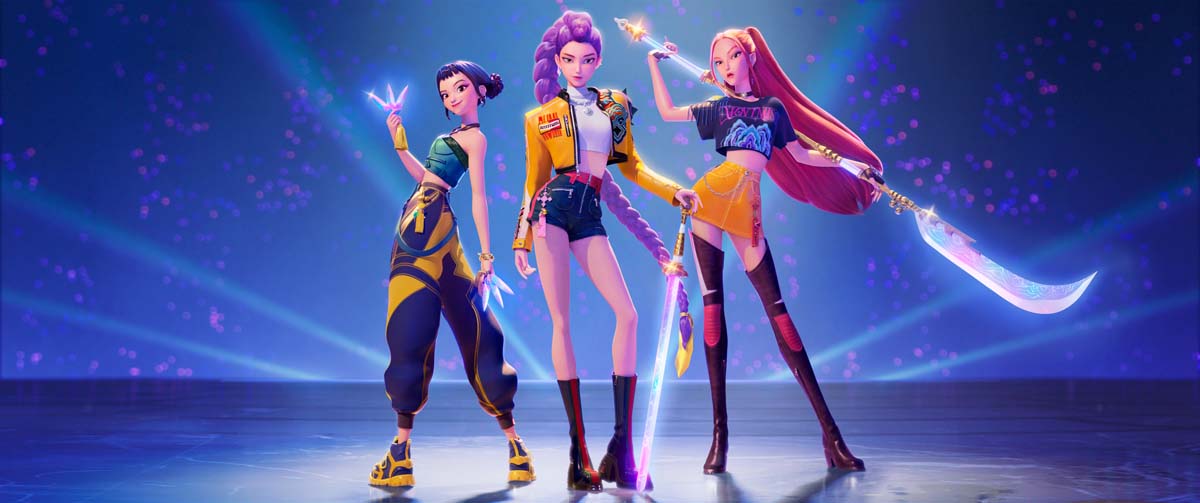
When you were getting choreography from Korea, what media were you getting?
Video. It could be filmed on an iPhone. My assistants would import the footage into the Avid. We would watch it. They’d just be in a dance studio. If it was Huntrix choreography there’d be three people dancing. They’d give us take one and take two. “Here’s a different thing.” They’d do take three. We would watch them all in my edit bay, and I’d chop them together to the best parts we liked.
Then when it was the Soja Boys, there’d be five people on screen and they’d say, “Here’s one version we came up with. Here’s another version we came up with. Here’s another version we came up with.” We’d all watch it. Chris and Maggie would say, “I really like this. I really like this.” I’m not a dancer, so I didn’t have a whole lot of input, but I would say, “If they do this, that would make a really good cut to this.”
I would give my input about how I think certain dance moves might help the cutting or the pace of the sequence. Then we would send the edited choreography back with the notes on the parts we liked. “Can you do this? Can you do that?” Or “That was great.”
This movie had more media in an Avid than I’ve probably ever had in my life. Kira Tamagawa - who’s now my associate editor, who was my first assistant editor on this film - told me before the Eddies that we had just under 62,000 storyboards in the Avid.

Wow! Right after “Soda Pop” is the “Getting Battle Ready” speed montage. Can you talk about cutting a montage and how that might have evolved? It’s a fast little flurry of fun edits.
That’s actually one of my favorite things to talk about, because it used to be a very, very, very long sequence, and it was very James Bond, very Batman-like. They’re in their apartment, they go to their lair. It was to a K-pop song.
They were doing a whole lot of fun stuff with nails and makeups, and outfits. It was very, very fun, but it was long, and all it did was get them ready to go. I said, “Look, we need to cut this. The audience knows that they left. They went home, they got ready because at the end of ‘Soda Pop’ the girls say, ‘Let’s go get battle-ready.’”
After we cut that sequence out we thought, “I’m sure we’ll be fine.” Then we watched it back and thought, “We really want to see them getting ready. We tried so many versions of that sequence. and then after we cut it, they were like, we really need something.
Finally I said, “I have an idea. Come back tomorrow.” I found this stuff on YouTube of these Korean women practicing death metal screams. I went down this whole worm-hole of Korean metal music. It was really fun, actually. People must have thought I was crazy on the 405. (LA freeway).
So I kind of mashed together this really loud Korean death metal song that was extremely high tempo. Then I cut over these Korean women doing death metal screams over it.
One of the best things about having a music editor was that I could go to him and say, “I have this song, then at the end I really want these three huge snare kicks, then this really crunchy, fuzzed out, distorted power chord of a guitar.”
He opened up this amazing program - I think it was called Splice. He asked, what note do you want? What kind of guitar do you want? What pedals do you want it?”
And he just made it happen. We created this little 12 second sequence and I showed it to them and they said, “Yep, that’s perfect! That’s all we needed.”
That was one of the most fun things, because it was just this thing that I imagined, got it together really quickly just by using what I could to make sure it was musically correct. And every person got a fun little comedic beat. It turned out to be this really great little fun sequence.
That’s all we needed. We didn’t need this whole long thing of them going into their apartment, getting ready one by one, doing all of these other gags when you can just kind of get this raw rock metal, badass warrior moment from these girls, which is great because it’s a whole different side of the girls you hadn’t seen before. The previous sequence was very in tune to their personalities. Instead, for 10 seconds, you get, “Oh, my God! That was awesome.”
That was the other really fun thing about this movie was that we could do things like that, and it wouldn’t upset anything about the world. Maggie always wanted to keep it silly and fun when we could. That’s one of my proudest moments on the movie.
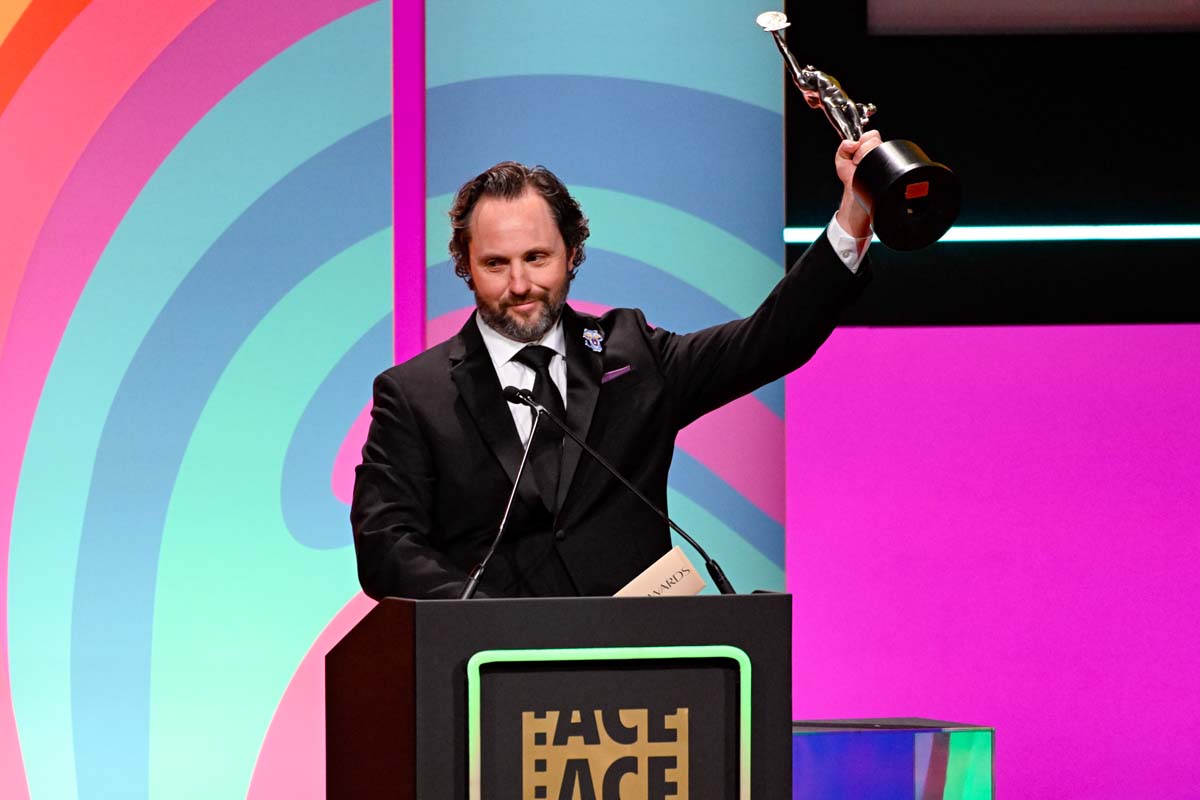
Schauff at the ACE Eddies
You won an ACE Eddie and an Annie for Best Editing, what do you think people saw in the editing that was worthy of those awards? Or when you are looking at somebody else’s work, what makes you say, “That’s great editing?”
One thing that I think people probably saw in this movie from an editing standpoint was the variation of styles, knowing how fast it goes at some point, then also how slow it goes at others.
I think the variation, and really editing to what the movie needed. I edit 100 different ways in this movie and the movie needs it. It’s super fast, like those little flashbacks - you only need them for as long as you need them.
Or the sequence we were just talking about - the “Get Ready” sequence only needed to be 10 seconds, though at one point it was three minutes. Then when all things break down - like after the concert- and we’re just sitting with the girls backstage, using longer shots.
Knowing when not to cut is a big thing for me, especially in animation. It’s hard in storyboards when you’re just sitting on a frame where nothing’s happening. Which is why I might put a little camera move or something.
I hope when people watched it that they felt the editing when they needed to feel it and that they didn’t feel it when they weren’t supposed to feel it - the invisible art of editing.
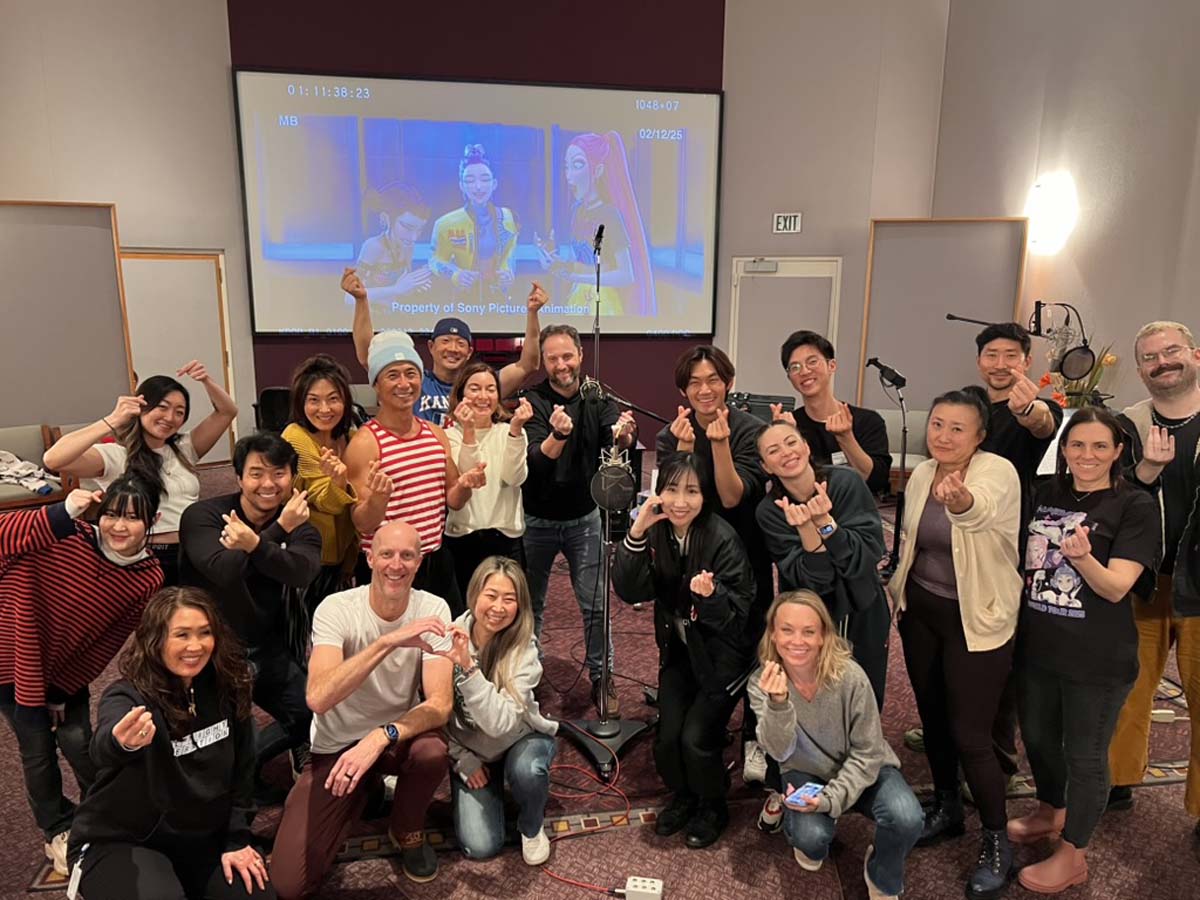
Post team
I like to think people watched it and thought, “He has quite a range of editing and really editing to what the movie needed.” We had so much varying degrees of situations in our movie, having them all feel like one thing with being in a lot of different situations, I think is a big part of the editor’s job: to make sure it all feels like the same thing.
If I notice the editing, my brain immediately calls out, “Oh, I would have held on that longer,” or “I would have cut there.”
So if I watch a movie and I didn’t say any of those things, I think, “That was edited really well because I didn’t notice it, or I did notice it when I needed to notice it.” It’s kind of the yin and yang of editing to me. I don’t think, “This is my editing style.” I edit to the story.
One movie I always give an example of amazing editing - and it’s a very simple movie, it’s a live action movie - is John Hughes’ movie, Uncle Buck. It’s a great movie. We watch it every year around the holidays and every year I appreciate it more and more and more. There’s not really any action. There’s not a lot of big camera moves.
There’s not a lot of big set pieces. It’s just a movie you sit in. But the editing of that movie is so precise and so great when you watch it. You don’t have to edit like crazy to get your point across.
Sometimes the simplest thing to do is not to cut or break up simple cuts in a way that goes along with the dialogue or the story. I never go into a project saying, “This is what I do when I edit a film.” I let the film tell me how it needs to be edited.

Let’s talk about the bathhouse fight. It’s got great action, but inside every single shot there’s a ton of rhythm to it. Talk to me about the construction of that originally, and then the evolution of that scene as it went through the phases.
That was one sequence where we didn’t create a song for it ourselves. We had a needle drop in there that was more rock and roll to get the pace of the music, so we knew that one was going to be a huge challenge, action-wise. We cut away to Rumi and Juni fighting while the rest of them are fighting, and we come back.
That sequence, structurally, we always knew what needed to happen. They go into the bathhouse. They fight the boys. Rumi and Juni have a moment. Rumi’s secret has to be revealed to the last person that needs to know. But we also need to show all these other things and story points, so the idea of the sequence was always there. We always knew what it was going to be.

The benefit to not making a song for that was that we had the option to do as much action - extend shots or cut shots or do whatever we needed. That sequence was one of the biggest collaborations between animation and camera and choreography.
Some of the animators we have are absolutely amazing. They will take rough shapes in After Effects or Maya, and they’ll do camera movements and pitch to the directors: “What if we did this!” or “Instead of having all these shots, what if we had a big orbiting camera throughout the entire thing where we saw them all fighting at once instead of all these quick cuts?”
So that one took a very long time to finish because all the action and ideas people kept coming up with. Each one upping the one before it. Luckily, I had all the freedom in the world to take in all that stuff, and try all that stuff, because we knew it was going to be a needle-drop song.
They weren’t singing. They were just fighting for once, so we could really let the fighting just be the fighting and the emotionality between Rumi and Juni when they’re off alone. Then when Mia and Zoe say, “Rumi, we need you!” but her pattern is showing, so we had the opportunity to really just swing for the fences on that one.
If I missed animation dailies, an assistant would bring in a shot that’s three seconds longer than the shot I had, and I’d say, “Whoa, whoa, whoa! What is going on with this? Extending this is crazy!” Then the directors would have to explain how all the new ideas were supposed to work. If you ever missed a meeting, you’d be out of the loop on that sequence because so much would happen in one round of animation dailies.
At one point it was getting a little long. I don’t think we ever dialed it back, but we were very conscious of “Let’s not overstay our welcome with this.” But we ended on a joke. The old guy saying, “Hey, this is the men’s bathroom!” Then they immediately say, “Oh, sorry!” They leave, then that joke gave us this great opportunity to look through the door and see that old man, and he starts singing “Soda Pop,” then he gets eaten by the demon. So we found all these amazing ways just remind the audience of the stakes as we were going.
That was the first big showdown between the Saja Boys and Huntrix. We knew neither one of them could win. We knew it had to end in a stand-off, because they’re about to go into the big takedown montage of them winning back and forth.
A lot of people think “That’s a cool action sequence, but - just like all the sequences - that had so many purposes underneath the hood of what we needed to do, storytelling underneath all the action. So every time the action would get ramped up, we’d make sure that all those other pieces and dominoes were still falling into place.
Musically it changes a lot. We go from the needle-drop, then we go to more serious score, then it ends on the big climax, then it’s kind of silent.
One of the things I always wanted to make sure of is that sometimes we had quietness in the movie - that we didn’t have music or songs after that.
So when that song ends, it’s pretty quiet after that Jinu gets sucked back down to the demon world and it’s a little more somber.
Then the girls are trying to write a song. It starts as a bad song and they can’t figure it out, but then it picks up. So the music also represents where they are as a group, emotionally.
The more I talk about every sequence, the more I realize how much work it took to get them to work.
Congratulations on your ACE Eddie and your Annie. It was wonderful talking to you.
Thanks for having me. This is this is a good time. I haven’t talked in this depth about it in a while, so it was fun to kind of relive some of these moments.
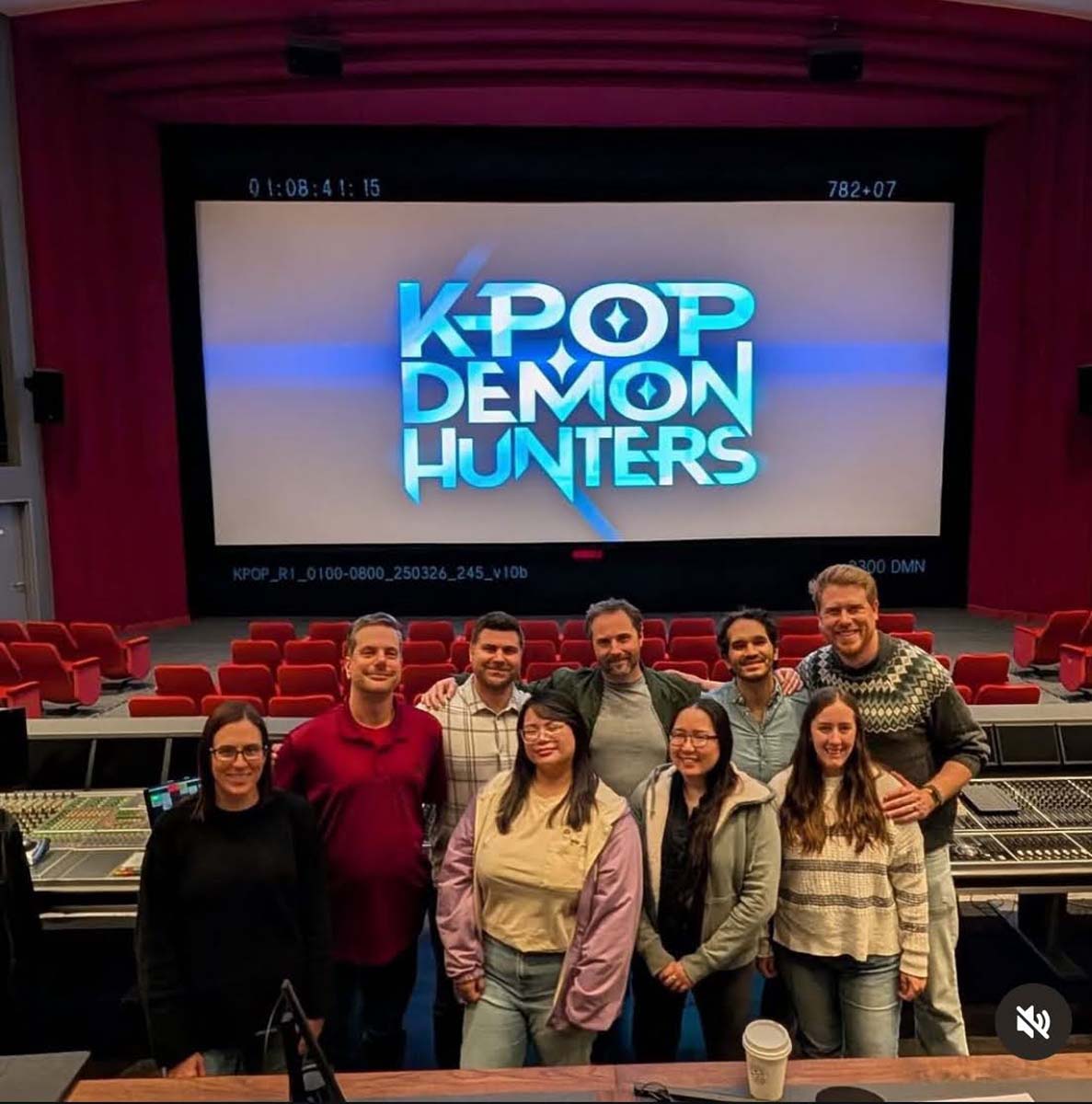
On the Mix Stage
 April 2, 2026
Project Hail Mary
Joel was last on Art of the Cut for his work on the Disney film, Jungle Cruise. Joel’s other work includes Thor: Ragnarok, Transformers: Rise ...
Read more March 26, 2026
Young Sherlock
Today on Art of the Cut, we speak with four of the editors on the buzzy new Amazon Prime series, Young Sherlock. With us are ...
Read more February 26, 2026
Marty Supreme
Today on Art of the Cut we speak with director/editor Josh Safdie and his co-editor and co-writer, Ronald Bronstein. Safdie and Bronstein are nominated this ...
Read more