













I Love Boosters
A deep-dive into why editors have to cut out great scenes and moments, how to balance the fantastical with the real, grounded moments, and Terel’s number one rule of determining the pace of a film.


Today on Art of the Cut, we speak with Terel Gibson, ACE, about editing Boots Riley’s feature film, I Love Boosters.
Terel has been on Art of the Cut before for his work on the TV series Skeleton Crew. His other work includes another Boots Riley film, Sorry to Bother You, as well as, Ready or Not, Hawkeye,and The Astronaut.
Terel, it’s so great to have you back on Art of the Cut again. The last time we spoke was to discuss the Star Wars TV series Skeleton Crew. Welcome.
Thanks for having me back. I appreciate it, man.
I Love Boosters is about as different from Skeleton Crew as you can get! Tell me a little bit about your involvement in this film.
It’s funny that you mentioned Skeleton Crew because that was a project that was interrupted midway by the strikes, so it ended up extending.
I worked on that for about two and a half years or so. It pushed the start date for this movie, so I wasn’t able to come on immediately. But luckily everything worked itself out and I was able to join them as they were beginningthe post-production process, so it all worked out for the best ultimately.
But, I do like to work on any number of different kinds of genres. People have a tendency to get a little pigeonholed into a particular lane. The industry really does try to paint you into a corner.
I’ve always actively tried to avoid that, if at all possible, because I like to watch different kinds of things. I don’t know a single person that only sticks to one particular genre in terms of their own entertainment and what they enjoy, so I try to have my resume reflect my own eclectic tastes.
It’s always nice to get back home with Mr. Boots Riley, but when we’re not working together, I still like to venture out and try new and interesting things.
How long have you known him, and what’s your relationship been like?
We met as he was about a week into production on Sorry to Bother You. We have a mutual friend and filmmaker named Catherine Hardwicke, who introduced us. Catherine is amazing. To know or is to love her.
I had the opportunity to work with her once and Boots was in production and I think he reached out to Catherine and asked if she knew of any editors that might be a good fit for his project. So that’s how we ended up getting, connected, basically.
We had a great experience on that movie. It was myself, assistant editor Kate Prescott, and Boots in a tiny post facility on the West Side, trying to make a Sundance deadline. That went really well.
We immediately had this affinity… this shorthand… which is rare in this business and really nice when you have that connection.
We immediately connected and kept in touch over the years. The project he did between Sorry to Bother You and Boosters was I’m a Virgo and I was actually - if you can believe it - still on Skeleton Crew, so we got out of sync a little bit, but fortunately, we were able to lock back in on this one and get the band back together.
That’s the tricky thing with some of the scheduling of these things, even if you have a director who loves you, you can’t just wait around for their next film. You’ve got to be filling in the days.
I think that’s the biggest fear as a freelancer is if you pass on something - thinking that another thing that’s going to come through and that doesn’t come through, it’s really a nightmare scenario. That kind of keeps you up at night.
Boosters pushed a few times based on the availability of a particular actress. It just kept pushing and pushing and pushing and it gets to the point where you say, “I have to make a decision here,” but things do have a way of lining themselves back up again.
Fortunately, that was the case with this. But that is always a scary feeling because there are no guarantees.
Even when they start rolling, there’s not a guarantee. There are so many forces in the world that are standing in the way of a movie actually getting made that sometimes you just have to take what’s available in front of you and hope for the best. Boots and I will certainly repeat down the road because we really enjoy collaborating with each other.
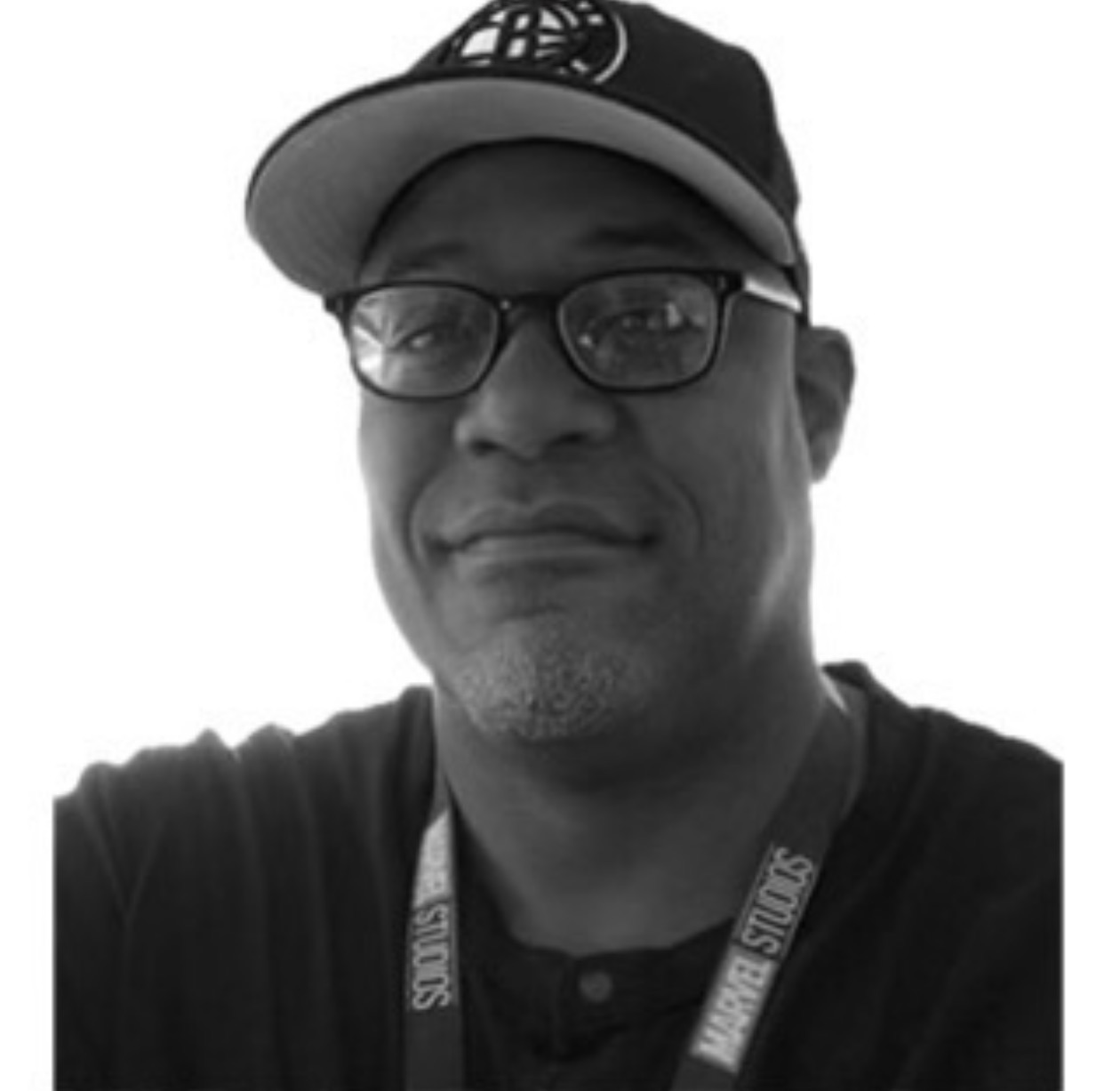
Editor Terel Gibson, ACE
You mentioned that you had kind of a shorthand. How much of that is just a similar taste?
I think that that’s probably, 99% of it. It’s just a sensibility thing. I was a fan of Boots when he was a rapper/musician. I had his cassettes, which I still have. A week into production, I showed him, “This is a tape of yours that I got in the eighth grade.”
We’re very, very like minded individuals. We both like the idea of what is possible, how far you could stretch the medium, the idea of collage - that you could take things that might seem disparate or disconnected and fuse them together to come up with something completely new and fresh.
We grew up on the same kinds of movies, so I think that bodes well, so our references are kind of the same. We speak the same language. We talk a lot about like transitions.
He’d say, “Let’s try a George Lucas there, or an Edgar Wright there.” I know what he’s talking about. He speaks that language very much. He speaks that way with the actors too.
He told me a story once. He said to an actor, “I want you to look at him like they have a calculator in their pocket.” So he speaks that kind of language where it’s not literal.
He just gives you suggestions and guardrails about what he’s feeling, then leaves space for you as an artist to interpret that in your own way, to kind of give him what he’s looking for, which I really appreciate.
It’s not micromanaging or prescriptive. It’s more free flowing and adventurous, which makes his movies so fun. That comes across on screen, too. It just pops. It feels like they left the back door open to the studio and we snuck in at night with a bunch of equipment and Boots just said, “Let’s shoot something with all their stuff.
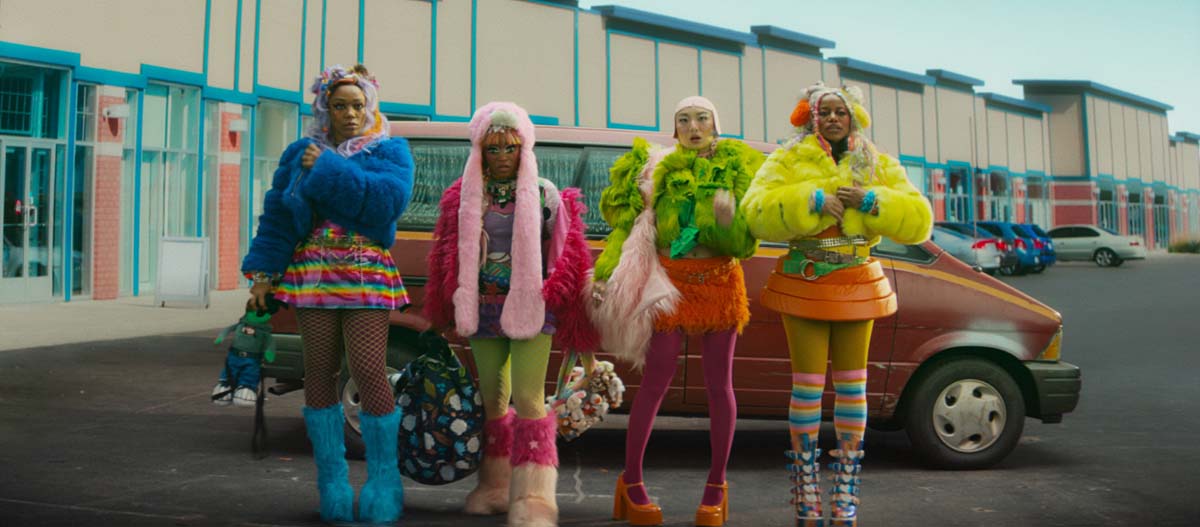
He did a lot of different things on this movie. There’s everything from old school miniatures to Volume work, which is something we employed quite heavily on Star Wars projects. He takes what he likes from everything, and tries to avoid the trap of CGI whenever possible.

Director Boots Riley on set of *I Love Boosters*
Wow, I didn’t see the Volume work.
That’s good. That’s the way it’s supposed to work, right? It’s a replacement for a process screen on driving scenes - when they’re going through the mall. It’s good that you didn’t notice, but it’s there.
I think there’s every sort of modern day and old school form of filmmaking all represented in here from stop motion - Jason and the Argonauts - to the miniature work.
It’s a wild collage of ideas and techniques. He was able to find incredible artists that are still around, that are the best at what they do.
I love the idea of some of the references that you had. To me, I felt like maybe there was some Terry Gilliam in there.
Sure, sure. I’ve always thought about the worldbuilding. The wildness of it all, his aesthetic. If you think about someone like a Terry Gilliam or a David Lynch, you plop yourself down in that seat and immediately you know what world you’re in. You know you’re in his sandbox, and that’s really rare.
That’s always a dream of mine to work with a director with that clear of a vision and that much imagination that they could build a world that exists way beyond the screen that you’re seeing, like you imagine that this world is the world.
Like Sorry to Bother You took place two blocks that way, and I’m a Virgo took place a mile and a half down that way. But it’s all sort of immersed in this complete, fully rendered world that he creates in his mind. That’s incredible to do because it requires so much attention to detail, so much boldness.
All of the people that are involved have to be down for that, because these are complicated shows. There’s no simple scene in this movie.
It’s just popping with ideas and color and texture and mood and all of those things help to hopefully have a cumulative effect where you feel like you went on a wild ride with us.

Can you talk to me a little bit about the technical aspect the filming?
Part of my job is to really not get caught up in how it was done. I really try to react as much as possible as an audience member.
At the end of the day, I’m looking for what affects me in the most plausible way – whether I buy things where I don’t feel the stagecraft of it all, and that every moment feels like that’s something I could feel.
Overall, they did just such an amazing job from photography to production design and art direction, just everybody. Every frame was a painting. It really becomes my job to not be indulgent about those sorts of things, because at the end of the day, it’s about: “Are these compelling characters? Am I telling a compelling story?” The rest is sort of bonus.
I really do hone in and focus on what is the most effective way of telling the story, and when are we most effectively telling the story? When are we entering a land where it feels a hair indulgent?
Those are the things that I try to keep an eye on and make sure that we’re not venturing into a place where other filmmakers know how hard it was to get that, but the audience will not care.
If the story is not moving along in a compelling way or we have double beats or if we’re not keeping the story in the flow of the dynamic shifts, feeling organic, then all of the beauty in the stagecraft doesn’t really matter.

There’s a mini music documentary at the beginning of the film if I’m remembering that correctly.
You’re maybe talking about the Christie Smith (Demi Moore’s character) documentary - like her backstory. The girls are watching it on the phone.
Tell me about that. When you were cutting that did you feel like “I’m not editing I Love Boosters anymore. I’m editing a documentary by a different filmmaking team.”
It’s important also to mention that there was another editor that preceded me. Skeleton Crew went long, so there was a bit of a scheduling thing. So he got that up on its feet and he and his assistant did a fantastic job with that. That was pretty well baked when I got there. So, for us, it was more about sort of a collage approach - which Boots likes to do.
But there’s also the legal parameters about what you can and can’t do in terms of some of the imagery that was being used, so a lot of it - through the tireless work of our VFX team and my assistant editor, Mark Jones – was to really really comb through that and present Boots with options that we could actually use.
The bones were all there, but there were a lot of archival and forensic work that was done in that sequence to try to actually - number one - bring it to life, but also do it in a way where we could present it in the actual film itself.
There’s two examples of that. There’s Christie’s documentary and there’s also Jianhu’s back story. I have to make sure those scenes are paced correctly so that you don’t venture so far - you’re not coloring so far out of the lines - that you feel like the movie has kind of stopped and becomes completely tangential.
You want to make sure that the girls are present, that they’re interacting with what they’re seeing in the scene.
I love that something that Boots does grow uniquely. It’s something we did also in I’m Sorry to Bother You with the claymation sequence where we describe how these people become “equisapiens.” Boots is really good at making medicine totally entertaining.
Boots is thinking, “People are going to be wondering how Demi Moore’s character got to be the person that she is?”
And it’s such a wild and compelling story. What a great way to do it. Like, “Let’s just do a film within the film.” So it was kind of described like a Russian doll, there’s a story and then there’s a story within the story, within the story, within the story, and it just keeps going deeper and deeper.
Hopefully, at the end of the day, you’re still wondering, “I wonder what the Doctor Jack movie would be? Or the pinky ring guy?” All of these people seem so “lived in” that hopefully you’re left craving more. “I would love a little side-quest movie about LaKeith’s story. How did he get there?” I would watch that all day. That’s how incredibly rich and layered his storytelling is.
It’s got layers and layers and layers of things going on, and hopefully they all add up to a compelling whole, and feel like they’re not tangential.
You mentioned “medicine” earlier. I’m assuming you’re talking about exposition?
Exposition. Yeah, yeah. As an editor, nothing is more unsatisfying as a sentence that starts with “Remember when…”
…any time two characters are explaining to each other what they should already know…
That is just cinematic Ambien. It takes some really good writing because you do have to figure out a way to do that - judiciously and creatively. But if that is your solution, it is a tough thing to pull off because people might not even realize it, but there’s something that just shuts off in the audience’s primal brain when somebody says those words.
Especially if they’re telling what the audiences already knows and they’re catching another character up. That is absolutely deadly. What’s amazing about what Boots does is he really hides that medicine very, very effectively.
You have to give everybody a good backstory that makes a more compelling character. You have to treat your antagonist and your protagonist with equal measure in terms of their characterization, so you understand their motivation, where they’re coming from.
It makes for higher drama. I think that he does that incredibly brilliantly. He gets to the “why” of it all in a really entertaining way, in a creative way that you don’t normally see.

There are some pretty fantastical, elements to the story, and there’s some very grounded elements to the story. How are you bouncing between them or switching between them? Did you discuss the tonal shifts that were required?
This is such a heightened almost carnival like experience that in a weird way I felt like the tonal shifts in Sorry to Bother You were more pointed in a way.
I use that as a point of comparison, because those are the two movies that Boots and I worked on together. The lows are not as low, as you would find in Sorry to Bother You - where Cassius is on an island.
Ultimately, there’s a “be careful what you wish for”bcomponent. So with the nature of this being more of an ensemble piece with a lot more going on, I don’t think that we deviated as far tonally from the original conceit. I think the movie kind of bounces along with a certain exuberance that’s pretty consistent.
There’s always moments - sitting in an audience in a room with the actual audience watching the movie - you know where those tonal shifts work and where they don’t work. I’m not going to say that there wasn’t some calibration in terms of how far we could take them, or how low we could go or for how long you could spend there. But that’s just something that you have to experience with an audience to feel it.
I’ve always found that as long as you’re not joinking the audience from tone to tone in the span of five minutes - you’re not going from very big comedy or drama to very, very dark, morose - so that they don’t know how they’re taking it.
As long as you’re not doing that, you can get away with a lot. It’s just a matter of smoothing out that sort of curve as much as possible, so that when you are in a certain mode that you spend a significant amount of time there where it feels organic and warranted before you start to climb back out of it, then shift gears into another kind of energy.
You just don’t want to go from an exciting car chase sequence that’s full-on to a morose sequence. That’s where the audience thinks, “Oh, I thought I was watching this and now I’m watching this.
What’s going on?” They’ll go with you, but you just have to be making sure that you throttle and modulate that tone throughout in a mindful way when you’re trying to modulate that tone.

Did the actors give you multiple temperatures and then you could decide the scene maybe needs to be cooled down a little bit.
Absolutely. These actors are just amazing. They gave options. They’re going to improv. They’re going to try things, and Boots is very, very open to exploration. He loves his actors and gives them the opportunity to play. Best idea wins, ultimately. Some of Keke’s really, really funny lines, I’m sure she threw out there in the moment.
She’s so experienced and she’s so incredibly instinctive - especially when she and LaKeith are working together. It’s just like watching heavyweight champions - like chess - just going back and forth.
They just know in their DNA who their character is, what the moment is, what it requires. And when you do that - if you know it cold - then you can explore. It’s a safe space.
Why not try some things? And a lot of those things ultimately do end up in the movie because they are so real. We had a real feast of a riches in terms of performance. To be able to have the opportunity to work with their material is a “pinch yourself” moment for sure.
I grew up as a great Demi Moore fan. I just never thought there would ever be a world where I would get to work on a scene that she was in. That was not on my bingo card.
So it’s been a great experience. It’s exciting to see an actor that’s been around for a while get a chance to do something you haven’t seen them do before. I think they’re all very excited about that.
You can feel that energy pop off the screen. And Boots just lets them loose and lets them play in that sandbox.

You mentioned Keke doing some some improv or coming up with lines herself. How are you dealing with that as an editor? Trying to either remember that something was unique and different and trying to include it or saying, “I don’t know if that’s on character” or whatever?
What I will do is flag them through a system of locators. I use locators a lot in the timeline. Green locators are generally something that surprised me.
Doesn’t necessarily have to be improv, but it has to be something that I found unexpected when I was watching dailies. That being said, it may not work at all, but I’m keeping track of those so that when I start getting a sequence on its feet and going around and around, I’ll go back and double check.
Those are usually organic things that will find their way into the cut on the first pass. Then we’ll see - in the context of if it’s a bridge too far or not. There are a lot of surprises that way. Sometimes it feels a little bit like acting.
Those are areas you have to keep an eye on. You feel like they’re trying to be funny. Then sometimes it just happens and you’ll never be able to recreate that moment. It just happened. It’s lightning in a bottle. You’ve captured it, and I’m going to try my best to get it in there. I’m going to try to find a way to fit that in. But if it doesn’t work, it doesn’t work. But a lot of times it works.
Those moments that surprise you are the most exciting thing about the process. It’s the unexpected things. When you’re editing, when you’re storytelling, if you can just throw people a curveball every now and then.
Those little additions of spice here and there are what makes it feel special and real. And it’s all about the details, you know?
So if you have a surprise or two in any particular scene, it will tickle the audience in a way that perhaps the scripted version would not. If you have a steady appetite for surprises and moments that you would naturally sort of expect to be there, that do feel grounded and do feel real for the character that creates an experience that keeps the audience a little off balance in a good way.
You don’t want the audience to be so ahead that they know what this scene is: “Here’s the part where she’s at her lowest point. A great example… I’m not sure how PG-rated this podcast is - we’ll just say that there’s a moment where LaKeith Stanfield demonstrates his amazing “skill set” in a particular way that is both disturbing and humorous.
Then Keke’s got a line that undercuts how disturbing it all is, and it’s just fucking amazing. It’s so funny. And every screening we have, it just destroys every single time. So watch the movie. You’ll know it when you see it. It’s a quip that is just one for the ages, and it just kind of buttons the whole sequence in a beautiful way, so I’ll leave it at that.
The performances are great. They’re very realistic. You feel like they’re not acting. But then there are moments in the film that are clearly outside of true life. I’m thinking about one of the booster sequences where they’re shoplifting and Keke walks out of a store with enough layers of stolen clothing that she looks like the Michelin man. You couldn’t possibly walk out of a store that way. Talk to me about balancing the real with the fantastic.
That’s its super power. I describe it as like if you’re watching a normal show, then somebody walked over and starts messing with the controls on the TV. Everything was real, but now it’s all super-saturated, super-rich and heightened.
It’s nothing more than an exaggerated form of our “reality.” You’re just taking what’s there and just really enhancing it all, so that it becomes all the more vivid. But the conceit is still grounded in something real.
And the actors are also treating it like it’s completely real - like this is just another day in this world. And if the actors are treating it that way, and if the filmmakers are framing it and you’re cutting it and you’re treating it in a way where this is all their reality, much in the way you’d find in a Terry Gilliam movie or a Wes Anderson movie. That is their world, right?
So treat it as such. As long as it’s rooted in the human condition and these people are behaving in the way that human beings in our world would behave and reacting in that way, they can get away with a lot.
I think that’s what makes this stuff play so well for an audience as well. You’re just giving me a fever dream version of my own reality.

That’s a great way to put it. You mentioned scene transitions early on in the discussion, like, “Let’s do a George Lucas transition.” Talk to me about deciding how to get from one scene to another. And do you think there’s an editorial difference between deciding when a shot ends within a scene and when a shot ends at the end of a scene?
That’s a really good question. There’s no science to any of this - at least in my mind. It’s all about feel. If anything I want a scene to end at its height. I don’t want a scene to sort of recede into this sort of denouement where there are just extra beats at the end.
I approach every movie that way. Leave them wanting more and that will give you a sense of seamlessness. To that end I also really try to make sure that transitions are pulling you along so it doesn’t feel like, “Now what’s this scene about? Here’s the master, then we’re stepping into coverage. I try to avoid that and make it feel like the movie never stopped, basically.
Not having these long beats, unless they’re warranted, maybe a big dramatic turn or something like that where we want a hold so that we get some sense of what our protagonist is going through.
Those can be warranted in places, but balance the sense of: “I have the audience. I value their time, and I’m going to keep things moving and keep them moving as seamlessly as possible.” Unless I want this big moment to really settle, and I want them to kind of live in the quiet of this moment for a beat or two, so that that really lands hard.
But, generally speaking, I’d say it’s always best to not overplay your hand. And with a Boots movie, you’re going to have a feast of riches, of great moments. But, you could feel it with the audience, “Oh, that is a peak. It doesn’t get any better than this. So how can we judiciously segue into the next section of the next idea rather than be greedy about it?” I think that is what good movies effectively do.
I think that leads to re-watchability, too, because people want to hear that song because they’re craving more from it. So I’d rather them crave more and be left craving more than to be completely gluttonous about it and have them feel like they’ve gotten their fill.
That’s a hard thing to modulate because there’s a lot of great stuff in this movie that could have made the cut that are much longer sequences, but there are pretty rigorous processes where we determine what the rhythm that serves the whole was best for those particular moments.
So it’s always in service of the entire movie, never in service of a scene in and of itself. I think that is the number one rule.
Boots shoots and has plans predominantly for how these transitions are supposed to go. So if there’s la dolly zoom when we’re cutting from Corvette in one environment to her in another environment, that’s planned.
That’s not any kind of magical discovery in the edit. That’s how we intended it to be. It was shot as such.
And that’s a gift too, because those are always the best way to do it. If it’s framed for that, if it’s shot for that, there’s an actual plan. And Boots is really good about that, because you do find sometimes with some filmmakers that they didn’t really even think about, “What is the start of the scene?” in terms of how this is going to connect to the preceding scene, outgoing scene it’s a wonderful, wonderful gift. And it only helps the audience’s perception of a movie that feels assured and feels well-rendered and seamless. It just moves in a way that just feels completely organic.

You mentioned how you had to sometimes cut out great stuff to be in service to the overall pace of the story. I would think that would sometimes possibly ruin those great ideas again for transitions because Boots has a great transition planned, but now you’re deciding to cut out three sentences early or to excise a scene that was supposed to be between two others.
Yeah, that can happen. Boots is also really good about deciding that if something doesn’t work, he’s not going to force it. It needed to go through a process, there’s no question. Boots is really good at embracing the limitations of what can and can’t be done. He’s very quick to say, “That didn’t work. Moving on.”
He doesn’t lament it. He doesn’t try to force it in there just because it was his original conceit. In some ways I think he kind of enjoys those limitations. I’ll say oftentimes, “Well, that’s all we were able to do.”
So instead of trying to make an approximation of his visual original intent, he will just embrace the limitations and just come up with a better idea based on what he was able to achieve, because the two most precious commodities as filmmakers are time and money.
If you don’t have enough time and you don’t have enough money, then some of these ideas might fall short of your original expectation. He’s really good at making what some filmmakers would consider a weakness a strength.

A good example is the mall chase scene, which was considerably longer. That’s when they’re being chased by the futuristic police van and they go up the escalators and all that. There was a version of that where they went up multiple levels of that mall, and it’s all miniatures.
The practical stuff was shot in this abandoned mall in the Bay area, and it was just freaking crazy. But it just so happened that where it fell in the movie, you couldn’t have an extended chase in that mall, then have another extended chase on the street, so that had to be put through its paces.
There are hundreds of versions of that where we took a little bit out and, “Oh, that’s too far. Put it back in.” Then take a little more out and finally we found a proper balance for that sequence.
That was a tricky one because it was so great and it was so cool and was so amazing the way they were able to pull that off with those miniatures. And if you watch it as a short film you’d think, “This is the greatest thing ever.”
But context is king, and the way it fell in the movie, it just had to be a certain length. So that was achieved by not necessarily cutting out the beginning of it or the end of it. It begins and ends the same way. But there were levels and levels and levels of that sequence of them traveling up escalators.
Let’s cheat it so that they go up one escalator and not four escalators. So there’s always ways around that.
You’d be surprised at the benefit of just reducing some couplets, even in a dialogue scene, just remove these two lines. Then if you can’t even remember what you took out a day later, that’s a hell of a lift. If you don’t even remember what was there, that’s telling you that that was always meant to be.
Amen. Everybody thinks that the editor’s job is to cut out the bad stuff, but cutting out the good stuff is the brutal and true task of the editor.
Absolutely, absolutely! That is so that’s so true. If a movie is poorly paced, you’re not valuing the audience’s time. What I always say is: “Never underestimate an audience’s ability to not give a shit about what you’re doing.
You’ll know when you sit in a room with an audience and you have a brilliant moment that doesn’t land because there’s too much before it. That stuff may be great, but there is no way it can survive in this context.
That’s why you screen the movie early, you screen it often and you learn those things and you learn that sometimes some of your best jokes might not be suited for this particular story.
We had to cut down some stuff with LaKeith and Keke that was absolutely amazing, but where it fell in the particular sequence and the events surrounding it dictated that it had to be a certain length. So that’s what you do. That being said, I do lament the days of DVD bonus features. I just wish you could throw all that stuff in there.
We did have an opportunity where Boots wanted to include a sequence originally in a beauty shop when they discover a particular device and we kind of repurposed that at the end of the credits, kind of like old school bonus material.
She did such a great job. I’m going to give her this gift and give me that gift of putting it at the end of the movie. I do miss those days where those things you’re talking about still can live on, just not necessarily in the movie.
Give me another example of this idea that you were talking about of a great moment, but because of where it lands in the movie, or because of the overall length of the movie and pace of the movie, it has to go. Movie fans that see deleted scenes that are fantastic don’t understand why they’re not left in the movie because they don’t have to see it in the context of the movie. They’re just seeing it as its own separate thing.
Can you think of any example of “Here’s this great moment, and we wanted to keep it, but we also realized through screenings or through our own watching of it that it had to go.” What’s the creative discussion between you and Boots?
I would describe it more of in terms of beats rather than scenes. Don Cheadle had some great stuff during his Doctor Jack pyramid scheme theme that felt like it was swinging a little too hard for the fences, you know, but they cracked us up.
They were funny as hell, but the sequence couldn’t support the weight of all of that and we were very carefully not to have characters say things that might be funny, but out of character. That’s a big, big red line for Boots.
The lines would have crushed - probably would have gotten a laugh - but Boots also wants to make sure that we’re serving the character.
There are certain times with extended versions, it almost demystifies and changes my experience of watching the movie. Like Apocalypse Now - the Redux version - has that full French plantation sequence. Apparently Coppola spent hundreds and hundreds of thousands of dollars and got this incredible spread. It’s this long sequence, but it changes the entire movie. It stops the movie dead in its tracks.
You realize that through the rigor of post-production, movies end up where they need to be. Rarely do I see these versions of these extended cuts where I think, “I can’t believe they got rid of that. That was amazing. This was a better version of the movie.”
I can’t think of any examples of that. I just try not to be precious about anything. If there’s anything I’ve learned over the years it’s: “Don’t underestimate the audience’s ability to just completely check out if you’re overstaying your welcome a beat or two.”
Make sure we’re moving the story forward, make sure that everything is as compelling as possible, that we’re choosing the right point of view and that the movie is singing.
Some of my favorite movies - the ones with this incredible pace to them - they all move along and everything is of value. It’s nothing but gold. That’s what you want.
I’ve been reading a lot of novels, and the same applies to that art form. There are places where you can sit and read a description of a beautiful sunset or whatever, but there are other places where the story needs to maintain its momentum.
We always talk about this idea of how do you craft a story where you don’t alienate your core audience that appreciates all the nuance, but also keeps the tent big enoughto bring people in that maybe wouldn’t necessarily go to a movie that’s a little left field and a little off the wall? I think that’s the balance that I think great filmmakers will strike.
If you look at the really good ones - those movies that stand the test of time - they are keenly aware of where their audience is and respecting their time and really lock into the notion of everything is a story, every frame is a story, every moment is a story.
Is this something that I’m doing because it’s needed, or is it something I’m doing for myself, because of how difficult it was to get this particular moment captured?
The good ones will have their finger on the pulse of the audience at all times, and they want to make a movie that has this feeling that it just never stopped.
It just felt like there was nothing else but the movie. That’s all that was for that period of time. The fastest way to get off track is to have extra beats and moments that don’t service the whole.
Terel, thank you so much for talking to me about this movie. It’s a super fun ride, and I hope people get a chance to see it in the theaters, if not, someplace on streaming. But this is definitely one of those you want to see in theater.
Yeah. Check it out while you still can. It’s a wild ride, and it definitely rewards a theatrical experience, so go check it out.
 October 5, 2026
The Whisper Man
Chris has been on Art of the Cut before for The Menu, The Many Saints of Newark, A Quiet Place, and Assassin’s Creed. He has ...
Read more September 23, 2026
Sean Combs: The Reckoning
Charles Divak has been on Art of the Cut in the past for Chimp Crazy, for which he was nominated for an Emmy and won ...
Read more September 3, 2026
The Dog Stars
There's nothing like The Dog Stars in his filmography. That's a testament to him - that he is constantly interested in different stories and different ...
Read more
Subscribe to our newsletter
Get all the latest news, blog posts and product updates from Boris FX, delivered directly to your inbox.
Welcome!
Thanks for opting-in to our newsletter. You'll receive an email momentarily with your confirmation.