











Coyote vs. Acme
A discussion of the benefits of “prevising” an entire movie, the iterative process that shapes a film, and the scene that was scripted for the middle of the film but ended up as the inciting incident.


Today on Art of the Cut, Carsten Kurpanek discusses the editing of a film that is very unusual: Coyote versus Acme. Firstly, it’s a combination of live action and animation, and second, for financial reasons, the studio decided not to release it after it was already completed.
Only years later did another company swoop in and buy the production rights and decide to release the film that had been languishing in a vault for almost three years.
Kurpanek has edited numerous films, including Rambo: Last Blood, Escape Plan 2: Hades, and an episode of the TV series Eastsiders. He also was a previs editor on Teenage Mutant Ninja Turtles: Out of the Shadows.
Carsten, so nice to have you on Art of the Cut.
Thank you so much. I’m excited to be here.
I’m assuming you cut this like a typical animated film. You started with storyboards?
Yeah, we started with storyboards. In pre-production I worked from home for a year. It was still during Covid - March 21st - when we started. [Director Dave Green] and I were both in L.A., but we worked remotely during Covid. We started with storyboards, like you would with any traditional animated movie.
What was different from that process is that we didn’t just do, a storyboard animatic. We actually transposed those storyboard animatics into a previs scene. We used Framestore in London.
Whenever we had an animatic for a scene that we liked - with like temp voices and storyboards, sound effects and temp score - we would send it to Framestore and they would create 3D previs of the scene with a little CGI Wiley blocked in as well.
I cut that on top of the storyboards. Once we were happy with the 3D layout of the scene, we would remove Wiley and any other characters, then our animators and story artists would draw what we called “sketch-vis” on top of the 3D animation to indicate the Looney Tunes characters in the key poses as hand-drawn images with alpha-channels that we would stack on top of the previs.
The goal of the entire thing was that we would end up with a 3D previs version of the movie, where 2D animated drawings of the Looney Tunes characters would be on top of it, where the 3D would represent what would become the live action, and the 2D could be used as a performance reference for the shoot later on.
For me, later on, it was very, very helpful when we were shooting, because most of the time in movies like this - we learned from the shoot of Tom and Jerry, where they didn’t have that - when you’re on set, you often simply don’t know what the animated characters will do. It’s like the VFX movies where the actors are acting to a ball on a stick.
The actors have to just follow the direction, but with the sketch-vis we knew the timings and actions of the characters and what the scene was about.
So it was a great reference on set for Dave to show: “Here is what Wiley does in that scene.” So Will could really kind of get a feel of what his costar - even if it wasn’t on set visually - was doing in the scene.
I think it really helped us. Sometimes we’d even 1:1 match camera shots. There’s a great crane shot with Tweety being introduced that we literally match from the previs 1:1.
Because we had alphas of our drawings, we could even lay that onto the playback monitor on set and really see it timed out in real time.

It sounds like you were on set yourself.
We shot in Albuquerque, New Mexico, in the spring of ‘22, for three months. I was next to set. I worked out of a building next to the stage. Dave sometimes called me over. You plan, and you have previs, but it doesn’t always translates 100%.
If we had to change coverage he’d sometimes called me over to make sure that everything’s good editorially and but didn’t happen very often.
I have to admit, I am not a huge fan of being on set. I’m an editor for a reason: from chaos, I like to create order, and the set always feels like a war zone. It’s interesting and it’s exciting, but I try to focus on the edit.

Editor Carsten Kuparnek
Dave would come by and we could review things in a timely manner, so he was feeling good when he finished the day. I stayed “up to camera.” We worked really hard. I had Ned Thorne, my first assistant editor on Kung Fury.
He was an additional editor as well. He was helping me assemble the movie because a lot of stuff was going on. The main crew, though, was in London.
What kind of scratch voices did you use early in and when did you get finals?
It was an iterative rolling process. Eric Bauza basically did 90% of the voices. Candi Milo did Granny and the witch, but Eric did pretty much everybody else. We had regular sessions with him every time we changed the cut and changed ideas. We iterated quite a bit. What the Looney Tunes were saying were changing.
There are things we can talk later about where we entirely recast scenes that were shot live action, but then we used a different Looney Tunes character in that scene later on in post, so we needed Eric quite a lot to do these voices because those are really hard to do for an editorial team. He was always game, and just a great collaborator.
He has a booth at home, so it was always easy to ask, “Can you do a session?” He would be on for a couple of hours and we recorded new lines and cut them in.
Originally what we started with was a table read. That was my first video that I worked with, which had the full cast, which was cool. That was a Zoom call.
One of my favorite memories of the whole production was a point in the script where Eric had to speak multiple Looney Tunes characters in a row, and he was just going wild. Everybody’s jaws dropped.
When he was done, people spontaneously applauded, because it was so incredible to witness. So that was the first voice pass - that Zoom recording – and the quality wasn’t the best.

We were a year in pre-production. My cut would inform some of the rewrites. It was a very collaborative process. Every time the dialogue changed, we needed to swap some stuff out.
My wife’s an actress, Courtney Hawkins, so she did a couple of voices. Her voice is still in the movie as well - in the Carrot Festival commercial. I would do a lot of things, too. There was actually a moment where we had a couple of major dialogue rewrites that I wanted to mock up quicker than we could get scratch ADR, so me – with my wonderful German accent - did multiple voices.
That was only ever seen by Dave and Chris and I. We jokingly called that the German edit. We couldn’t show that to an audience, but looking at something that is rough, Chris can extrapolate what the outcome could be and the potential could be of an edit. I think it’s an important skill in general when you work with collaborators who are able to see the potential, knowing you can always refine the edit.
We spend a lot of time scoring and tracking everything, but every time I go to the mix stage and you hear the final sound, the improvements are so staggering. When it’s polished and the color is done and everything is finished. So I always have to remind myself when something plays in an earlier stage, you know it’s going to fly later.

Did you have access to the full Looney Tunes sound effect library?
We did have all the Hanna-Barbera sound effects as well, and we pulled all the original cartoons as well. Sometimes we didn’t have clean, tracks for those because they just don’t exist any more. Sound effects were sometimes hard to come by because you had the score of the cartoons on top of it, but usually the score is sparse, so you can always pull a cool explosion.
It’s actually really interesting when you temp something like a Wiley explosion. The first instinct might be - because you’re making a big feature film - to put a huge modern explosion there, but sometimes a simple classic Wiley pop from an original cartoon might actually be funnier. It’s sort of about the effect. We have the original Roadrunner “meep meep” in there, of course.

We really try to stay as close to the cartoons as possible, but we didn’t use any of the score. The score was a big, big, big challenge. I would absolutely say it was the hardest, movie to score in my career simply because it doesn’t fit a mold.
It is a courtroom drama, a 70s conspiracy thriller, Looney Tunes family comedy. If you’re doing a horror movie, there’s a million scores that you can pull from, and it tonally will kind of sit in the pocket here.
I had dramatic scenes that are played straight, and the comedy comes through some of the absurdist clash of having a Looney Tunes character in the scene. So what do you go for with the score? Do you lean into the dramatic score, or do you lean into the comedy? Our instinct usually was playing it straight, so we scored with things like Spotlight, Dark Waters, Succession, dramatic scores in the beginning.
After the first big chase, I think we had Munich in there at one point by John Williams. It was very funny to us. There is this fine line where you want to feel something - you want to honor the pain that he goes through - but you also want to laugh about it in a way, so it’s a really fine line.
But if you if you go too dark, it’ll undermine the comedy eventually as well. It just will feel heavy, which just not great. And if you lean into a comedy score, it usually undermines the sincerity and authenticity of the emotion. We didn’t want the movie to be cynical. We didn’t want this to be some meta-comedy. This is a sincere movie. This is Mr. Smith Goes to Washington. It’s All the President’s Men with Looney Tunes.
Stephen Price did a fantastic score and I’m absolutely in love with it. I did not envy him for that challenge. He totally, knocked it out of the park, in my eyes. He managed to honor the movie, honor the stakes, honor the emotion, but also added a little bit of whimsical quality to it.

One of the first places where I noticed score that was supposed to sound more like a dramatic film was when coyote goes back to his lair after the missile attack. Do you remember what you temped with? Or the discussion with the director and the composer about that music?
That was one where we originally leaned into the dramatic-ness - that we used John Williams’ Munich - one of the cues from the Munich score. It was funny to us, and we really liked it, but it does play super dramatic. We tried several things.
I’m sure we tried a dozen things. One that we really loved was a Johnny Cash Nine Inch Nails cover of “Hurt” that played super fun, but then became almost like a show-stealer because it becomes so meta with the lyrics and him feeling the pain and all that. It just became distracting in a way.
So Steven did a beautiful score piece that we felt was the perfect middle ground that kind of nailed that sweet balance between honoring the emotion, making us feel the pain, but also underlying supporting a little bit of the comedy of it all.

You used some previous Coyote cartoons as flashbacks. Were those scripted, and did you have all of the cartoons actually in your Avid?
Our pre-production was cut on Adobe Premiere. It was a small team for a couple of months. A lot of times it was just me, honestly. So I would get Photoshop files, previs files. I really liked the Dynamic Link function to go into Photoshop and manipulating plates when I was doing things.
But then during production, we switched to Avid Media Composer, simply because it was a large crew. We had Krisztián Seres as our first assistant, and Lili Gyarmati as a second assistant and, with an editorial trainee, Annie Bozhilova.
We had effects editor Rod Chisholm and assistant VFX editor, Freddie Heppell. Connor Hughes was our music editor, so there were a lot of people that had to access the project. Having an Avid… it’s just rock solid.
There just wasn’t a problem. There was a little bit of a trouble for Ned and for Chris because they had to re-import everything from Premiere and the previs animatic. That was a little bit of a task that wasn’t too pleasurable, but we all got it going.
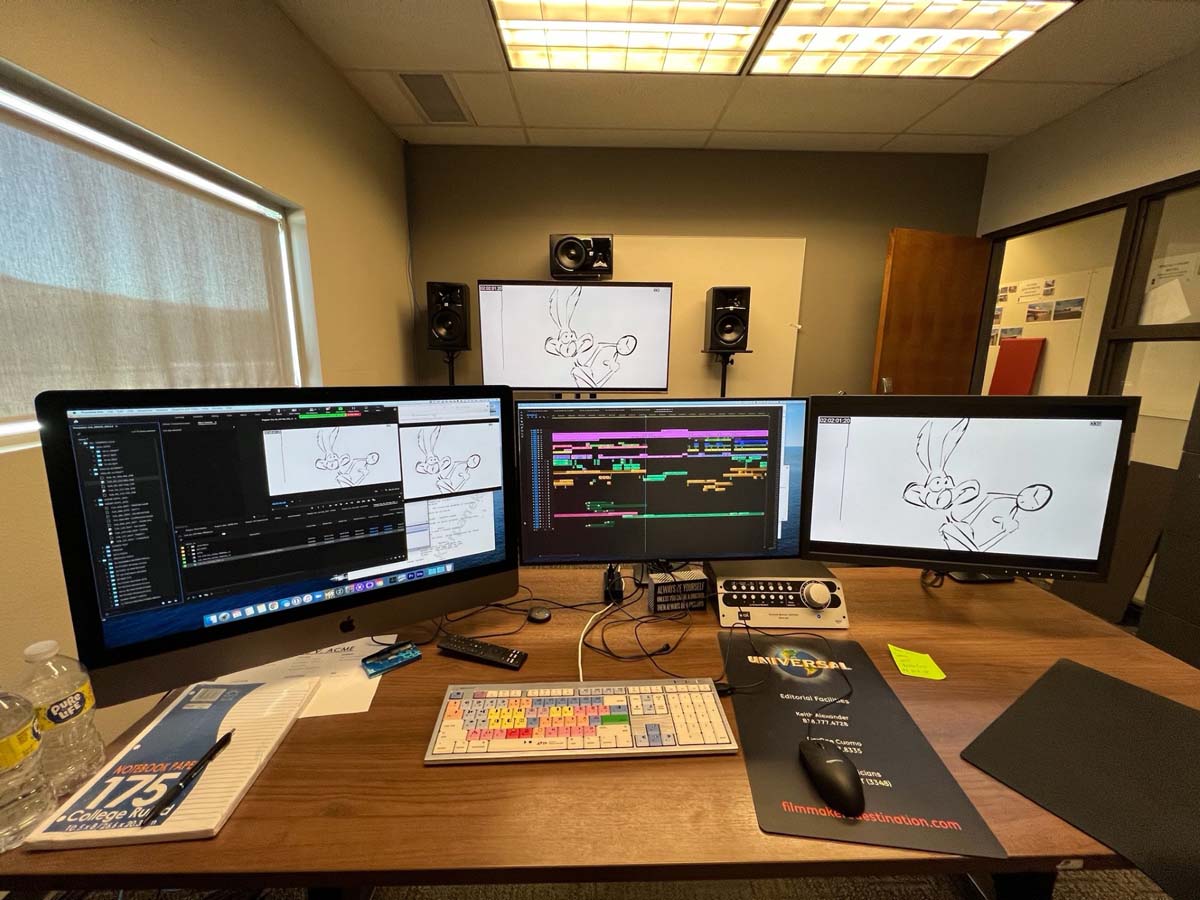
I had all the cartoons in the Avid, and we regularly reviewed cartoons for reference as well to get inspiration. What makes it funny? Really trying to figure that out.
We did not have it scripted or in the animatic that we would use the actual cartoons in the movie. That was a post decision. It came from two experiments, really. The first thing we shot was actually those advertisements that Will does the camera as a lawyer.
I think they’ve been posted as a marketing gag - these typical late night lawyer ads that we made. When we cut those we had the idea of “why don’t we cut extra cartoons on top of it?” That wasn’t the scripted idea, but let’s do it, and we really liked that.
We made them black and white. Then we played around with teaser/trailer ideas where we used the cartoons and we used the “Hurt” track for that. It was just something where we were playing and experimenting with some marketing ideas on the side.
That eventually led to - probably Dave - saying “Let’s try it over.” It’s an interesting experiment because it almost plays like a flashback of Wiley’s memory, but it’s also a bit meta. We all kind of loved it. Having that parachute silverware joke gets me every time. I just absolutely love that one, so that’s how that basically came to be.

Can you fill us in on the easter egg of the name of the law firm of Avery Jones and Maltese?
We have a ton of Easter eggs in the movie. Dave really wanted to honor the history of the original cartoons and the artists behind it. So, the law firm is named after the legendary artists Tex Avery, Chuck Jones, and Michael Maltese.
It’s a fun little thing. Obviously people are picking up on stuff like this and get excited. I think that’s it’s a really nice thing for the fans too.
Did you watch any Looney Tunes as research?
I absolutely did, yes. I saw all the cartoons. I also grew up on them. Mt dad’s 80 almost, living in Germany. My parent’s are not film buffs, but when I told them that I got this new job and I’m going to cut a Wiley Coyote movie, his response was, “Meep meep.”
It’s a beautiful example of how global these characters are. They are something I, I grew up with, and enjoyed with my dad when I was a small child. I watched them all before I started.
But the biggest use-case for them was mostly when we were really trying to build some of the gags and really trying to figure out why something lands or why it doesn’t land - what’s the reason. It often comes down to timing or just like the simple placement of a sound effect, clearing out other things before or how the music accentuates the thing.
There’s just so much to learn from these masters: how they build these scenes, how they build tension, how they build anticipation and then break your expectation and land another thing.
There’s always a “hat on a hat” but in a good way where you think it’s done, but then other rock falls on his head. So we definitely try to find inspiration from the originals as much as we could.

We talked a little bit about how much the script changed as you were working. Was most of the change happening during the previs stage, the storyboard phase or did it go much deeper?
There were some structural changes in pre-production. Like the midpoint, for example, was moved to become the inciting incident. The settlement offered by Acme in the original version was at the midpoint. Then it was decided that having Acme reach out with a settlement offer right away, made more sense. It makes Wiley really active in causing the dilemma that Kevin faces.
He’s kind of stuck because Wiley rejects the settlement, as we know from the trailer. That was the biggest structural change.
That was sort of a collaborative effort that we found when we when we looked at the script versus animatic and how the movie flowed.
Those structural changes didn’t happen anymore in post. We did make the movie we shot, but we had to make changes that were the usual thing when you get feedback in test screenings or studio feedback - we would try to address some notes.
For example, we didn’t have Bugs Bunny in the movie at first, so the shooting script did not have Bugs Bunny. They felt early on that Bugs was a show stealer. He can take over a movie.
Dave wanted this to be a Wiley Coyote/Road Runner movie and really wanted to feature him, but we also quickly realized that it’s a bit of a missed opportunity as well.
So we reconceived a scene, featuring Bugs that previously had a different Looney Tunes character. Those were interesting pictorial challenges. And it also is something that I really love from an editorial perspective.
When you shoot something that is fully live action, you’re kind of stuck with what you have. Obviously you’ve got some tools - you can do a reshoot or ADR or try to recut it and lift some lines here and there, but, when half of your cast is not there, it really opens up some remix options.
We would then work together and write new dialogue for the characters and writer Samy Burch would write Bugs, then I would provide her with “Okay, this is what I have with Will in this case and Lana and how can we combine these things so it feels natural and you’re not feeling like those characters were never in the same place?” So it’s obviously authentic and matching. So those were fun.
Generally speaking, what Samy – the scriptwriter - really owned was the emotion and the deadpan sincerity and really carrying the drama in her script. She did a beautiful, sophisticated script that really is the foundation of the entire movie.
Then our story artists would then pitch the Looney Tunes and they would come up with side gags and additional things on top of these scenes. They were also funny. I think they kind of own the voice of Wiley and the other, characters.
It was very much a collaboration and on two sides of the things - the written word and the visual explorations of the animators and story artists - that come together to create the whole.
When you actually shot the live action, how much coverage was there? Or were you really locked into what you determined with the previs and the storyboards for coverage?
They really didn’t want to shoot this like an animated movie. He really wanted it to feel real. We shot Cinemascope and really tried to mimic 70s movies like All the Presidents Man. And, and David Fincher’s Zodiac.
Dave was a big fan of Succession. There’s that famous Succession scene with the congressional hearings. If you look at that it definitely had the same feel of handheld and kind of dirty with people in foreground and making it feel real and realistic.
There are blurry background cartoon characters. We didn’t try to keep the frame clean and things like that, but I think it really made the effects people’s life harder, of course. But we really tried to push there. Obviously some of the plates are clean, but Dave really tried to keep it real. It was really finding a grounded way to tell the movie.
We had Dave Berkeley sometimes filling in as a puppeteer as well. So in addition to our reference that we had from the animatic, sometimes if we needed to act something out for timing, we would shoot a couple of times with Wiley puppets, then remove the puppet, get in a proper take then without the puppet to get a clean one for visual effects.
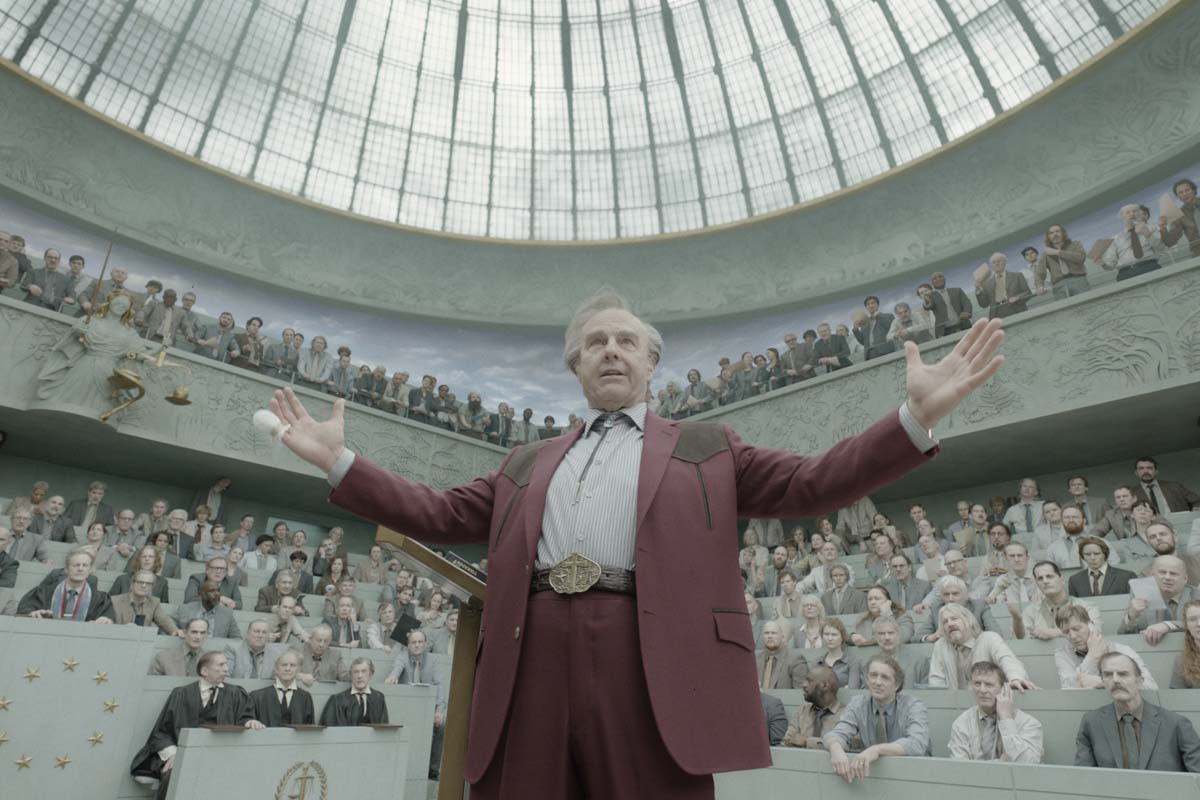
In terms of coverage, I think the largest scene was, by far, the congressional hearing. We had a lot of cameras and a lot of takes, and I think we had a total of almost 24 hours of footage on that sequence. I think the original cut was 16 to 18 minutes. The final version is about 12. It’s a fairly large sequence. It was fun to cut.

When you do a scene - like the Tasmanian devil scene in the courtroom – could you change up the edit from the previs? Were you locked into a certain coverage?
This is - in fact - another scene where - when we shot the movie - Taz was not the witness in that scene! That was a decision that we did in post. We had a really, really fun character: a sheep that was the head of PR. My wife voiced it in the temp, and it was really fun. Everybody liked it. But when we screened the movie, we all felt that the scene was good, but it didn’t sing.
I don’t think it was anyone’s fault, per se. What we kind of figured is that it had to do sort of that the sheep wasn’t an A-list Looney Tunes character. People are there for the characters and we all basically agreed, “Why are we not featuring one of our stars in the scene like this?” We were joking, like, you would have George Clooney in this role.
You would have a character that resonates with an audience more, not a new character. Why are we fighting against the audience? It’s like a concert when the band plays a new song, the audience is supportive, but it’s not the same as when the hit comes, you know?
So we were we were thinking Porky for a while. I think Ryan Delaney, who was our animation producer, suggested Taz. We all started laughing at the idea because obviously he speaks gibberish and that makes the entire scene even funnier. So then we go in and try to make it work.

At one point he gets catapulted out of a seat. That was in the script, but the sheep was doing it, but we needed a better exit. Originally, this unconscious sheep was carried out so the footage is sort of different. That’s the fun part about editing.
Obviously, when you find ways to tell a new story with the existing material and create some magic, then someone watches it and they have no idea that it was completely rejiggered… It’s a really fun scene and a crowd-pleaser. The kids love it, too. It’s great.
Since you were able to feel the story in a real way, using the table read and using story reels at the beginning, how close was your first assembly of the movie?
It was longer simply because when you have live action footage, usually there’s just a little bit of length added when things happen in real time on set, but it wasn’t exceptionally longer. I don’t fully remember. I think our first cut was a little under 110 minutes.
I think the final is 93 minutes, so we we lost some time. I think the biggest two changes are Bugs and Taz. Then there were some lifted scenes, of course. Originally we had a scene early on where Porky and his lawyer and Kevin are talking. We made that just a “walk and talk” basically, where he’s trying to talk to Porky and tries to get him to come to the office. So there are some micro trims in scenes. There are lifts. There’s rejiggering of scenes.

It’s definitely different enough from our previs that I would say it’s fairly different. Not structurally per se, but we obviously worked for a year and a half on the movie to improve it in every single capacity.
If I watched the animatic now, I would probably think, “Okay! Lots of work to be done!” At the same time while you’re in it, obviously it all feels incremental. You’re just trying to find the best movie possible, and we were relentless, relentless.
The artists were relentless. We were always trying to find little things like: I’m one of the voices of the spiders. Before the Daphne scene, those spiders were an idea that came up. “Can we add some more 2D-elements and create a bit of a fun moment there?”
So it’s not just a crane down to a car arriving, but it feels more like our world. And so you have that little mugging sequence. It’s just really cute and funny. Those kind of things - really finding moments that we can enhance in any way.
We did a lot of stuff in 2D as well - hand-drawn 2D. Wiley is a two-and-a-half-D rigged character but, from production economics, it’s just not possible to completely hand-draw an entire movie. Ironically, when you’re deep into production, it’s also economically not advisable to then create new characters like Bugs and dump that on the VFX team that have absolute full plates and delivery schedules, so Duncan Studio stepped up for that one and hand-drew in Bugs.
The VFX team did a really great job. And I know some people with keen eyes and very deep animation backgrounds, they’ll probably figure out the differences and can point them out, but I think generally it’s a really great result that we got that blend seamlessly between the different approaches of getting these Looney Tunes characters on the screen.

Can you remember approximately the length of the first assembly after you’ve got plates and then what was the final length of the storyreel version?
I think it was around 100 minutes. The final cut is definitely the shortest version of the movie.
I also grew up on movies that were about 90 mintues. I don’t have a problem with that. I think family movies specifically, don’t need to be over two hours. The changes in runtime are really just sharpening, tightening, trying to find the perfect flow of it.
My point in asking the question is because I talk to a lot of people about the first assembly and the length of it. Many times you’re at double the end runtime or I’ve cut films that drop 20% - 30 minutes to get to a two hour movie. But because you have the opportunity of cutting with storyboards - looking at it in context, having the table read - you’re able to get the number down that way instead of having it end up after production.

I see what you are referring to. I think we had to be more disciplined there. It’s just not that we couldn’t go on set and then completely improvise different timings and things. I think having the animatic and having this invisible cast where we predetermined at least the ballpark of what these characters were doing at the time, and because it required sometimes rigging special effects, we couldn’t deviate too much from the original scene that we set out to shoot.
So I think that’s probably why the assembly sort of landed in the ballpark. That’s the main reason. I think it’s just having a clear blueprint and following these alphas of our Looney Tunes characters actions to guide the shoot. I think that probably kept us from going too overboard on things. That’s the main reason I never felt like I had to fight the runtime.
I did an interview a couple of years ago with a Japanese editor working for a Japanese production company, and they reshot the entire movie. How I figured that out was I asked, “How long was the first assembly compared to what you ended up with?” And they said, “It was exactly the same length.” I said, “I’ve never heard of that in all my years. They said, “It’s because we pre-shot the movie with iPhones and substitute actors.” They were able to see in context that they don’t need a scene. They cut out all those scenes without shooting them with a crew.
That’s an interesting approach. Having done both animation and that pre-production of having an animatic and looking at the cut and looking at the story and evaluating things, I think it’s really helpful. I wish more life action movies would do this as well, because a lot of the times when when you edit, a lot your job is to fix some of that. There are story issues that pop up as it’s made.
Even the greatest script I’ve read, once you’ve visually translated, you see things differently. It plays differently. It’s nobody’s fault. It doesn’t mean there was a mistake in any way. It’s a piece of art that lives and breathes and you have to mold and shape it.

On the Mix Stage
Every movie that I’ve ever worked on, I trim multiple scenes and ten, 15, 20, 30 minutes out of the movie. And if you look at how many shoot days that was, you could have earned yourself multiple days or more time on the other scenes that actually made the cut.
Obviously it’s economics and time and all of that. But I’m a big fan of measuring twice and cutting once and it’s also really fun for an editor. Honestly, what’s beautiful for animation and that previs animatic pipeline that happens in animation much more is that you as an editor - if you have a great collaborator like Dave - you can put on many hats and advise the movie in many ways.
There are things where I had an idea for a shot and it became a shot. I had an idea for a gag and it made it in. For example – Dave’s going to laugh because I never shut up about it - but the porky gag at the end of the Daffy scene, that wasn’t scripted.
I just felt like we needed a button, and I looked at plates and had an idea, and I mocked it up with temp voice, and I presented it, and they liked it and it made the movie. When that test-screened, I was so scared.
It was the first time I made something that was supposed to be funny. I hoped it was, then the audience kind of laughed and I was so relieved because obviously you don’t want to have it land with a thud, then you have to cut out your own joke. But, it survived.
It’s also why the cancellation kind of hurt quite a bit. It’s so much more than a job. You’re spending years of your life and your own creativity and your passion and all that work, so you really connected with the movie when it is finished and then, it getting erased for an audience to never be seen. It wasn’t a pleasurable feeling. It felt like a break up of sorts that I didn’t have a control over.

Could you explain to people that might not know what happened, what happened?
It’s a complicated story, but Hollywood is currently in a bit of a funk, due to economic realities that were caused due to the streaming war. It all started with the Warner Discovery merger, and there was the cancellation of That Girl and Scooby Doo.
My heart goes out to Scooby Doo because they have not been rescued and That Girl has not been rescued. We had a happy end, but those crews suffered the same fate. Their movies are not coming out, so my heart goes out to them. It was basically a time of corporate belt tightening.
The streaming model was proving to be expensive and not bringing in necessarily the revenues that were thought. I’m not an economist, but basically Warner at that point changed their strategy. They just wanted to rely on big budget features like Dune and our movie - while we’re hopefully punching above our belt - with a $75 million budget, it’s sort of a mid-range budget for a studio like Warner Brothers and spending the spending for P&A is a big ask.
You have to spend 30, 40 million in marketing costs to push a movie out. I think that was just at that point with the studio regime change and the merger and all that restructuring. That’s sort of where that decision came to be. It was obviously devastating for us.
I’m glad that eventually Ketchup stepped in and purchased the distribution rights from Warner and the movie is now finally coming out. We had good test results with the audience. And the critics are agreeing with what we always felt: that we had a good movie. I’m glad that for everybody involved that audiences get to see it now, even if it took a few years.

Kuparnek at work at his Avid
It’s crazy that that decision was made after the movie was made.
Yeah. It was finished. We were in post-production in July 2023, in London. Then I went on a cruise and came home to LA and the writers’ strike was just about to be finished. I just figured, “What a time to be alive! I’ve got a studio movie coming out in theaters. It’s going to pick up in the spring. It’s all going to be great, you know?”
I’m just happy. Especially for Dave. My journey on this film was a little over two and a half years, but he developed the script with Samy. He’s been fighting the good fight since the cancellation and then repurchasing.
Now he’s been very much involved in marketing and things like that. This movie has been a journey of a lifetime for him and covering almost a decade, probably for him. It’s been a long road.
I didn’t realize that the original script was based on a New Yorker article. Did you ever read that?
Yeah, that was the first thing I’ve read. It’s a really funny piece. It’s such a great idea, of writing a legal document of a lawsuit. It was written in the 70s. There’s a little Easter egg in the movie of the New Yorker article visibly in the film. It’s in the scene with Terry when Kevin checks him into the motel.
He sits down on a couch and starts reading a magazine, and that’s The New Yorker magazine that actually has the article in it. It’s the cover of the actual New Yorker magazine.

That is a great little Easter egg. Thank you for that, and thank you for this great conversation. It’s been so interesting to hear about the very unusual production of this movie.
Glad to be here.

 October 15, 2026
Digger
Stephen’s been on Art of the Cut before for F1 and for The Revenant, for which he was nominated for an Oscar, a BAFTA and ...
Read more October 8, 2026
Heart of the Beast
Today on Art of the Cut, we speak with Oscar-nominated editor Dody Dorn, ACE, about her work on David Ayer’s film, Heart of the Beast.
Read more October 5, 2026
The Whisper Man
Chris has been on Art of the Cut before for The Menu, The Many Saints of Newark, A Quiet Place, and Assassin’s Creed. He has ...
Read more
Subscribe to our newsletter
Get all the latest news, blog posts and product updates from Boris FX, delivered directly to your inbox.
Welcome!
Thanks for opting-in to our newsletter. You'll receive an email momentarily with your confirmation.