


The Pitt
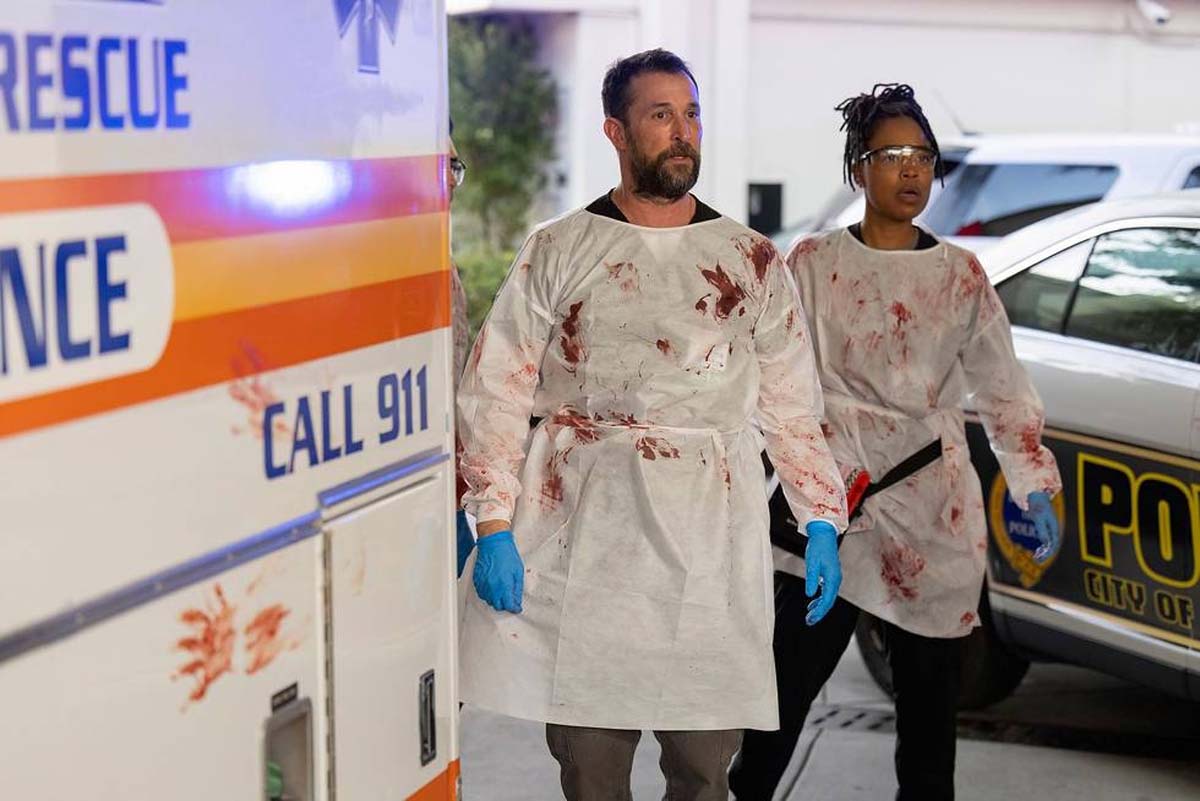
Today, the ACE Eddie-nominated editor of The Pitt, Mark Strand, ACE, discusses how the show was not supposed to have any music, how geography matters to the editing, and the value of subverting audience expectations when cutting.


Today on Art of the Cut we speak with editor Mark Strand, ACE, who is nominated for an ACE Eddie for Best Edited Drama Series for his work on The Pitt.
In addition to The Pitt, Mark’s work includes Shameless, Animal Kingdom, Rizzoli and Isles, Longmire, Nip/Tuck, and others.
It’s nice to have you on the show. Congratulations on The Pitt. I’m a big fan of the show.
Thank you very much. I appreciate it. Thank you so much for having me.
I know so many medical professionals and they’re traumatized by the realism of the show!
I’ve heard that a lot. We spend a lot of time getting that right. It was very important to all the producers that we get it right for our healthcare professionals.
But even dramatically, that specificity really bleeds through for the performances. It bleeds through for the stakes, it bleeds through for the drama versus melodrama. It’s so critical.
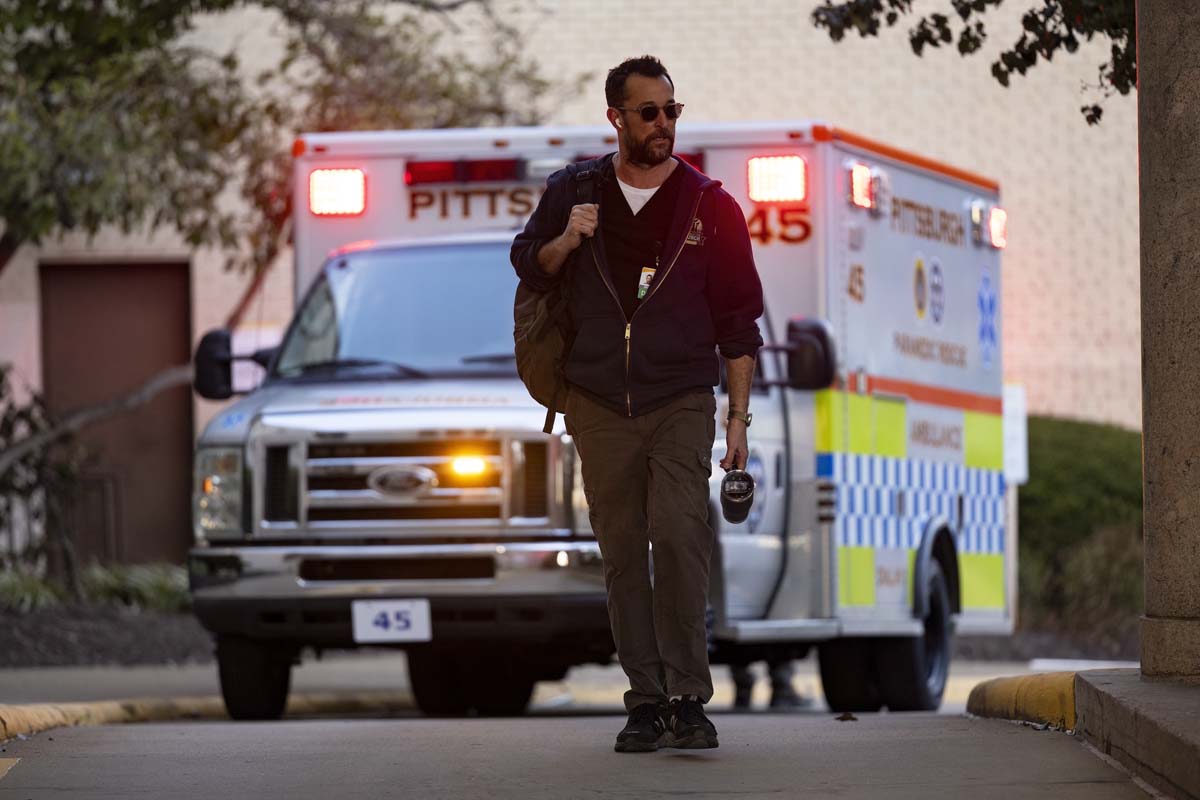
In episode one, season one you start with what some people would refer to as “shoe leather,” but obviously when we cut in that kind of stuff - travel time, going from one place to another - there’s a purpose.
There are maybe three purposes for that. First and foremost, there is a series reason, which I’ll sort of answer last. We’re setting up a new television program that looks and feels and chews like E.R.
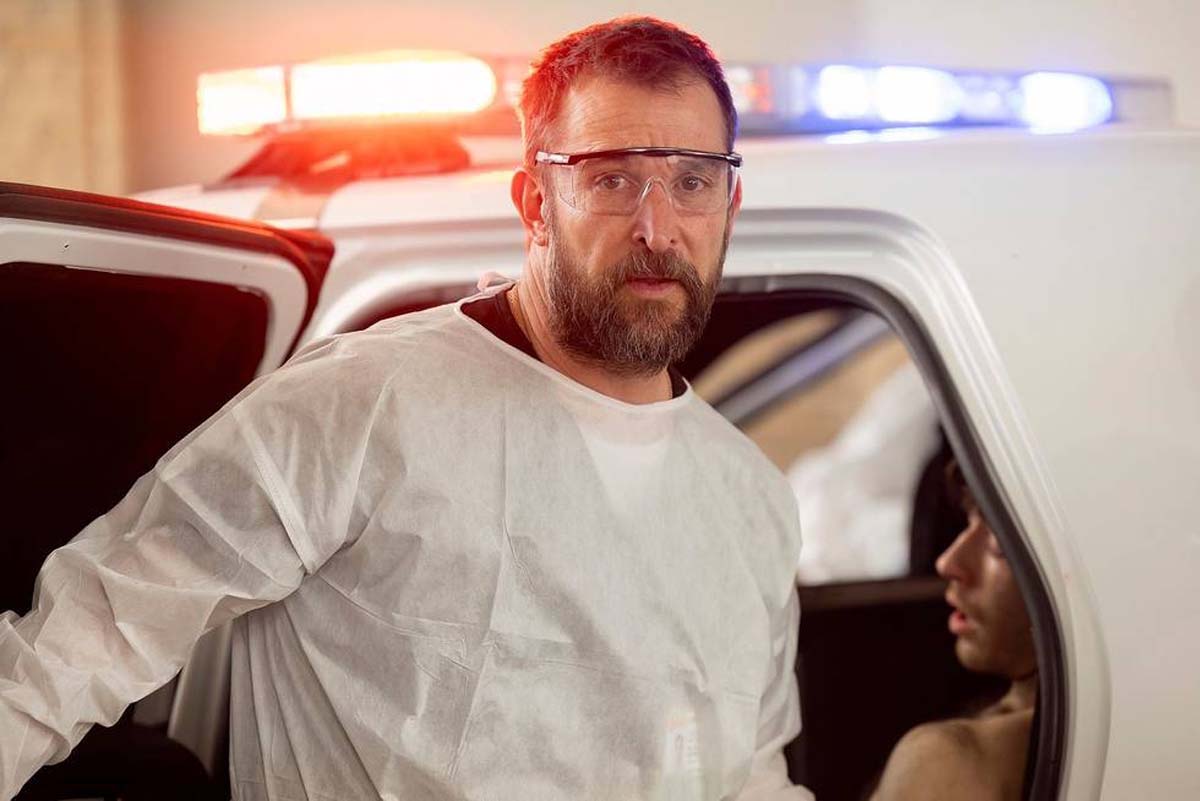
That was such a monster television program, and we’re about to have a show that stars Noah Wyle, who was the star of this other show, so somehow we need to draw a distinction. We’re about to be right up in Noah’s face.
But at the same time, we need to say, “This show is not that show.” So flying in over Pittsburgh, you’re setting the tone. You’re not in Chicago. This is not E.R.
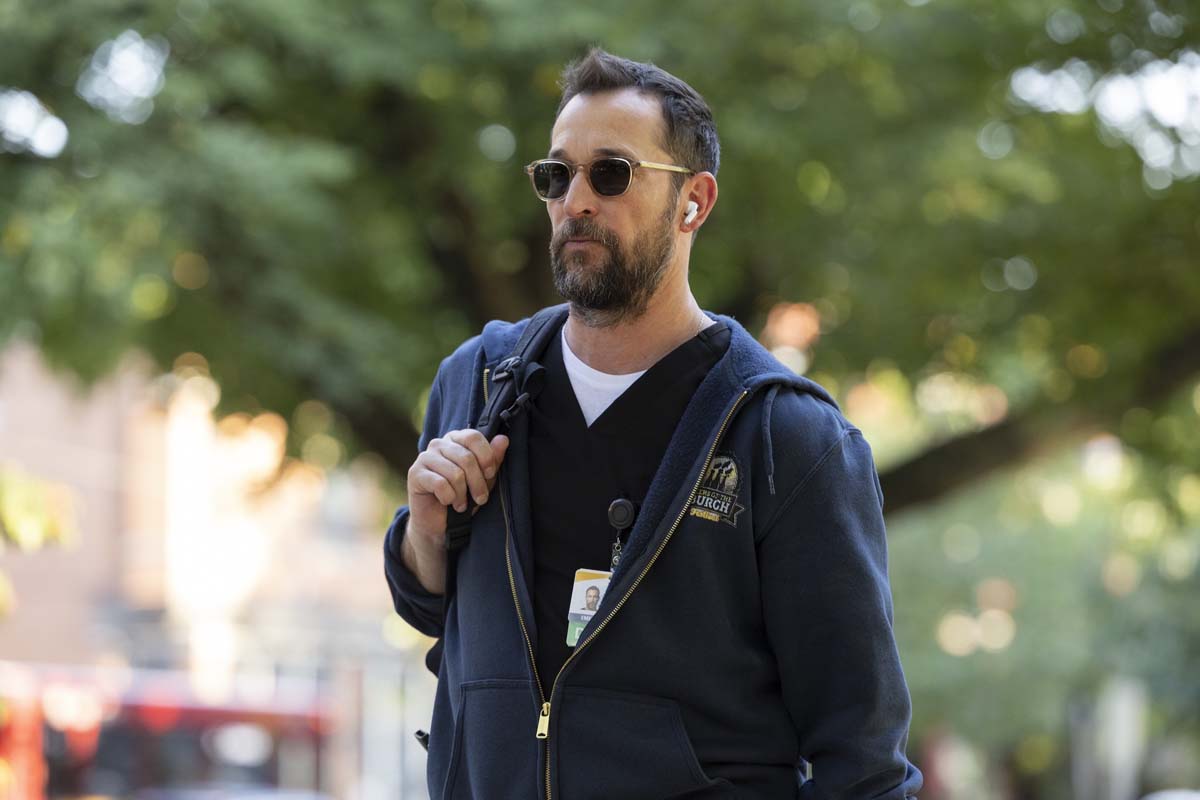
For the series, this is a part of this city. This is our guy. Then we are taking you - through the sound - he’s listening to music that - as initially conceived, and as we initially edited it - that was the only piece of music that was going to be in the whole show.
We’re finding our character. He’s listening to some music. He’s moving through space. He’s going into a hospital. He’s going down because – The Pitt doesn’t just mean Pittsburgh, it’s also because this is a basement E.R., so he’s going down into that space.
It’s part of the introduction to where we’re going to be as a series, as an actor, as a different character. This is not John Carter. This is Michael Rabinovich. Then we are in this E.R., so it works on all those levels.

Editor Mark Strand, ACE
Was that opening piece of music something that you edited to? Was it something that was scripted? Or was it something that you found in post?
That was the script. Our creator and writer, R. Scott Gemmill, is very good with music. He’s always got music on in his office while he’s working.
That was a specifically chosen cue from him. We did try other options, but that felt right. It felt right to him and to me.
I cut it more generally and we put a bunch of things up against it and played it through.
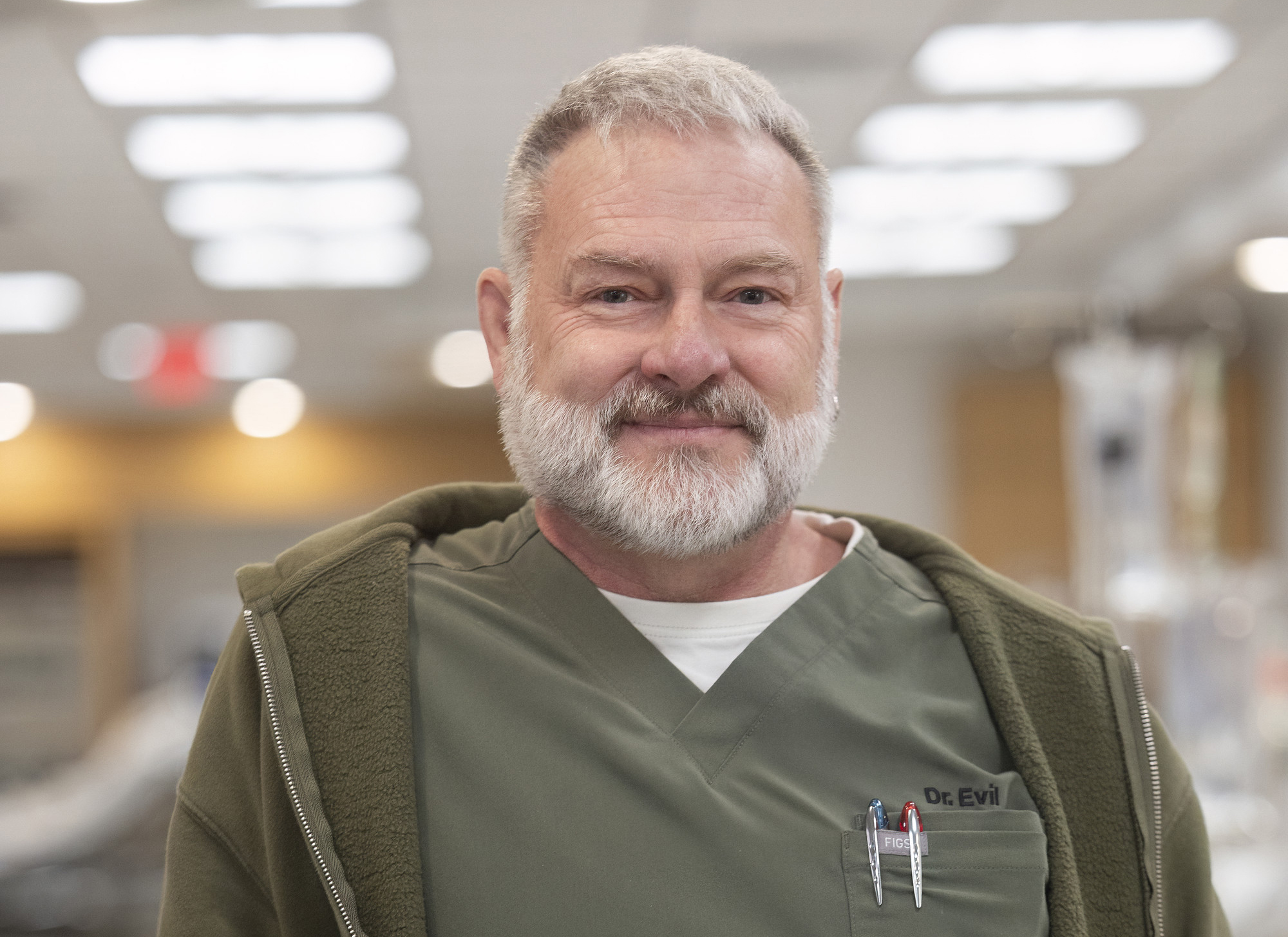
Creator and writer, R. Scott Gemmill
Is it possible - because this is a show like 24 where you’re going linearly through a day in time - is it possible to restructure things?
That’s such a great question - such a topical question for today - because this morning I was reshuffling scenes in the finale of season two, but fundamentally you have to honor the physical space. I was being asked to restructure something by the studio.
There were a couple things that happened in this last episode where we were trying to either cut out of a scene or could we just jump Robbie down the hall because we wanted to maybe remove something that was happening?
But the answer is “no.” You can’t jump. We have defined the space and we have defined what we’re doing, so we absolutely cannot jump Robbie down the hall. So occasionally, very occasionally, there might be a thing where we need to get through space, and we might pull up a scene between two other characters over in the other side of the ER just so we can maybe do some of the normal nipping and tucking that you might do.
I try not to time jump at all. I think it actually adds to the tension. You need to find a way to make life work. The writers spend a ton of time on this.
They know that if they’re going to have a conversation in the hub - which is where Dana sits in the middle of the whole ER - Trauma 2’s right there and North 15 is right here. So if you’re going to go from a patient in 2 to a trauma and have a conversation at the hub, well, it better be in North 15.
The ADs (assistant directors) have an entire map. We literally had a board game made for use in our tone meetings.
You’d be moving all the beds around to see where all the patients were, in order to make sure that everyone was aligned - that in the backgrounds you have the right people.
Nina Ruscio, who’s our production designer, made it. It’s in the style of CLUE, with our floor looking exactly like that. It’s a pretty fun game.
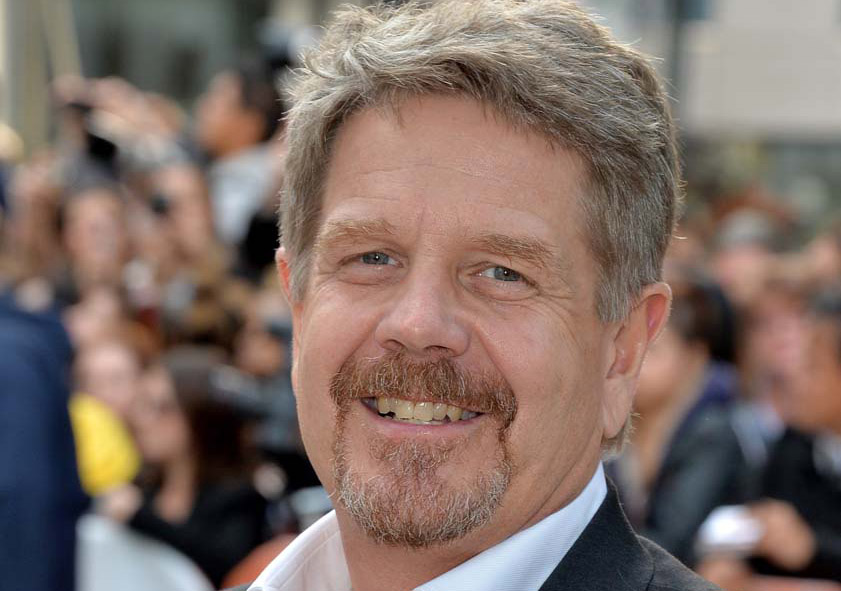
Director John Wells
There are a bunch of really high-energy, very choreographed camera moves with various actors. Do those have coverage or extra cameras or do you just say, “Hey, this was planned like this, I’m going to leave them like this unless something goes wrong.”
There is coverage. One of the tricks of this show is that we generally reset the entire staging because there are so many extras, and there are so many different moving parts.
If you see a character in “Chairs” - which is the waiting area - then later a doctor sees them in South 9, they will map: “When does that person move?”
It might be in the middle of scene four - in the background - you’ll see that person move. So all of these moving pieces are planned and set, then everything gets reset to one.
Because especially in these long takes, you’re just never going to get everyone to connect if you’re picking up coverage in the late part or whatever.
So most of this stuff - much like a play - will start right at one, go all the way through the entire take, then - in sort of John Wells-ian style - you’ll do your wider piece.
You’ll choreograph the move, find the articulation of the scene beats being told, then throw a tighter lens on and do a very similar move through that, then maybe pick up a few of the details as you do that. Then if you’re pushing, you’re generally pulling.
So you’ll get the same on both sides. So it will be covered in a multitude of ways. When they were doing E.R., a lot of that was Steadicam, trying to tell it all in a oner.
The editorial idea is the feel that the entire episode is a oner without doing a oner for a multitude of reasons.
First, for storytelling purposes, but also the feel needs to be that the scenes continue, so if we move from one space to another space, I like to travel with somebody.
So I could cut to the other room, then that person could arrive. That’s editorially acceptable on most shows, but not in our show.
We want to move with the person into the next room, because then our experience as the viewer is that we are following with someone. We might miss some stuff and we’ll have to pick it up. Just like that character wasn’t there for the beginning of the trauma.
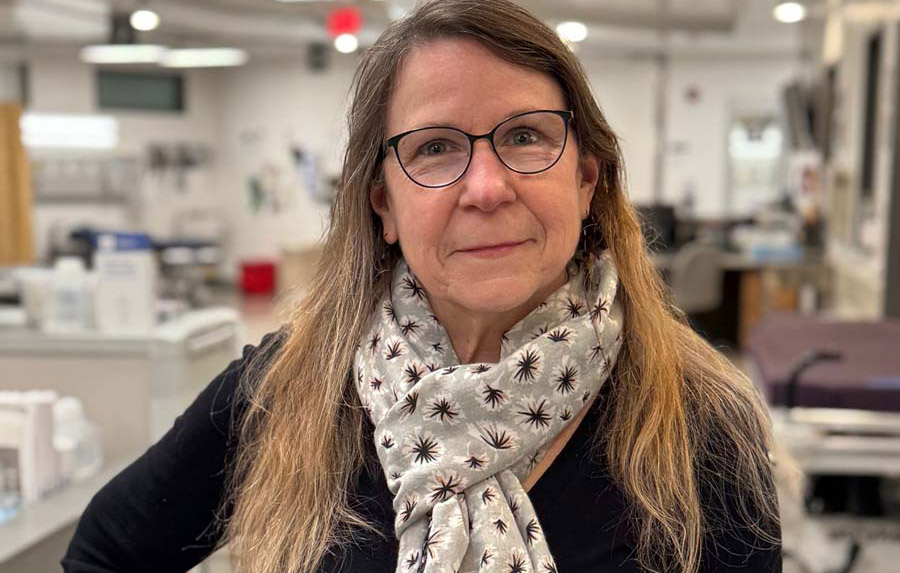
Production Designer Nina Ruscio
How much of those discussions and creative choices were discovered during post, and how much did the director or showrunner sit down with you as an editor beforehand and say, “This is how we want to do it. We want to follow that person. We don’t want to cut and arrive and have them arrive.”
Scott’s our showrunner, but John Wells is our sort of like our overlord. John and I have worked together for a long time. We worked most recently on Shameless and Animal Kingdom.
That is a touchstone of all of John’s work, which is that he would never want to enter a space before our character, because that point of view is very important to him.
That idea is a John Wells-ian kernel, then how everyone spokes off of that. That is a John Wells move. He directed the pilot.
That’s what he and I were doing in the pilot. He and Johanna Coelho - who’s our DP - are very connected to a point of view, and that is a foundational idea within the show.
Every guest director who comes in has that conversation in the tone meetings, that if you’re going to design shots they need to live within the philosophy of our coverage.
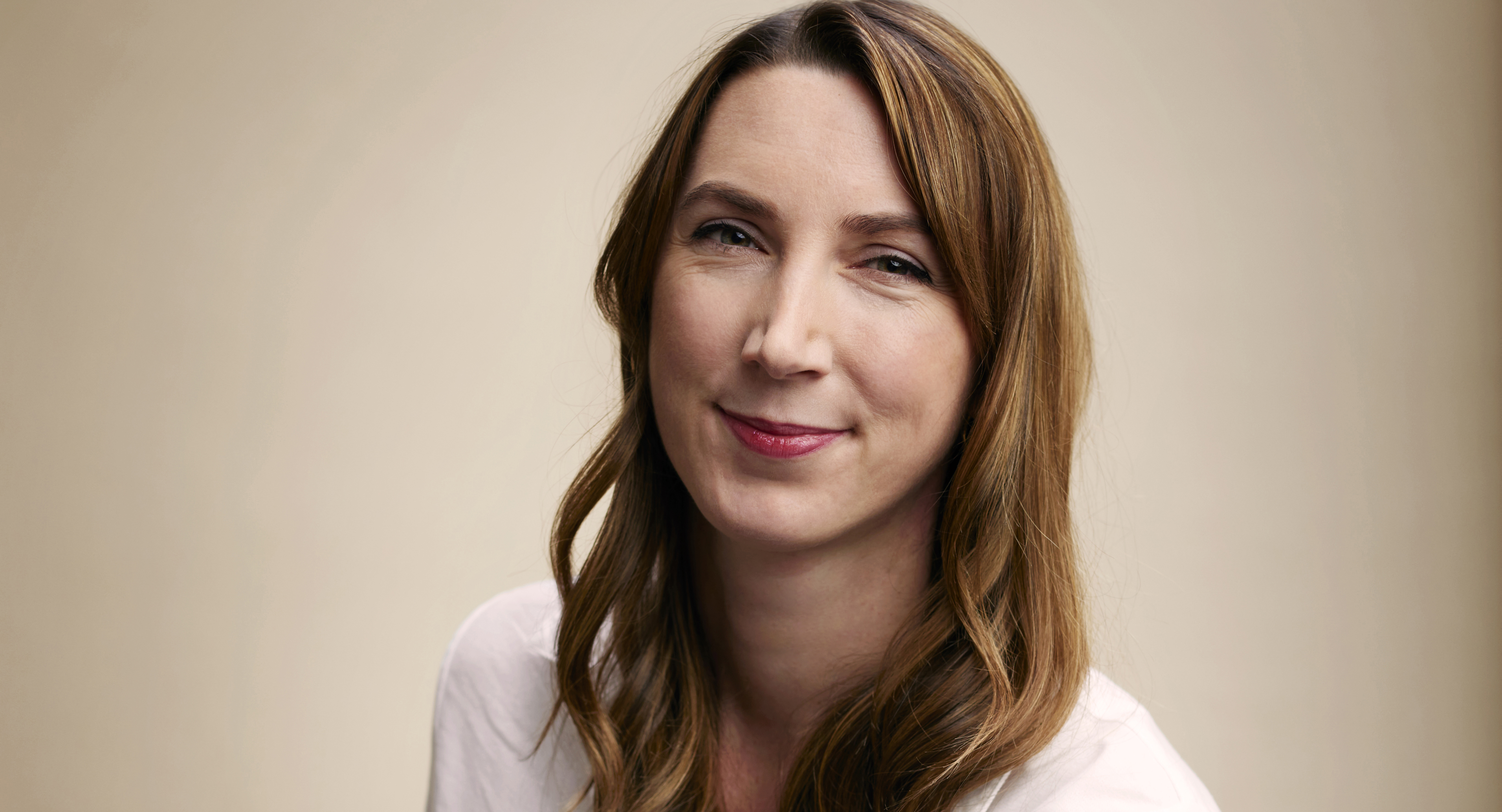
D.P. Johanna Coelho
Do you find that you have to guide some of those guest directors in style, or do you let them do their thing, then John will fix it later?
In general, as a television editor, you have your thumb on the pulse of what the genetics of the show is almost always better than a guest director. The guest director’s job - that’s what they pride themselves on - is coming in and being able to play in different sandboxes with different toolboxes.
It’s an exciting energy when they play in the sandbox but then do something different. With season one you’re still feeling it out and everyone’s trying to figure out: “Wait, is it documentary-style?” No, it’s not quite documentary style.
That’s a part of the camerawork, but it’s very present, so it isn’t just documentary. Documentary can observe. We are not “observe,” we are “experience.” So you need to be with your characters on their shoulders, moving through it.
And if this coverage can be with our character and then the next character - like the ballet and choreography as these characters step into frame, then they experience the move. Now we leave with this other person as they go out this other way. That is not documentary style.
At a certain level, it feels very documentary-style because it feels like it’s really happening, but it is a very specific point of view. Jojo, the DP with each director as they’re shooting the pieces, is having that conversation constantly.
In tone meetings we’re having that conversation, then the footage comes into my bay. Then I’ll have conversations with directors and they’ll say, “I see how you’re using these hand-offs in order to maintain that vibe.”
So everyone’s pulling the oars in the same direction, but it is a full team effort to make sure we are all making the same show, especially because it is one continuous shift.

Layout of The Pitt
A lot of the show is shot handheld. I’m assuming you can’t do split screens for blending.
You would assume, but I’ve been yelled at by my post producer, “Mark! You put too many split screens in!” I do it all the time. The Avid software has great tracking, so even with handheld stuff, you can sort of stabilize both sides, split match, then maybe add shake. Your toolbox is big.
But then that’s going to get handed off to some VFX editor…
Depending on the complexity. Yeah. I’ve gotten hit a few times with: “We can’t do this in the online bay! You should have told us!”
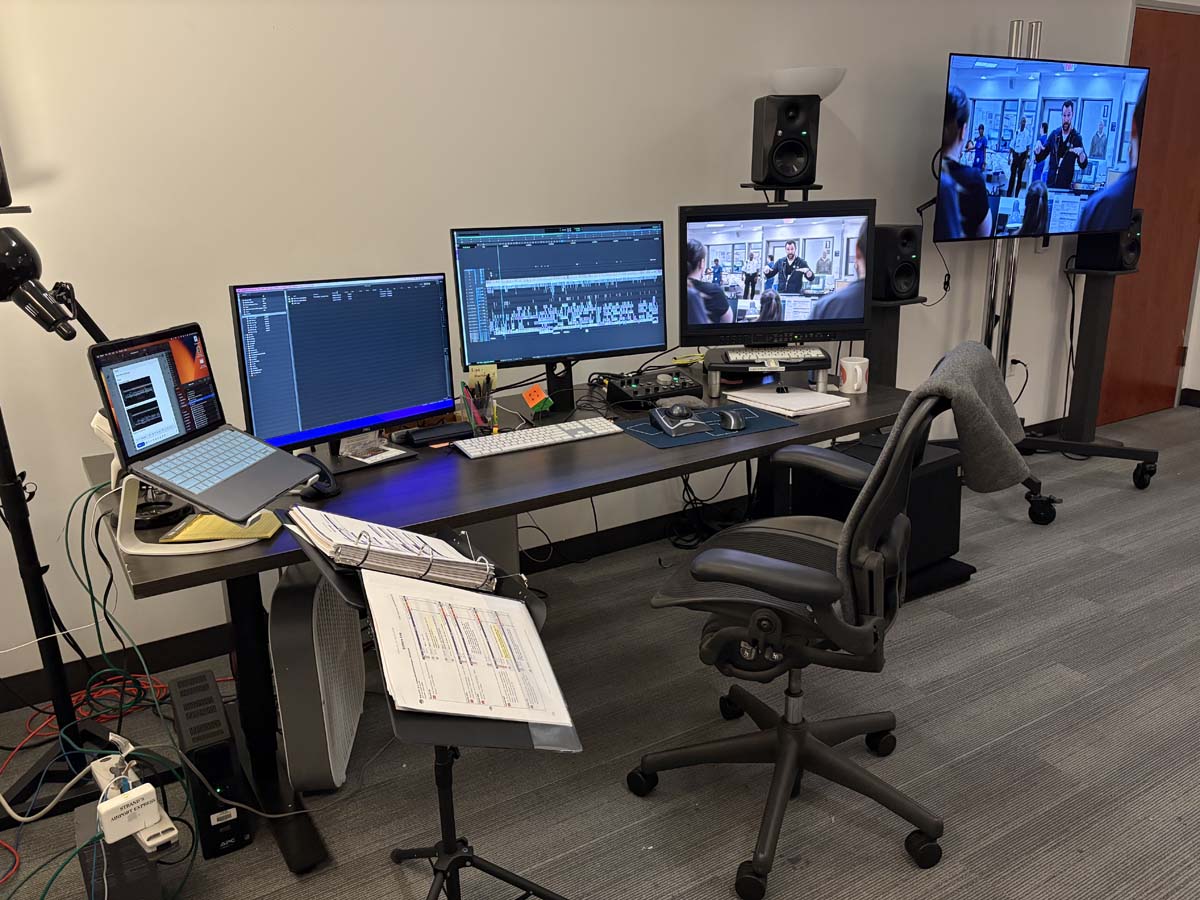
Mark’s edit desk for The Pitt
Continuing that idea: many of the shots have a lot of people in them. So what do you do about judging performance when you’re not judging a single person’s performance?
Sometimes - if it’s a lockdown show - you could slice and dice. The directors and the DP and the actors are incredible on the show. On every John Wells show you’re not allowed sides on set. Everyone has to know all their lines.
Think about that jargon and needing to know that jargon and needing to understand when you need to say these words! You need to walk in and say it within the behavior of the trauma. So these actors are on it.
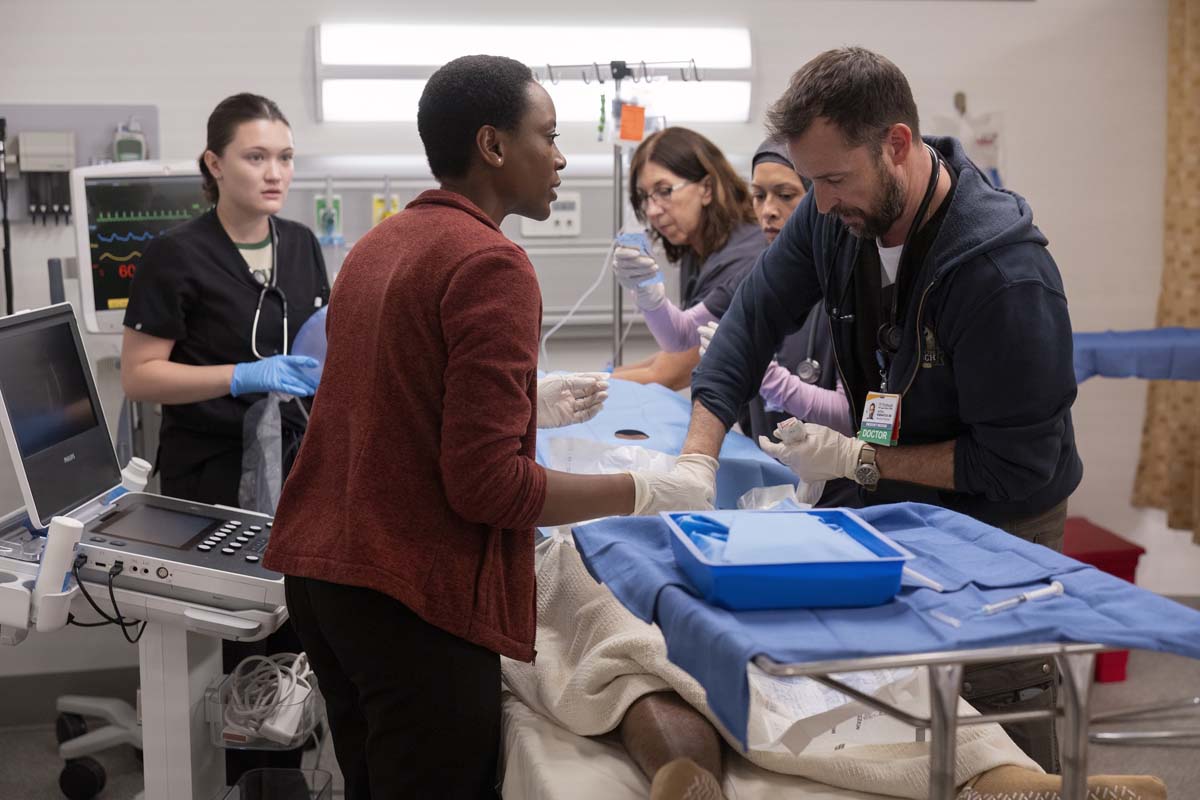
They have a medical rehearsal. The director is there for camera and blocking and performance, but then there’s a medical rehearsal beforehand in order to make sure that everyone understands what their characters are medically doing in those moments.
I think there’s a certain energy that comes with the theater of it all where we have to perform right now. We need to make this happen. So our actors are great. I do have to assess a complete performance based on everyone in the frame.
I do get jammed up. In a lot of shows it’s like, “I’ll just use this other piece.” Once you start cutting it up so that you can get the right piece of that line or the right piece of this line and the right piece of that line, and now you’re three edits in, rather than staying and racking and moving through space, that’s a different show.
That feels different. I think trying to honor the continuity of camera and location space is huge in the viewer’s experience of this story.
The other question I have about performance is not of the actors but of the camera operator. Because it’s handheld are you also judging how cool the camera moves are, or where something moves?
Constantly, constantly. That’s such a huge part of it. That’s where Jojo, the DP, and I are always in conversation, talking about what’s successful, what’s not successful. Do you need these pieces? We have the doctors. We’re over their shoulder and we’re with them, and other doctors are talking.
Then you have our patients talking to each other. So do you even need coverage patient to patient? That’s where the melodrama is. The melodrama is with patient-to-patient. but our show is a little bit more about our doctors and their relationship to just the patient.
In the first pilot, there was the child who ate a gummy. That first scene with Doctor Langdon, Patrick Ball and the child is entirely told with Patrick’s point of view. As he looks for the possible cause of the illness, the parents are talking. But we don’t see the parents very much.
We certainly don’t see them sliced out speaking to each other, even though there’s a lot of important parts of their conversation, like, “You brought a gummy into our house and left it in a place that our child could have access to it?”
And there’s anger between them, but that is secondary to the drama of our story, which is the point of view of the doctors and their experience. When there’s information that’s important to the patient, you might cut to it, so directors will shoot patient-to-patient.
We will shoot patient-to-doctor or caregiver-to-doctor, but where you use them and how you enter into that point of view needs to be through our doctors. That structure, that rigidity, has to be maintained in order to maintain the integrity and vibe and purpose of the scene.
You mentioned at the beginning of the show about how that that opening piece of music was supposed to be the only piece in the whole show. Did you mean the whole episode or the whole series?
I meant the series.100%.
Then what happened?
Well, the studio happened. What always happens is that people get scared. People don’t want to do it. Just like in any television series, until someone’s seen it. It’s why testing works so well for films. The studio needs to relax.
They believe in the storytellers because they’ve given them all this money and they’ve given them all this responsibility and they have asked them to make this television show. Then the palms get sweaty. The show’s about to go out.
There’s no music under any of these traumas. You can’t hide behind music in this show. You have to make these traumas work and the pace and the drama, authentic drama. Just like the actors are trying to be real and in the moment, you have to be in the moment editorially without the addition of music as your backup.
I haven’t used any music as I edited any of the show, but the studio has asked us to have drones, and percussion when a trauma comes in and stuff like that, but philosophically, that is not really the DNA of the show, but it’s in there because we’re partners.
We want to make sure that the studio and the network and the showrunners are getting very close to exactly what the vision is.
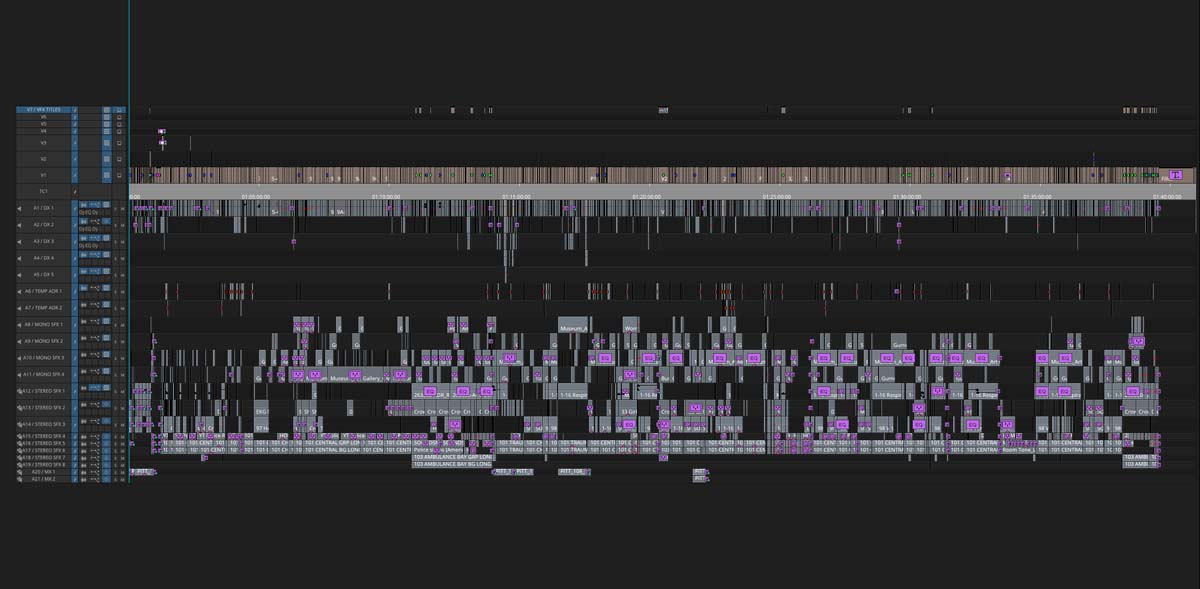
Avid timeline for The Pitt Episode 112 (Season 1, Episode 12 “6pm”)
In episode 112, there’s a scene where Noah’s character goes into a bathroom and he’s got some pills, and you would think that they would have music in it, but there’s no music. The only place where there is a drone or some sound design is when you go into a flashback.
That’s exactly right. Because of our caregiver’s experience with Covid and how traumatic that was, that had to feel different.
It heightens everything. In a show in which your present is so grounded, your flashbacks can be elsewhere, and that will heighten the present. As we moved in, we were doing some match cutting to get into it.
We cut face to face, but now the face has a Covid mask or it’s the point of view where now you’re looking through a Covid mask and the room is filled with people in their gear. So having that audio clue as well is just another space/time distinction. That’s how we were validating that move.
Also, in that specific flashback, you use some jump cutting. Tell me about the value of jump cutting.
It’s a tool that I use a lot in general, but I will not jump in The Pitt, although I did think of jumping in the final scene of season two because I just felt there was an emotional reason to do it and to make such a break from a style that we have been so connected to for two years can be so meaningful.
In editing, there are expectations, and you are either subverting or embracing those expectations to help drive story.
So much of what I’ve talked about is living within a space in order to maintain an expectation, because that expectation is working in our favor. That’s what I’m looking to do.
I did this scene once in the show Animal Kingdom. Animal Kingdom was an adrenalized show about a Southern California crime family. Those jump cuts drive pace. They’re exciting. They’re unexpected. You can really bang through a story very quickly.
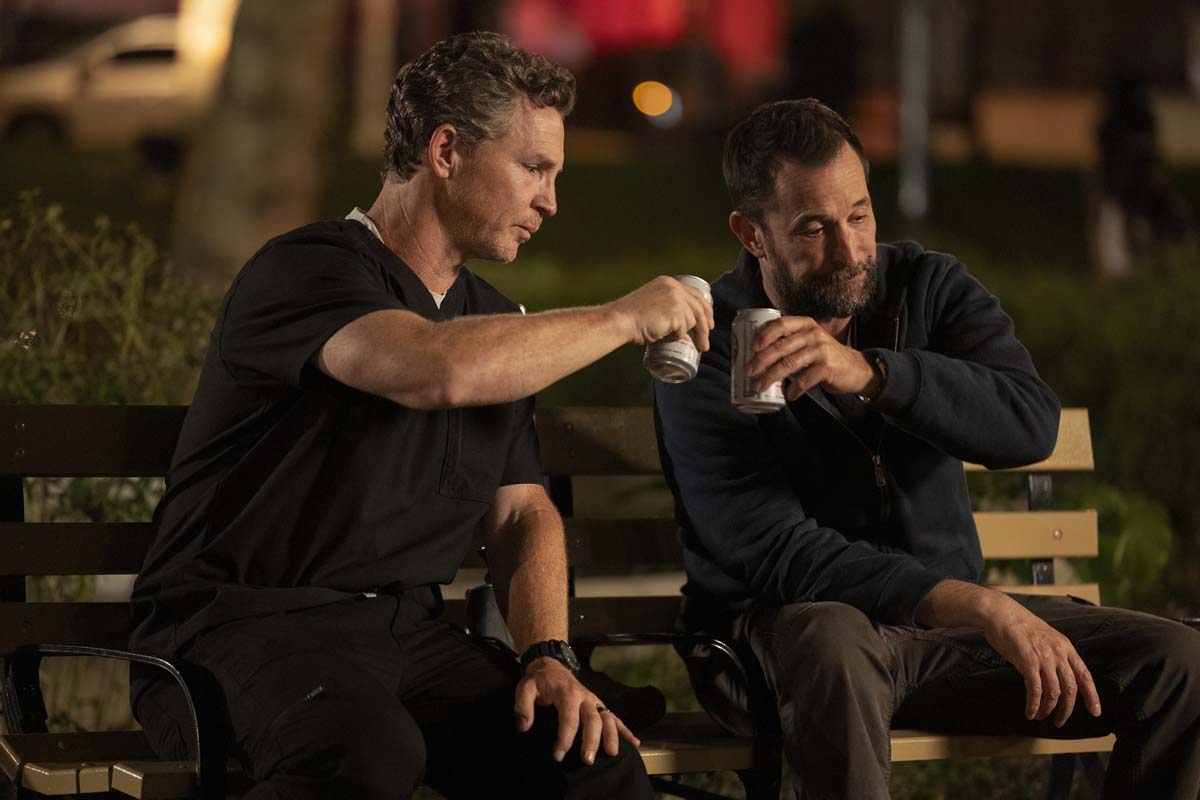
Shawn Hatosy and Noah Wyle
The jumpcuts are also violent in the case of that show.
In the case of that show, they can be. I had this long scene. Shawn Hatosy, who plays Doctor Abbot in The Pitt, also played this character Pope in Animal Kingdom. He was a troubled guy in the premiere of one season.
He was walking through space and I jumped him to move through the space, which was the style of the show.
And it worked. It’s part of what the show is, and I was doing it for that unsettling feeling. And John, who also happened to be directing that episode, said, “Whoa, whoa, whoa! Mark, what about the existential dread?” I looked at him like he’s nuts.
“What?” “Mark, we got to feel the existential dread.” So then we allowed him to walk all the way through this space. And in a show in which the expectation is the jump, it almost sands the edges off.
It’s maybe not as unsettling now because I’ve been using the jump cuts, so then we were elongating these scenes, and now that was unsettling, because that was the distinction. It was the expectation. Then what are we doing to undercut or support that expectation?
There’s a lot of overlapping dialogue. Is that tricky?
Always. I read something crazy about the Safdies where they just have everyone on top of everybody, then they just pull it all apart and have an ADR theater, and they just bring people in and they redo all the lines so you can get the clarity of it all.
In television we don’t really have that. So the overlapping dialogue is a blessing and a curse. It’s great because it really accentuates the idea of the patient care happening - if they’re taking blood pressure and they’re yelling that out, that is a part of the E.R.
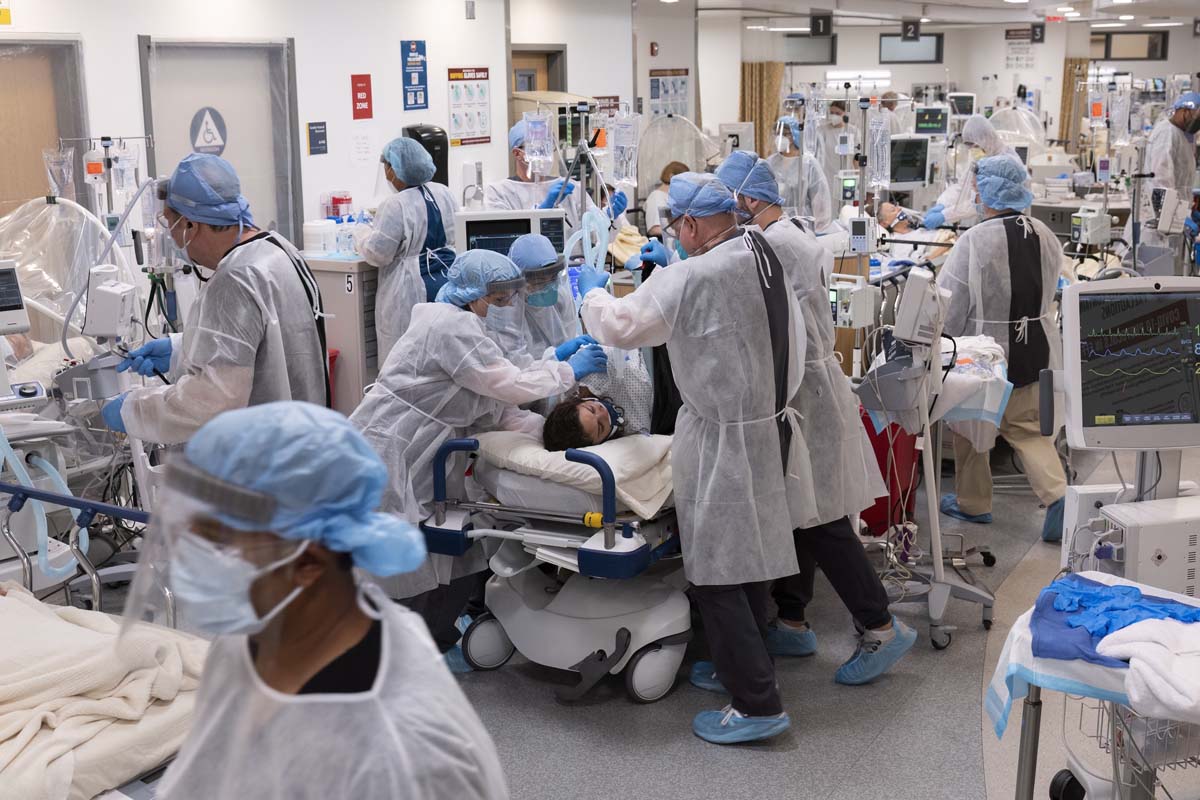
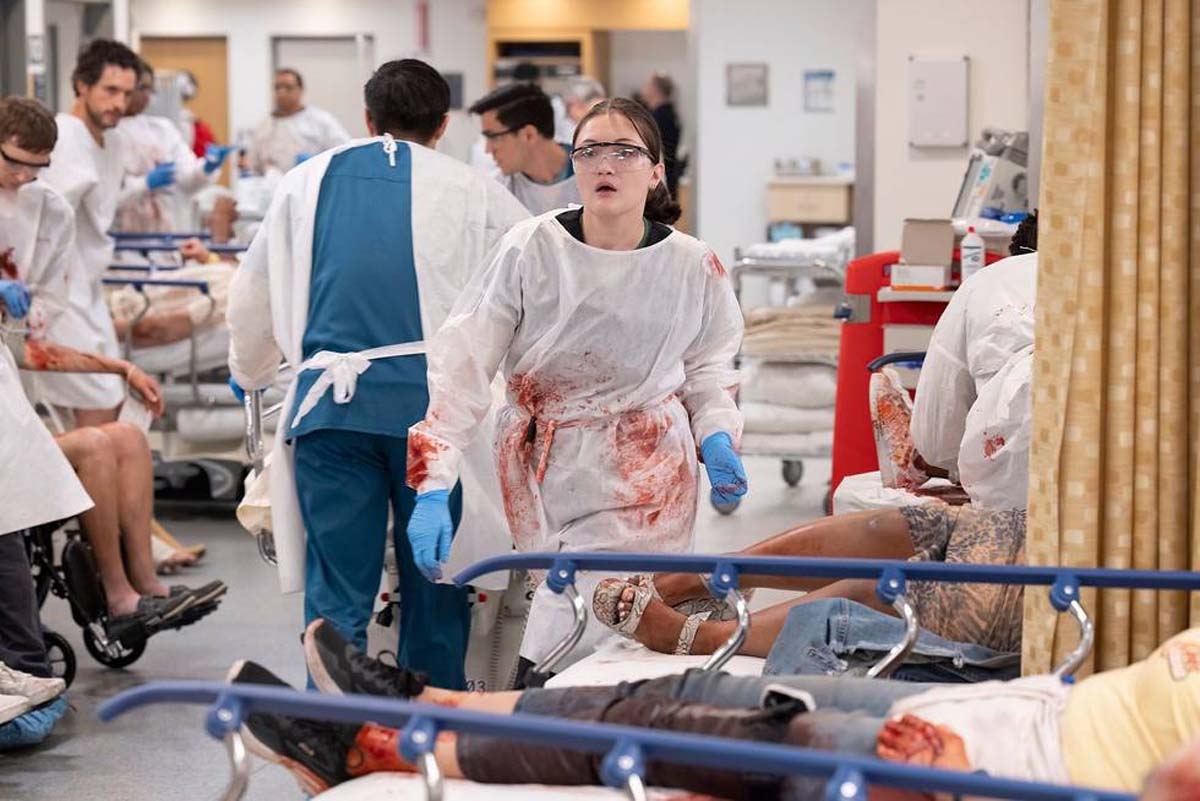
So the overlapping dialogue is essential to the show. Also it’s a spaghetti junction where you just need to sort of carve it out, pull it out - especially in episode 112 - which was the mass casualty episode. There are something like 54 patients that come in in the first ten minutes of that episode.
The performances are choreographed in the sense that every knows where everyone needs to be. They would call action, then everyone would be making all their moves throughout that whole take back to one all over again, back to one. So some of these things are happening at the same time in the trauma room, specifically in 112.
There are four different beds in the trauma room. The behaviors are happening at the same time in all four different beds. And I would have to extract what was happening storywise in each individual bed.
Von Varga, our sound mixer, is really, really good at getting as clean pieces of audio, so you can dig out the behavior on bed one while something’s happening in bed two. I can live here, then go over to bed two while that’s happening.
Theoretically, I might need to stretch out time, kind of replay a moment. You wouldn’t notice it when you’re watching it, but those two items were really happening at the same time, so trying to dig those out and pull them apart so that we are following each individual piece, even though it’s all really being done at the same time.
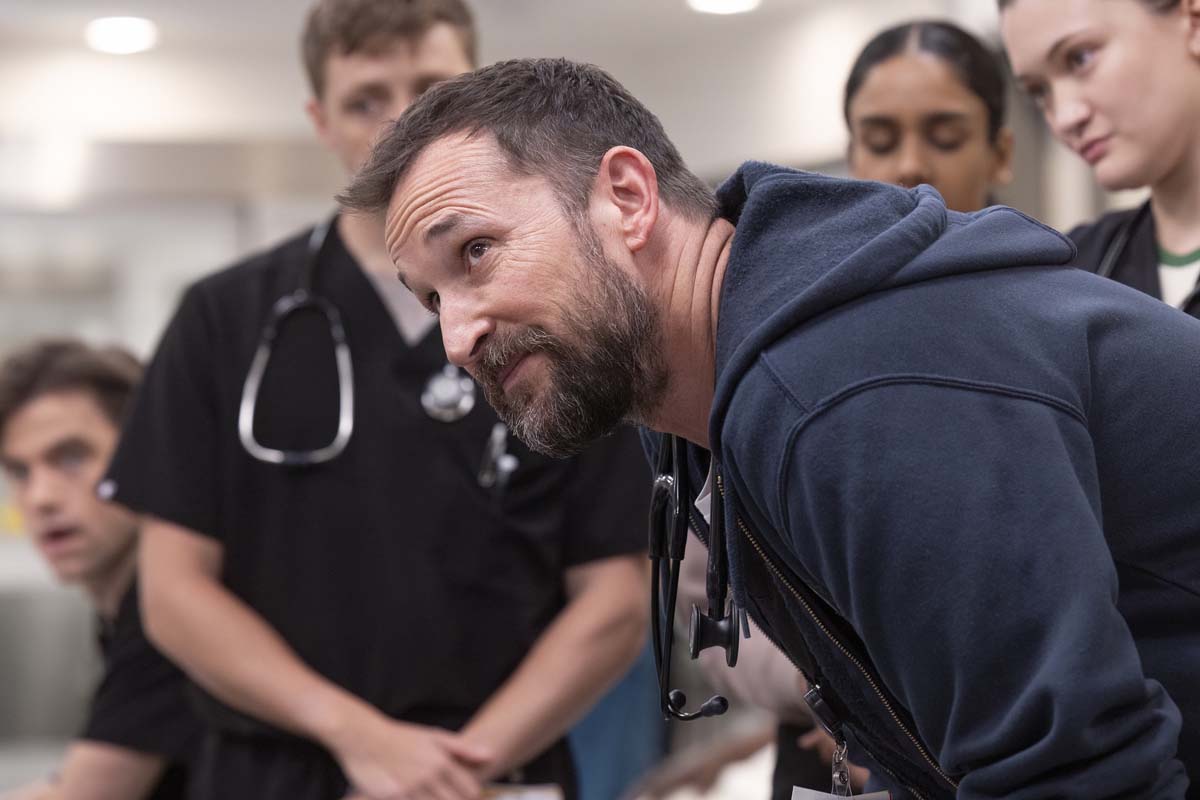
Do you have any multicam?
Yeah, we do, but the most important thing, as you know, for any multicam shoot is your A camera is your A shot. Do not mess with that. Make that your A shot so you can throw B if it’s not going to bastardize A because you have a primary shot and it’s doing something specific, so you need it to be doing it specifically.
Certainly in traumas we have two cameras. We’ll be up on both sides. We’ll be behind a patient’s head going both ways or down and over just to get the coverage for practical purposes. As you’re going through the space, that will generally be our A camera getting it.
Then the B camera will be just grabbing, grabbing, grabbing, grabbing. The style of our show is not using B camera footage.
In the mass casualties we had three cameras. Oftentimes you would have two cameras on the initial action, then the doctor would move to the next space and that third camera would be there to receive them in that third space, then we would transition.
Amanda Marsalis directed it, and she did an incredible job, making sure we had the connection as we moved around the room and through the spaces.
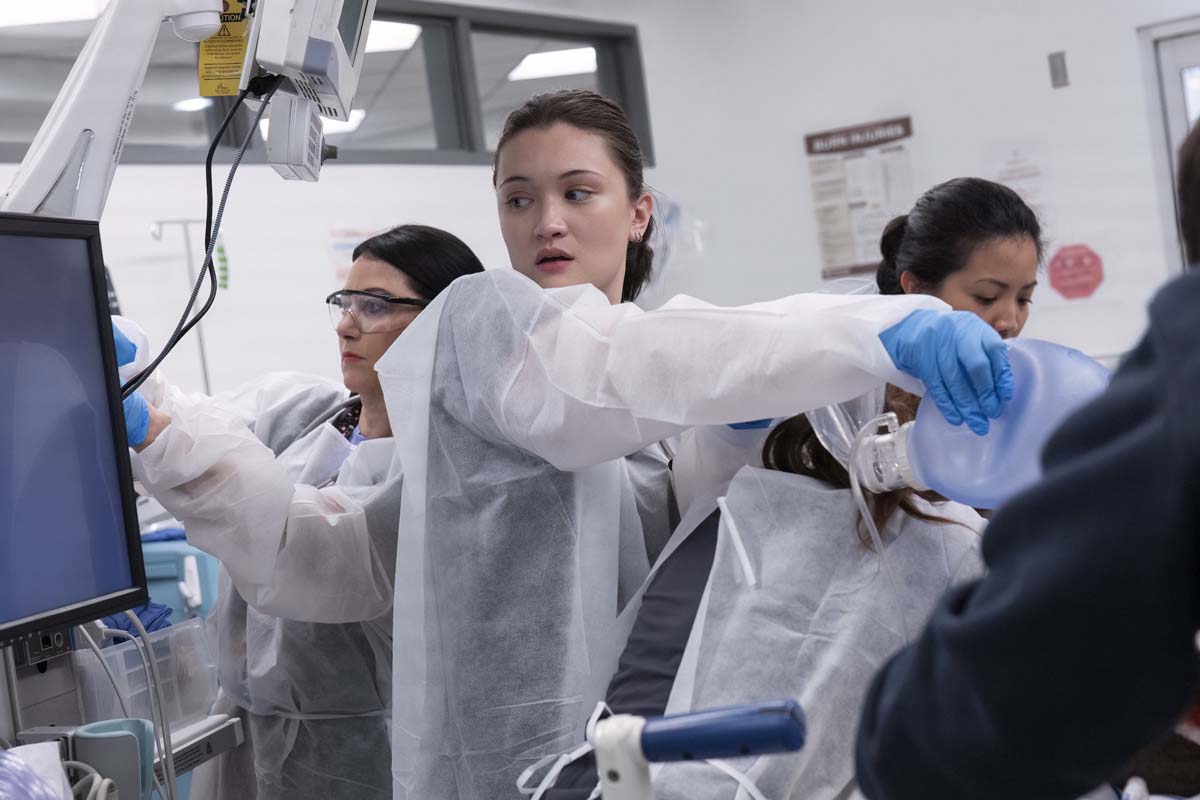
It sounds so complex for the directors.
It’s a real ballet. It’s the directors, it’s the assistant directors, it’s the actors, it’s everybody. Then you have all the other inner workings of a regular show. How do you play comedy? How do you play drama? How do you just tell the specificity of a story? All of those things.
Is there anything different about the dailies themselves - the coverage or how you have to organize it?
As you pointed out, each show feels like it’s one long scene.
Someone was asking me that the other day, “How do you even do a continuity?” I was telling them how important having a continuity is.
As an editor, your assistants generally create a continuity, but making sure you understand exactly why every scene is in the show is so important. When I was starting out cutting I used to do my own continuity just so I knew.
I understood what every single scene was about, so those building blocks were so cemented in my mind that by the time I was looking at footage I knew what I needed to look for, and I could really identify what the pieces were.
It’s such a compliment for us to hear that it all feels like one scene. You still have to shoot it in chunks and you have to break them down into digestible chunks that the actors can be prepared to perform. Oftentimes you will get scene 1 and 2 or 3 all in one bin.
Then my assistant, Emily, will put a note in there that says, “The last part of scene 3 is repeated at the beginning of scene 4 dailies.”
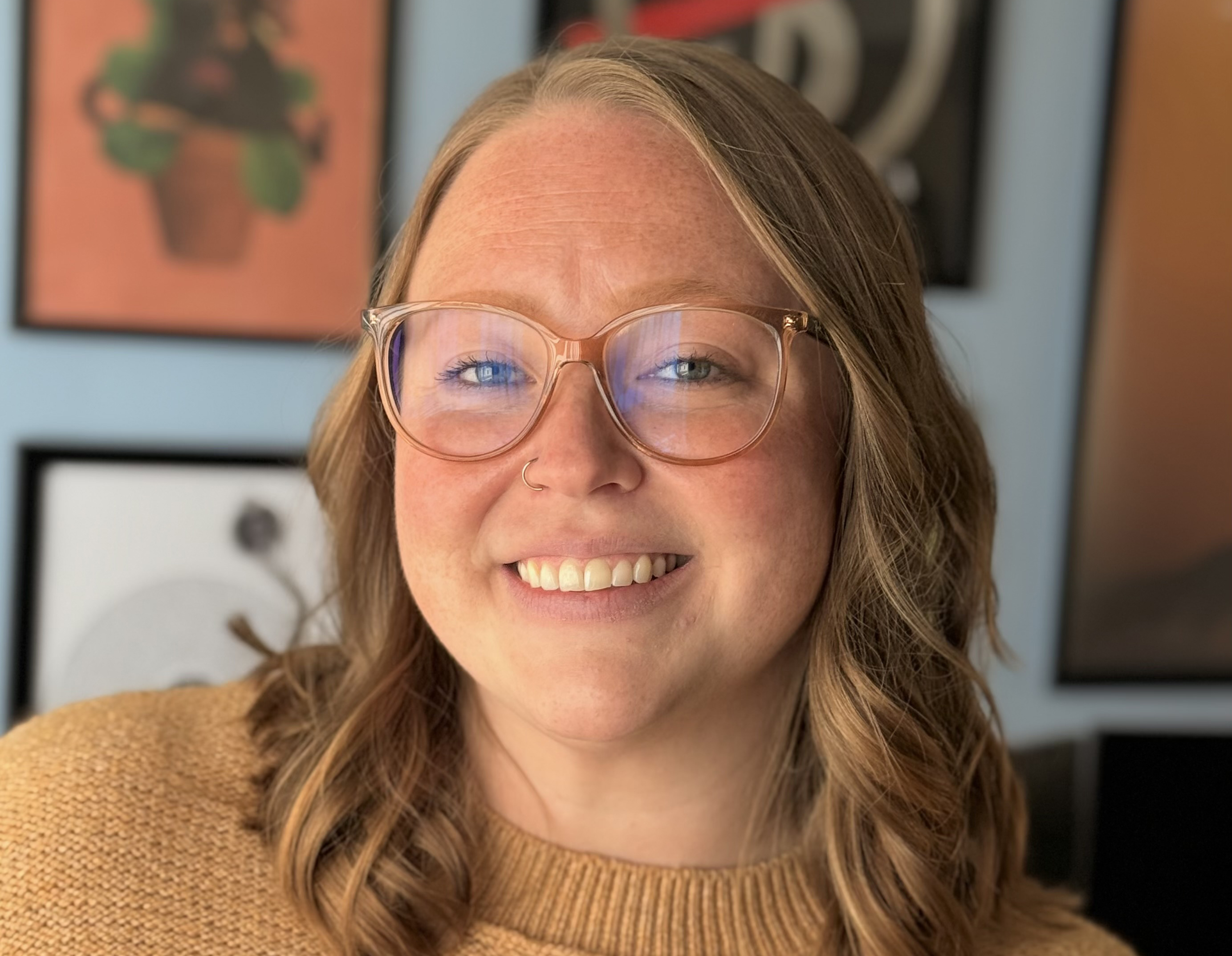
Assistant Editor Emily Merriman
Let’s give Emily a full shout out!
Emily Merriman. She’s phenomenal. She has been such a lifesaver to me because she’s so well organized. Her sound work really helps me.
As you transitioned into the pilot, you come into that first “Chairs” - which is the waiting area - so that has to have an energy and a sound environment that is so crazy because they are so busy.
So that was part of it. It was having the natural sounds of the city. Then you come into down into this downstairs and it’s going to be so cacophonous, then you enter into triage, which is that first section of the ER before you get back to the main area, and that has to have a sound that’s more active.
It’s not traumas and stuff. It’s just triaging people, but there’s more talking and communication: trying to work out what people have. Then you move back into the latter part, which is more bits and bobs and boops and phones, then the activity of the whole place.
I don’t know if you’ve noticed, but every once in a while you’ll see Doctor Robbie or other doctors look over their shoulder because of the activity in the space is alive, so putting sounds back there so that that stuff is validated within their performance.
Like, “What are you listening to, buddy? What do you hear over there?” so Emily’s got to come up with what it is. She was really instrumental in creating the initial sound pass as we were trying to sell the concept of what “Chairs” was, how active it was, what triage is, then what the general ER space sounds like. That was the first time we worked together. I’d give a note or a direction and she just embraced it, so she’s been phenomenal.
And you need that sound design because it’s also affecting pace, isn’t it?
Absolutely. Any editor will tell you that. Anytime there’s a drop out - especially in a show like this – of sound… so we’ll add in a gurney rattle or an IV clinking or the phone ringing or whatever it is, but basically every moment is filling those spaces with sound so that the world exists around us, but it can’t competeю
So it’s only in those quieter moments or in those movement moments that you can allow it to come in so that it feels like it’s always there.
Anything that you’re the proudest of or that’s the trickiest thing to get right in this show.
The emotion. It’s sort of the stamp of the show - or the theoretical idea of the stamp of the show - is that pace and feel and move. But that only works if the emotion is there.
These are people who care so much about their patients, but they’re also somewhat detached.
If it were Gray’s Anatomy, they would be having those moments in the room as the patient’s having them. When you’re with the patient or when you’re with the doctors, we can witness it from our doctor’s point of view, then climb into the emotion of the patients so that we can be witnessing it a little more intimately than, say, just over our doctor’s shoulder, because we want to feel it in the same way that that doctor would feel it.
But it doesn’t need to be embodied in that character until they’re in another space - maybe with another doctor in a place that’s appropriate for them to have those emotions.
These characters are bottling it, bottling it, bottling it, being professional, not allowing their own baggage to get in the way of the diagnostic job that they’re doing. The writers are so good at finding that balance.
Do you have to worry about hitting a specific length? Are there scenes or storylines that are getting excised, or is it just trimming scenes?
We don’t have a TRT that we’re trying to hit. Episode 112 is 40 minutes long. Fast. Go. That’s right for that story. Episode 101 might be 51 minutes long. For the season two finale, my first cut was 70 minutes.
It will air around 50 minutes because people’s body clocks have watched so much television, you’re kind of ready for the show to end around 48, 49 minutes.
It just happens. There are very specific stories that you can tell at a different length because of their engagement, but fundamentally, if it is an episode of television, it’s going to be around 48 minutes long, so our shows are generally around 50 minutes long.
When someone says the time of death, we are close to that minute in the episode, but not meticulous about that. If they say “Time of death 9:12, that doesn’t necessarily happen 12 minutes into that episode, but it’ll be “ish.”
In my initial interview with Noah Wyle and Scott, Noah pointed out that one of the inspirations for the show was the film Zone of Interest, which takes place outside of a concentration camp.
The time/space is continuous. You’ll be over here with this conversation while another conversation’s happening in the background. That was a driving force.
So while this show and that film were very different in many, many, many ways, it’s more about the time and that we can be over here and having this conversation while we can witness the continued activity - the traumas are next door to each other.
I don’t know if you remember in the pilot there’s a character who has the de-gloved foot, and then there’s
the guy who saved her, and he had a head trauma.
So we are moving in the foot trauma, then Noah can walk into the other trauma and we can leave the first one, go to the second one, but still have a visual connectivity to that first one, even though we are now experiencing the second one and then move back.
So not only is it the camerawork and not only is it the performance work, but it’s also how the space works - how that was designed in order to maintain that drama.
So that’s a slightly under-discussed piece of editing, which is how are the spaces connected so that you connect the story ideas. That is a hugely helpful part of the design of this show.
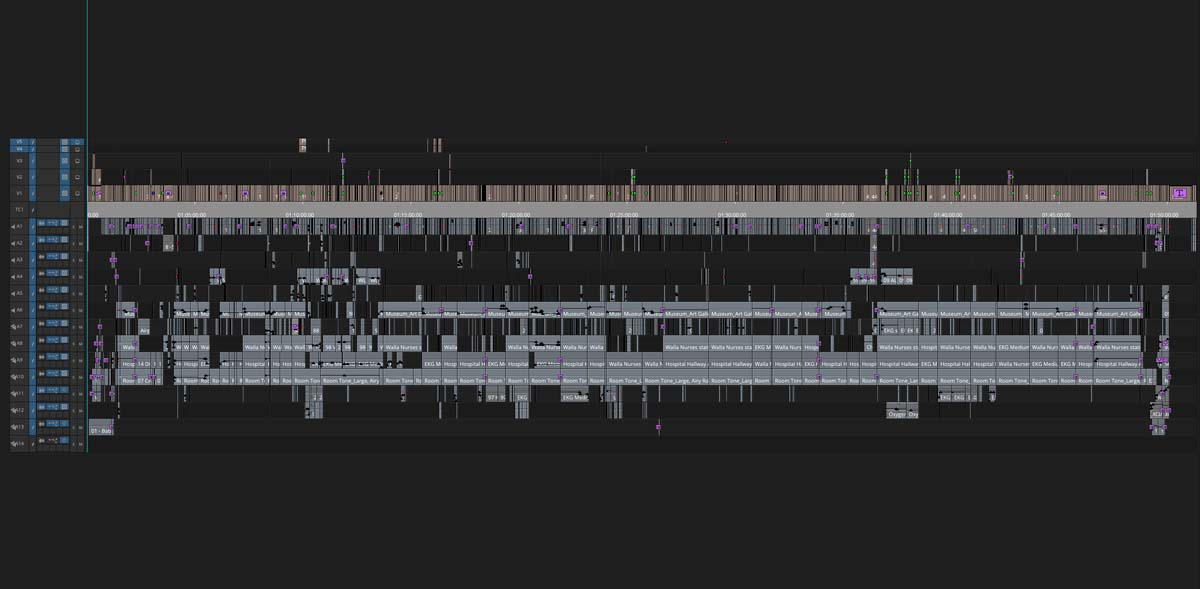
Avid timeline for The Pitt, pilot
Do you feel as an editor that you need to understand that geography, when the audience really doesn’t?
Yeah, I think you have to respect every piece with the understanding that if you’re going to subvert it, you’re doing it for a reason. Because the actors understand the space, that’s meaningful to them.
When they move, I need to know where they are because I need to know “What’s the travel time? Are we going to stay with them? Are we not going to stay with them? Am I going to take 2 or 3 steps out?” I do that sort of stuff.
It needs to feel continuous. It doesn’t have to need to be continuous. It’s not a slavish adherence to it, but you do need to understand it, even if it isn’t important to the experience of watching it all.
It’s so important to stay with what we are talking about, then something can interrupt it and you can then pan over to it.
Especially in these overlapping dialogue scenes that we were talking about, the camera operators - in an effort to help - sometimes are anticipating where they need to be.
Some of that - as they go through those takes - is to is not get the lines on camera. It’s actually to wait for the lines to start and then find them. It is in response to the behavior, not anticipating it.
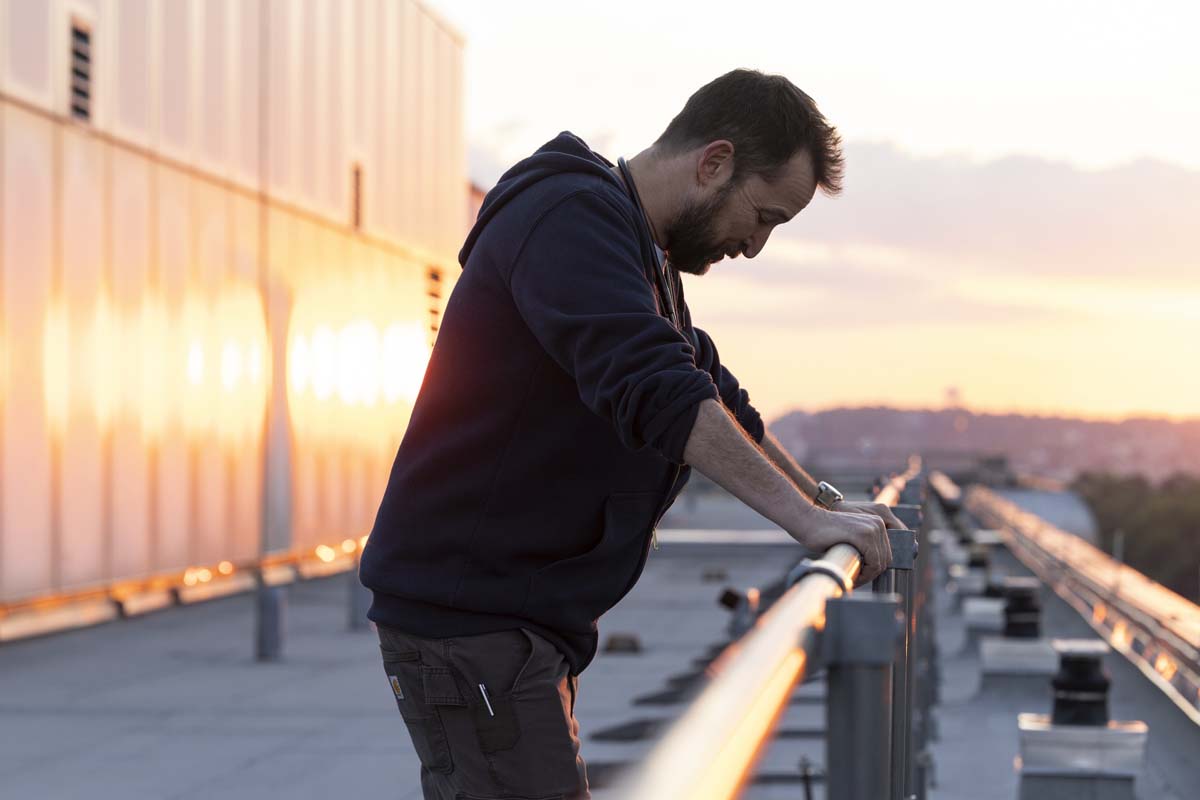
What happens in The Pitt - a lot will be: will this wide shot become a medium shot and then a tight shot and then a medium shot? Great! You are not the tight for everything. Let’s be fluid.
Let’s let the edits happen in camera, which means you need to be listening in camera for where the edits would be. You don’t need to anticipate them. Create them.
The less I can cut because it is cut in camera, the more the feeling of the show exists. Let’s say we start with our wider angle lens as we move through the space.
Maybe they’ll do nine takes in that first set up, as everyone’s working out their blocking and geography and getting into their rhythms.
The operators are also getting into their rhythms so that they can find where everyone is, and we can be dipping down appropriately, not having to cut into an insert, and we can be moving over to our characters so I don’t have to cut back. I can get a profile of that, and then we can slide back into the over on this piece. That’s fantastic.
Then when that has been worked out, if we just swap the lens to a tighter lens and do the same behavior, we’re not reinventing it for the new lens.
We do the same behavior within that longer lens. Then there will be cut points. Everyone now is in motion and knows what they’re doing.
Then you’re flipping and once you’ve turned around and you’re now doing that wide shot, you know what your complementary pieces are.
You’re playing that dance on the left foot instead of the right foot. Then you swap the lens and do the same. So you’ll get the push, you’ll get the pull, you’ll get the dip, you’ll get the pan. Then it’ll all hopefully connect seamlessly.
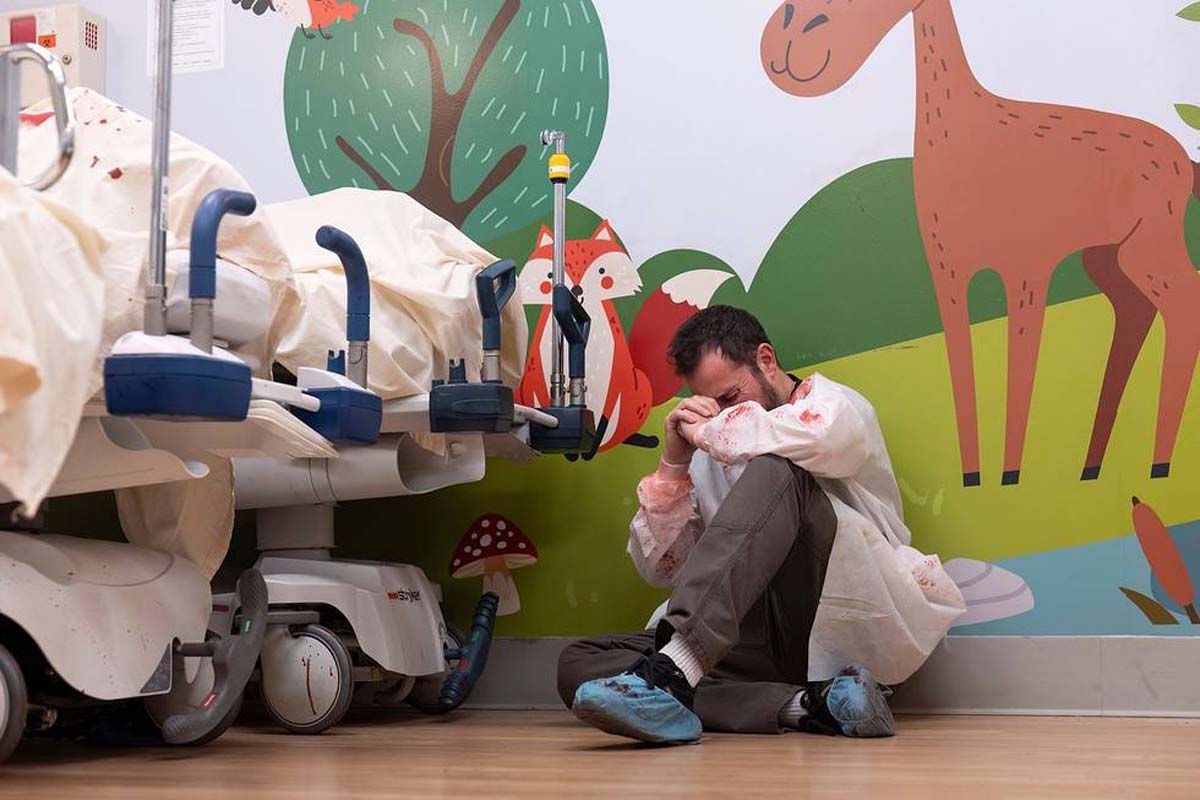
For a new editor I want to talk about determining when to be in a certain coverage choice. One of my examples is in scene 112, after Noah’s character is told about a miscarriage, you cut to a profile shot of him - which starts out as kind of an unusual shot - but then he turns into the camera.
As an editor, I’d be looking at that profile shot in dailies, thinking, “I don’t think I’m ever going to use this profile shot. I don’t love it.” But then you watch him turn into the camera and as the editor you realize that that’s the moment in the scene that the shot is designed for.
Everything you’re doing is trying to identify what is the most impactful moment to cut to something. It’s exactly what you’re asking, which is: when is it the appropriate shot for that moment?
This is new information to Robby, and Robby wants to hide from that character what his initial thoughts are of that, but he will turn to face this new piece of information and address it straight on.
It’s very important to him, so the closer we are to it - that’s a very standard thing, right? You want to be close for the emotion. You want to be able to see it.
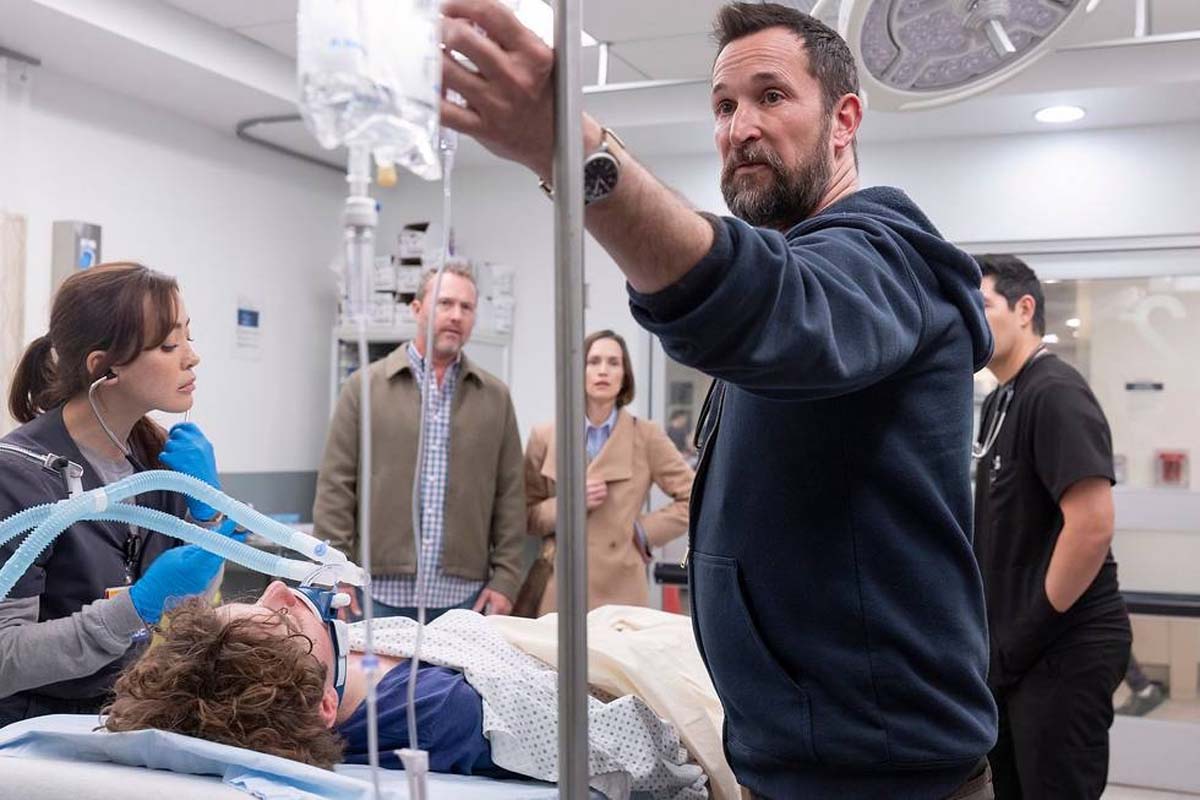
Everything is story-based, right? So it’s, “Okay, I want more information from him. I want something out of this.”
And it is provided to you in the shot. That’s incredibly satisfying. So his movement creates the edit in a sense. “I want to see what Robby is feeling. I’m not getting it.
Oh, here it is.” It’s that subversion or understanding the expectation and providing it when it’s right story-wise and when it’s satisfying.
So when you’re finding any of these pieces that you’re using, the most basic thing is that you want to be in the tightest shot possible that gives you all the information. So you don’t need to be on an extra wide for certain things because there’s all sorts of superfluous information.
So if that’s important - let’s say in episode 112 when we have all the patients coming in and it is important to know how many people there are or when we’re in on this intubation, and then we’ve been over here cutting open the collarbone, now all of a sudden, we reveal: “Remember all those other people? Look, they’re all here, and it’s all happening at once.” So when you reveal that information. So it’s all a question of expectation of information, and when it’s the right time to do it.
Thank you so much for chatting with me about this. Good luck at the Eddies
Thank you. I really appreciate you taking the time to talk to me.
 March 26, 2026
Young Sherlock
Today on Art of the Cut, we speak with four of the editors on the buzzy new Amazon Prime series, Young Sherlock. With us are ...
Read more January 28, 2026
Train Dreams
Parker was the 2025 Winner of the Jonathan Oppenheim Editing for the documentary André Is an Idiot. He has also been nominated for 2 Emmys ...
Read more November 26, 2025
The Running Man
Today we’re speaking with Oscar-nominated, Australian-born editor, Paul Machliss, ACE. We’ll be talking about his latest collaboration with director Edgar Wright on The Running Man.
Read more