


The American Revolution
Emmy-nominated editor Tricia Reidy, ACE, discusses how the theme of Ken Burns’ The American Revolution shaped the structure, the role of subtext in the opening shot, and the impact of the many celebrity voice-over actors on the film’s pacing and even its music.


Today on Art of the Cut we speak with multi-Emmy nominated editor Tricia Reidy, ACE about editing Ken Burns’ documentary series, The American Revolution.
Tricia has edited for Ken Burns and Florentine Films since college, including the documentary series The Civil War, which she edited with Paul Barnes and Bruce Shaw; Frank Lloyd Wright (Emmy-nominated for editing); and The War (Emmy-nominated). Others include Vietnam, The Roosevelts, and Muhammad Ali. Emmy-nominated
The American Revolution was also edited by Maya Mumma, ACE, and Craig Mellish, ACE. Maya was not included in this interview, but has been featured on Art of the Cut in the past. There are several mentions of editor Craig Mellish, in the interview. He is another Florentine Films editor and has been on Art of the Cut in the past.
Tricia, it’s so nice to meet you. I’ve watched some of The American Revolution, and it’s just lovely. It’s gorgeous.
I’m so glad to finally meet you and to be here. Thank you.
Let’s get started with a place where I normally start documentary interviews, which is why did it start it where it did? Why start it with the image that it does? Why start it with the quote that it does? There’s a Thomas Paine quote and a very interesting image that you can’t really tell what you’re looking at.
The first 10 minutes of the first episode
Yes. Like many films, not just documentaries, the beginnings and the endings are the trickiest part. The opening of The American Revolution went through several different structural changes.
The Thomas Paine quote was much later. In fact, I think in the first draft that we started working with, the film actually started with George Washington and the French and Indian War, which is now the first scene in the film after the title.
So it went through a lot of changes and the most drastic changes in the opening came after we had assembled at least the first 3 or 4 shows - so that we knew how to calibrate what episode one needed to speak to more directly.
Among those things was the idea of unity. We’re setting up so many things in episode one. I don’t think Episode One is really a representation of the rest of the shows.
It is its own kind of sui generis. (“Being the only example of its kind; unique.”) This is are the events leading up to the American Revolution.
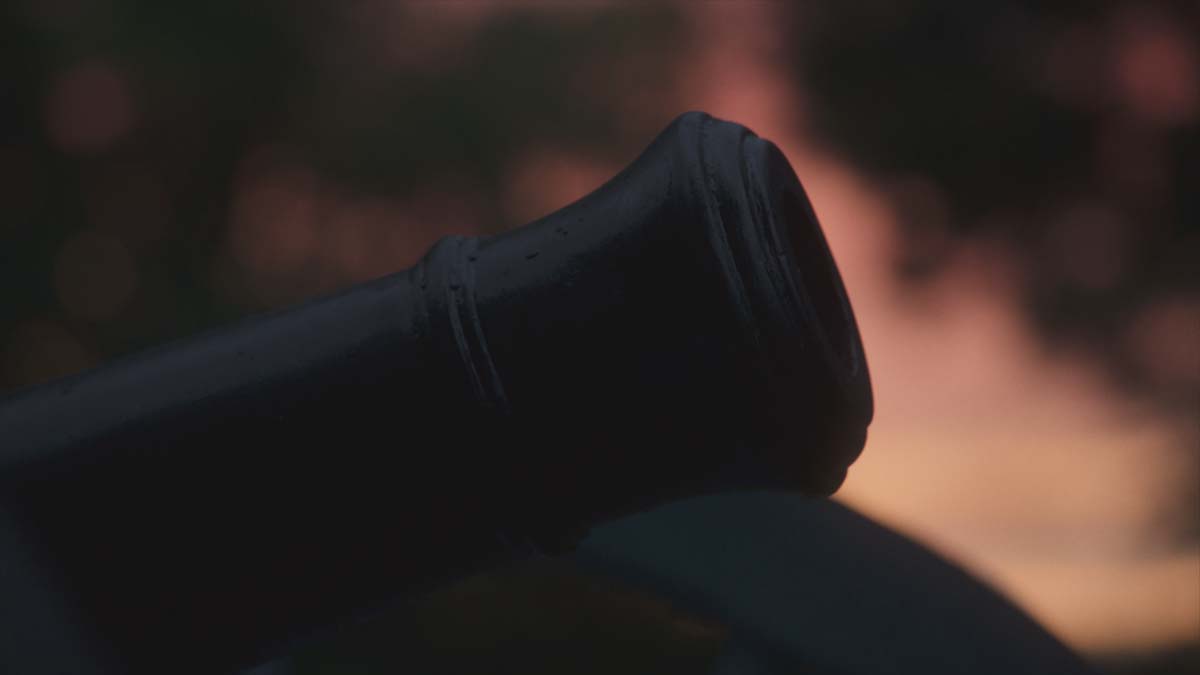
Opening image
The first image over that Paine quote - that Paine quote is really complicated - as are many of the first person quotes. It’s a different kind of language style. You don’t know where you are exactly.
[Director] Ken [Burns]’s sense was that the image had to be mysterious but by the end I think we understand it’s a canon and we are in a war, and that’s what we wanted to bring home with the opening. Ken really want[ed] the music to be mysterious.
The hope is that an audience is going to lean in: “I don’t exactly know what’s happening, but I’m going to stay with you.” We’ll see if that works.
Let’s talk about how much sound effects you add during the picture cut early on, and what’s the evolution of that as you go through the process?
The edit goes through a number of passes. Our first pass is a blind assembly where we’re just listening to the narration, which is read by Ken, and pretty much every talking head that talks on a subject is put in so that we can do some comparison and decide who says it better, and should we intercut these historians? Does it need more of a setup?
Then it’s rewritten, so when we actually start putting pictures in, we kind of jump right in and do some very rudimentary sound effects, if required. In the case of episode one, Lexington and Concord needs a little bit of a rumble in there to get the sense that there’s a battle going on to really sell some of these images, so I will put them in.
I think we are unusual because we put music in our first assembly. I think that’s unusual for many documentary filmmakers. Then as we get our feet on the ground, those things fill out.
I’m not a big fan of cutting [sound] effects, so I will often ask someone else on my team to do it -
either the assistant or we had a very talented apprentice.
I would ask, “Colin, I have this beautiful live sequence, but you’ve really got to sell it with some sound effects,” so that would be someone else’s job. It really is transformed by our an amazing sound editing team.
When we finally get into the mix, it’s just a whole different world when they get their hands on it and can do that. They’re just so much more talented than we are when it comes to all the effects. So that’s a huge step up when we finally get to the mix.
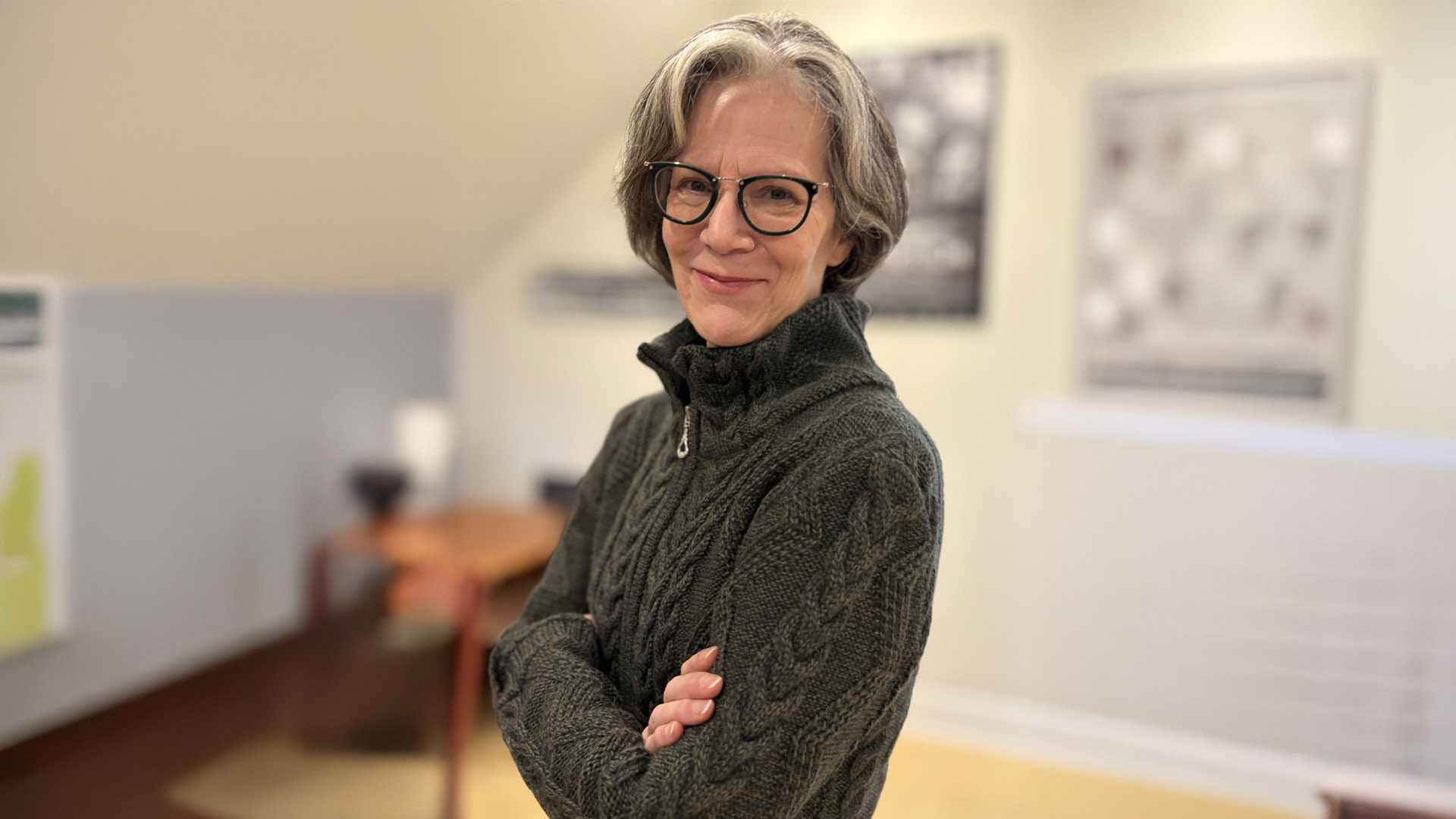
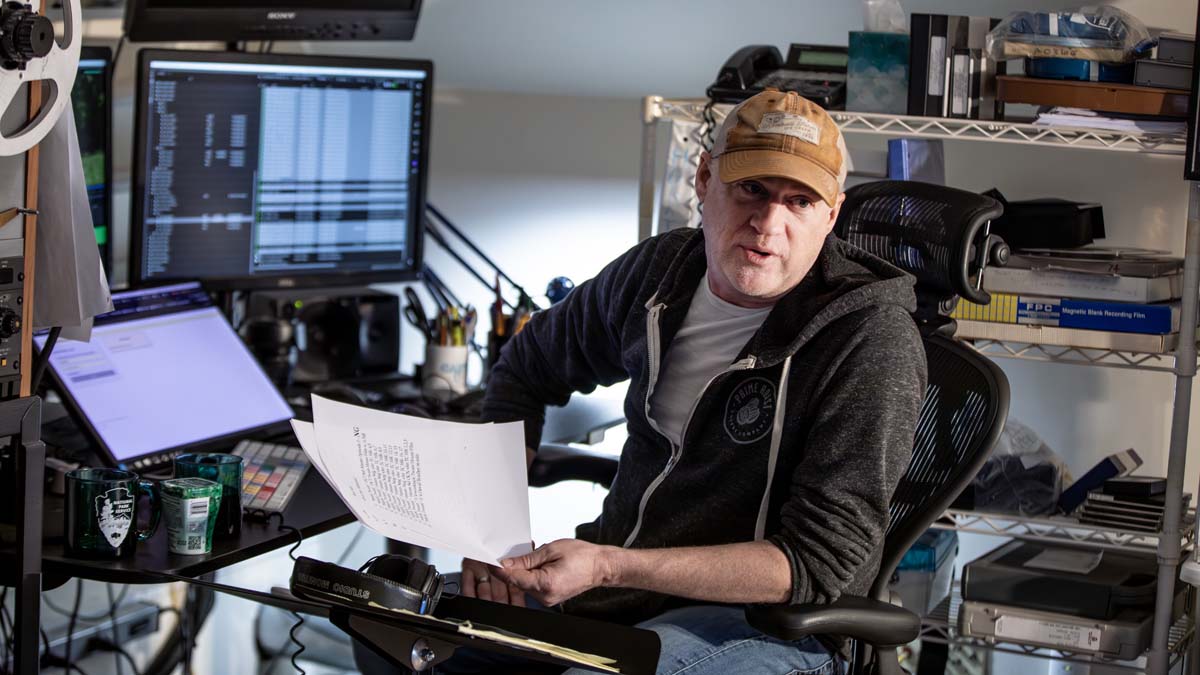
Editor Tricia Reidy, ACE
There’s a montage of re-creation footage that look like it’s from 1776: men walking with rifles at sun-up and women washing bloody clothes in a river. It’s just underscored with music and sound design. There’s no voice for a while. How long do you let the viewer sit with the image they’re presented with? Talk about being patient and not jumping straight in with voice over.
My first pass at the opening was structurally a little different, but it was all Rhiannon Gidden’s music. It was real fast. It went right to the narration and some of the talking heads. After we saw a few of the shows assembled, Ken’s biggest note was that - for him - it lacked emotion, so we made a very big music change there because that’s where that was going to come from. He suggested, “Let’s get some breathing room in here.”
It’s going to be the last time in episode one that you’re going to get a breath, so let’s just give it to them there.He even referenced the opening of The Civil War, which I thought was interesting because there is a long montage of stills in The Civil War, which is has a whole subtext.
I think those Civil War images were very new to most of the American public of the destroyed South, so they were very arresting. The other thing that came out of the first assembly is that this is a war.
It’s the American Revolution, and most people sort of think of it more as the Declaration of Independence and the signing and the Constitution, but the idea of battle after battle and the violence is something that might be new to people.
So putting this montage together, you wanted, to shot that it’s bloody with the cleaning of the laundry of the women.
I can’t really cut a montage until I know what it’s about, and for me, that was about: we are going to war here. The music is really telling me: “Someone’s going to have to start talking about this war now.”
Now that we’ve cycled through the montage part of it and this opening music part of it, it just felt like a natural time to bring in the voice of John Adams to tell you, “We’re in a war now.”
It’s also interesting because the war itself doesn’t start for a while in the documentary, so you’re kind of giving a little taste of it up front.
Right. That was the other big change in the opening. You need to really think of it as a visual table setting, so we want to see a map because we’re going to have a lot of maps. And I want to see some of our stylized reenactments.
And let’s put in a drone. Let’s see what you’re going to see, because the rest of episode one - until you get to Lexington and Concord - those things are not really a part of the visual landscape because episode one is kind of a different animal than the entire rest of the series.
There’s a section where you’re kind of describing that The Revolutionary War was also a civil war. Visually, that section used paintings. Sometimes you dipped to black between them, but sometimes you cut. What is guiding you when you decide, “I’m going to dip here.” or “I can just cut.”
The dips are very unusual. The material is guiding those decisions. The producers have me cutting the beginning and end. It’s easier to get the whole arc if the same person is doing those things. I first used dips to black at the very end of the series.
I used that technique because I want it to feel very different than everything else. We are zooming through time at that point. It’s a Thomas Jefferson quote, and he’s talking about what the future of this Democratic idea is going to be in the world.
Then we show images that span to basically 1970, so I wanted it to feel visually different than anything else. It was going to be the first time you saw three black and white stills together in the whole series, so I can kind of retrofitted that back to the opening.
It’s the idea that this is going to be a very bloody war. I thought it was a good idea that it does make it feel much different than anything else in that opening. Hopefully it grabs the attention and makes people understand what Abigail Adams is talking about. You should remember this idea because it’s going to be presented throughout the film.
I didn’t realize how much mob violence there was. Mobs in America have been destroying property and vandalizing things since the Revolutionary War.
We all have hope that that will be surprising to many viewers, actually. All of the Florentine films brings to my mind more modern things that this history is pointing to.
The other revelation to me was the idea that democracy as a concept was looked down upon. They thought the monarchy is the way to go. If you let the stupid stupid, common people try to run things, they’re going to screw it up.
Democracy was not looked at the way it is now. It’s an aristocratic thing. Only the aristocrats can run a country!
Talk to me about pre-lapping in the interviews. The first couple times in this first episode when we hear an expert on camera, we don’t see them immediately. What’s the value of that pre-lap?
It tends to be a very graceful way in. Sometimes, when I just pop somebody on, I’m taken aback when I’m coming out of - in this case - a painting. Sometimes it’s a little bit too jarring and just having some bit of a lead-in helps ease us into that talking head.
Plus the talking heads are edited and that might be the cleanest talking I can get on camera. The first part is very often cut out, and the last part is very often cut up. So we try to work around what would be the most graceful time to have them on camera.
You’re looking at the previous scene and the voice comes in and the image that’s accompanying that voice is really telling you something more than the voice would alone - than just looking at the person’s face.
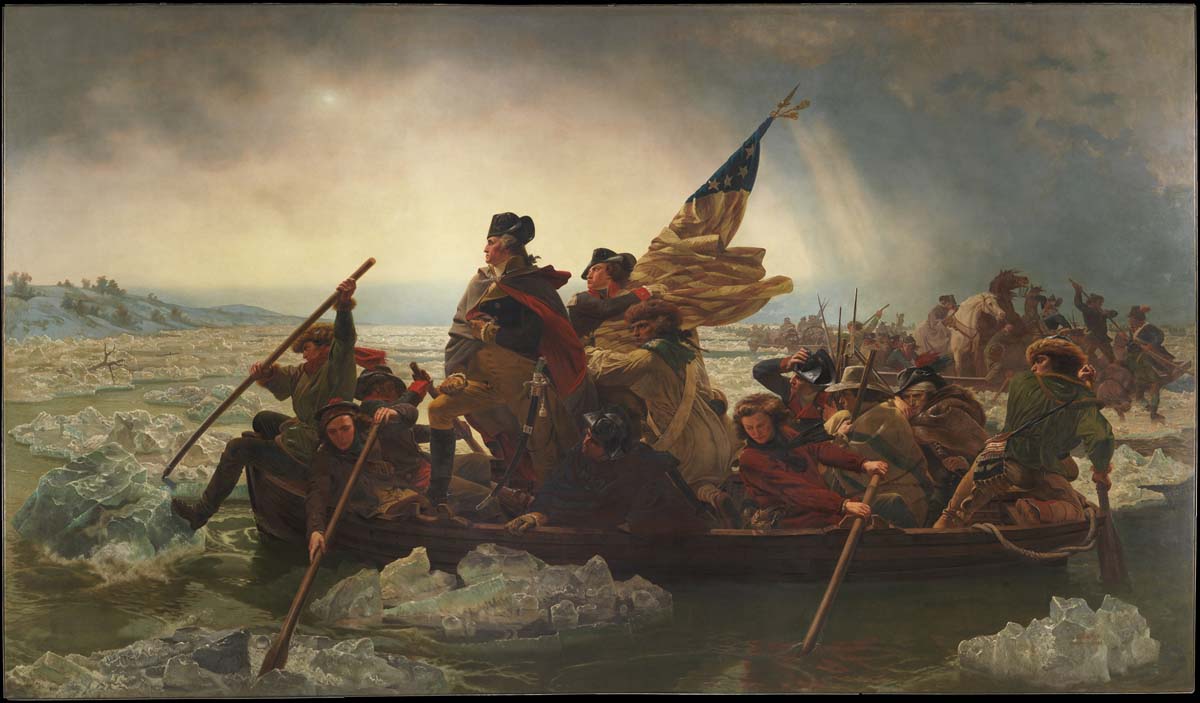
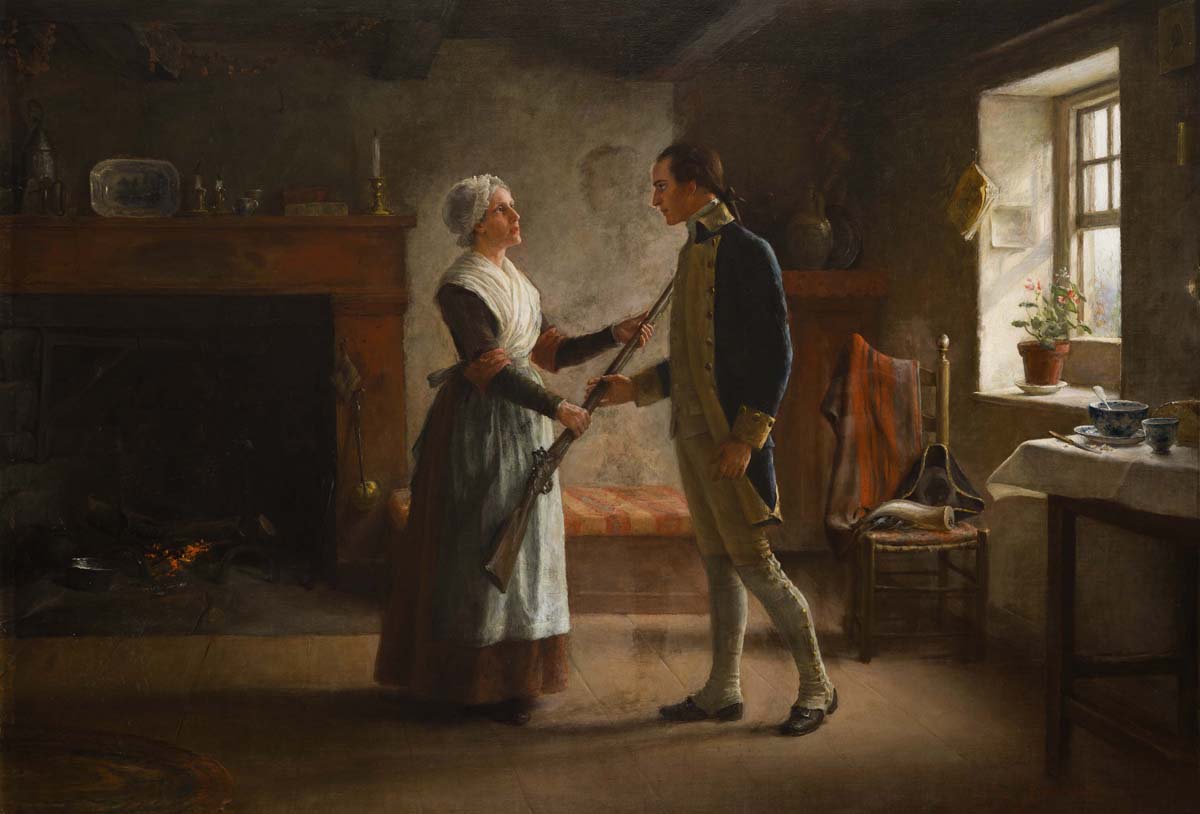
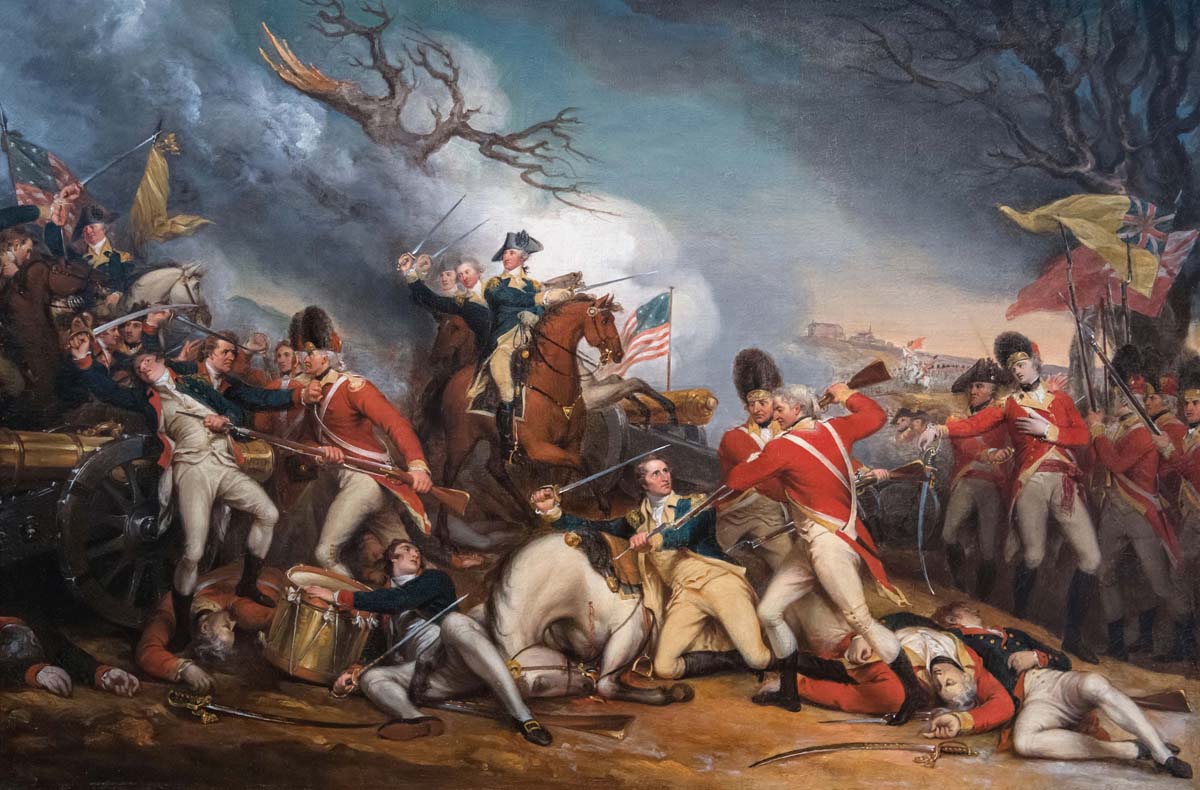
I have long loved the “Washington Crosses the Delaware” painting. To me it’s one of the most famous Revolutionary War paintings. When do you decide. “Oh, everybody knows this painting. Where are we going to put it?”
That’s exactly why it’s there! Because it’s among the most famous paintings. It’s a beautiful talking head by Maya Jasanoff. She even smiles when she’s on camera, which is kind of unusual for her.
And she says, “We all think we know about the revolution and these people and we put so much on them that it’s more than a person could possibly carry.”
As we cut to the painting, she says that our beliefs and feelings about this period are unreal and detached from reality. it’s a very famous painting. George Washington is so heroic.
She goes on to say, “This is not exactly how it’s going to be.” George Washington is very important. He’s not a flawless individual. He’s not a pure hero. From beginning to end he’s crucial to the American Revolution. But a pure hero? Not exactly. So, I have hope that it works in that way.
Talk about intercutting types of footage. You have re-creations. You’ve got paintings. You’ve got documents. Usually you’re not using them as “see and say,” so how are you deciding where to put a re-creation that clearly was not shot for a specific moment?
We try not to be “see dog, say dog” or “see and say.” It’s always a calibration of what needs to be concrete to make people understand and then what we can allow to sort of to speak to the subtext of what’s going on in the scene. That’s always the calibration.
And honestly - in this film - it’s like, “What do I have to cover this?” There’s really a lot! Because it’s 12 hours with no archival, no photos. The show is very, very hard. So some of those decisions are, “Gosh, we’re going to have to see a map here because I don’t understand this battle.
So give me a map to make me understand this paragraph of narration.” Is it making sense? Is it emotional? How do we have it make sense?
So the images are really a question of whether the information is subtextual or is it something you need to like really think about? I’m going to give you something really obvious that will explain the information to you. Every scene is a little bit different. Often, quotes lend themselves to a different interpretation visually.
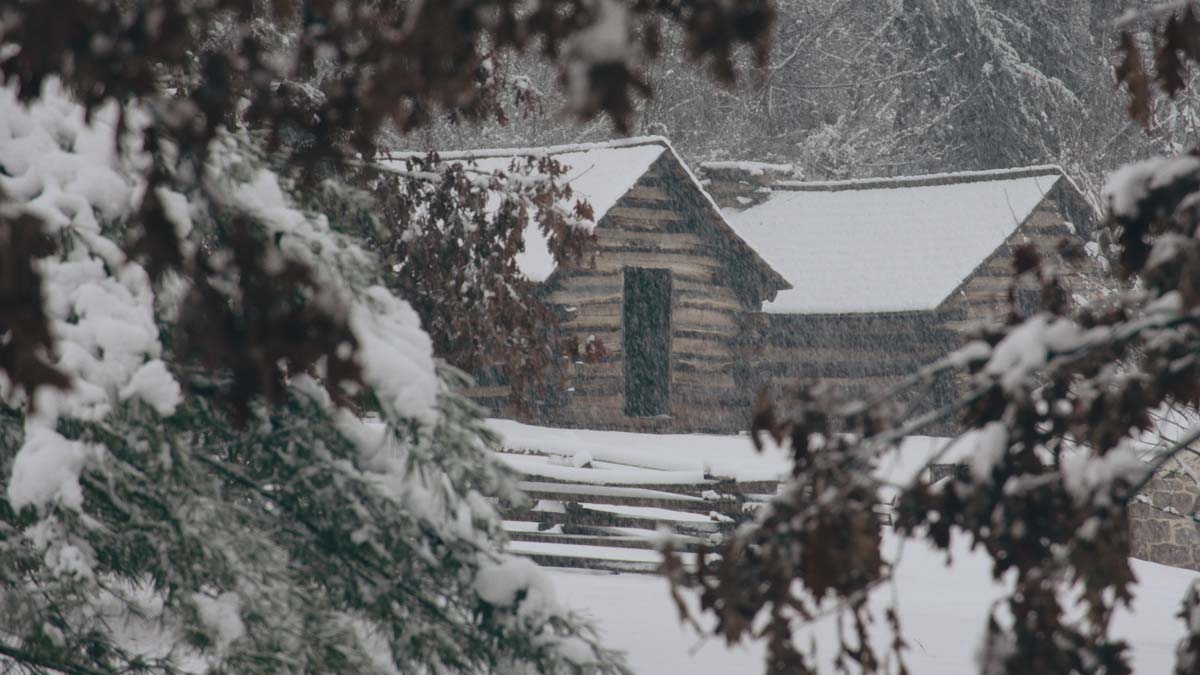
You mentioned the mob violence. We don’t have a lot of images of that. A tar and feathering scene happens in the winter. We’ve just seen a couple of that that exist, so you then have the ability to just hold for a bit and see the detail of a dripping icicle on his home as he’s recuperating for six weeks from being tarred and feathered. Some of those re-creation details naturally fit into the subtext of the story.
Can you talk about subtext and how you’re trying to speak to subtext and help subtext?
That’s a great question. Oftentimes for me, I like to use a slightly different piece of music that’s going to be teasing out a different emotion than what the text is saying. Sometimes they’re marching along and you just have some marching music, but an example of that with music is the first shot in Episode 1 has some very spooky music.
It’s not a particularly spooky quote, but we were trying to say that Thomas Paine is talking about what’s going to be a war. If you were just to read the quote, it might not give you that sense that it’s a dire situation, but the subtext of what we’re doing there is to point you in a slightly different direction with some of the effects and with some of the music.
Another example: there’s a total eclipse during the during the Revolutionary War. It’s in Episode 5. They’re marching towards the Battle of Monmouth. It’s a moment not quite out of time, but it is a little bit. We sort of go all over the country.
We use the harp and have this little magical moment that is a non war. It’s almost a sense of unity of the country because they’re all looking up at this total eclipse.
So if you were just to read it, you might not get it from the text, but we sort of infused it with a slightly more magical feeling, like this is going to be a moment of unity in this country. It often comes with the imagery, but also often with the music choice.
Let’s talk about choosing when to go to people on camera. This series has a lot of experts discussing information, so there’s not a lot of emotion in the in the expert commentary. The emotion is usually what drives me to use the on-camera moments, but here, you don’t really have that, so when are you going on-camera with an interview?
Often, it’s just where there’s a clean place where they speaks for 20 seconds straight. I have hope that whatever expression they’re bringing to it will be at least the equivalent of an emotional thing.
I have hope that whenever we choose to cut when we take them off camera I have an image that’s really going to speak to what they’re saying. Not necessarily to illustrate it, but at least give it another dimension besides what the words are saying.
You have to be on- camera at some point so we don’t get confused about who’s talking, but you’re right. They’re not generally particularly emotional, so where can we add a really appropriate image to what they’re saying to make it a stronger scene?
There are places where we could conceivably leave experts on camera but I would hope that adding the image is really going to help people understand or feel or get some other larger sense of what’s going on.
But what’s the opposite argument? Is it cutting to them when you feel that what they’re saying is something that the audience really needs to latch on carry through the rest of the story? Oftentimes, in fiction editing, many editors have said, that they make sure that if somebody says something that you need to understand and carry through the rest of the movie, they’re going to use the speaker on camera, as opposed to using a reaction shot. That helps the audience absorb it.
I absolutely agree with that. They have to be on camera for some of those key moments. I think it’s true in documentary as well.
As you discuss Samuel Adams - which happens a lot through this first episode - there’s a re-creation still image of paper and ink, and that gets overlaid with some text that animates on, and there’s re-creation footage of a printing press in operation. Does the editor have anything to do with requesting those elements? Or do you just discover them in dailies? How does that work?
I think I requested them. One of our our other editors, Craig Mellish, actually shot the pile of newspapers. I think the Sam Adams part was difficult to understand before we had the images.
I was trying to find a way to explain to the audience that Sam Adams was kind of the first propagandist. He’s the first one who’s really writing in the newspaper.
He’s not even using his own name sometimes. He’s really out to rile people up against this taxation situation, so to get the sense that he’s to he wrote a lot, I wanted people to see some of his outlandish words.
We did a lot of work with newspapers on America and the Holocaust, because it was important for us to understand what the American people knew and didn’t know about the Holocaust, so we worked with a lot of newspapers to visualize it.
The revolutionary newspapers are printed in this horrible, tiny, illegible type. You can’t get anything from those newspapers, so I thought, “Okay, how are we going to make this clear?” We tried a couple different things. We have a brilliant graphics designer in house in Walpole, New Hampshire, Brian Lee.
So I’d tell him, “I’ve got three lines of text that - after reading all of these Sam Adams quotes from the newspaper - how can we present these?” I wanted them to be very outlandish. He was really Propaganda 101, so it was really my hope that everyone else was going to buy my ideas.
Everyone at the screenings would chime in, “I don’t like this line. Can we find something else?” So then the producers would kind of rejigger it to make it a little more graceful and to really sell the idea that this guy is a rabble-rouser.
You mentioned a little bit about how those scenes evolve. You start out with voiceover and maybe an expert talking about Sam Adams, but you don’t have the images of the printing press or the newspaper graphic. So then you, as the editor, are trying to figure out what you want to see?
Exactly. Some of those printing presses are leftover shots from when they did a film about Benjamin Franklin, because he was a printer, so we had a bunch of printing stuff that they hadn’t used.
In terms of going out and shooting, we would keep lists. You go to the producers and to [cinematographer/producer] Buddy Squires, who really spent a lot of time in the field developing the look that we ultimately landed on. We would have sort of a running list of: “I could really use such and such.”
We shot a lot of Revolutionary craftspeople doing their crafts. They might not necessarily be for a particular scene, but they finally find their home.
For example, you see a silversmith working when we’re talking about the Sons of Liberty, who tended to be the working people. That just became part of this idea of using the media to spread your message, and that’s how the printing press came into being in that scene.
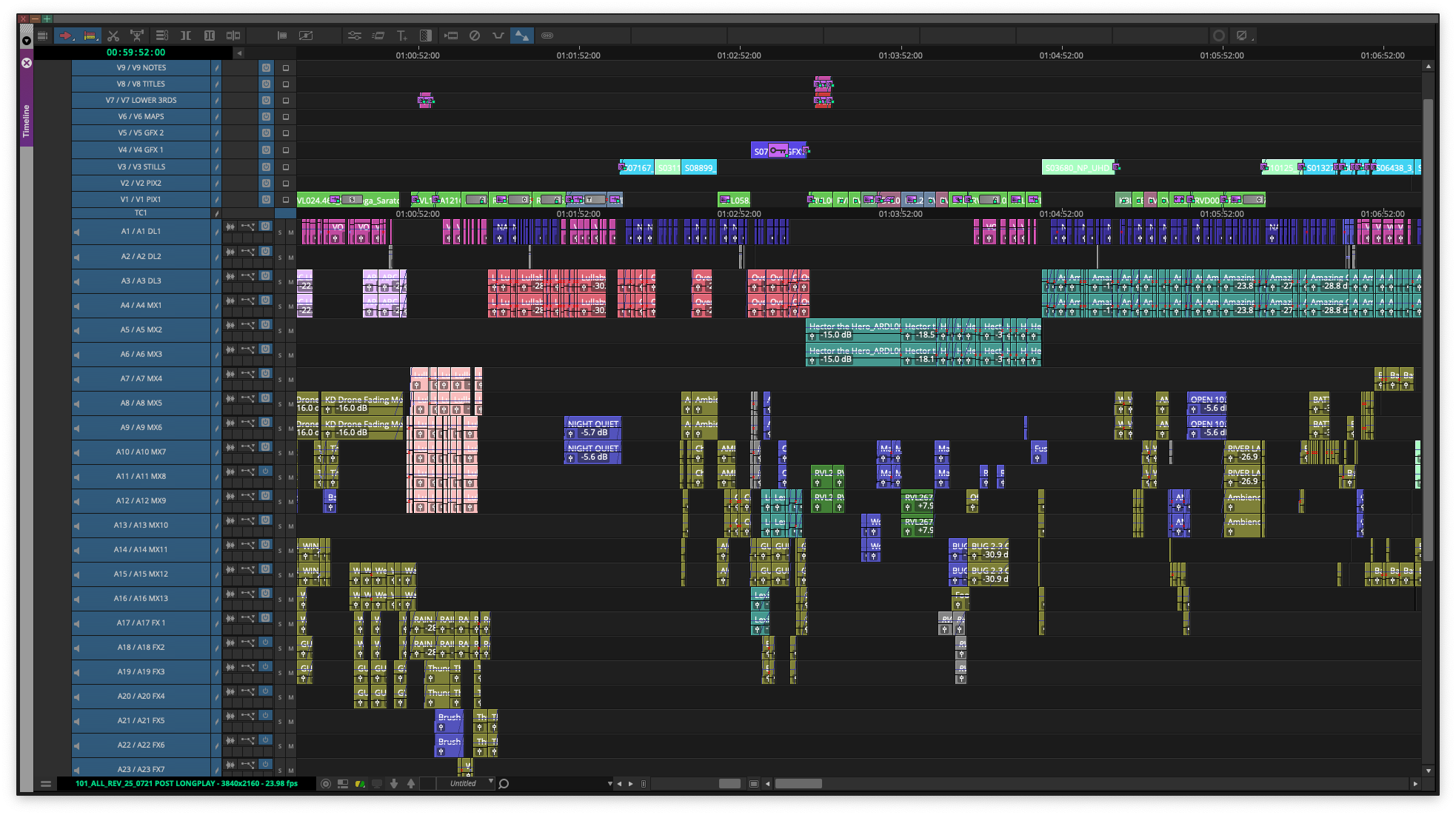
Avid timeline of the opening 7-minute segment of Episode 1 of The American Revolution
You must have done some loop group ADR. There was a scene where you showed a painting of some people in a bar having conversations. The narration said that people were talking, and underneath that, you hear murmured conversations. Does your sound team go out and do loop group ADR?
They were so on it. Marlena Grzaslewicz is the premiere dialog editor in New York. She used to teach, so she’s kind of responsible for every sound editor’s career in New York City.
Her whole team did a at least two ADR sessions when they came on board, after having looked at everything and made really wise strategic decisions about the kind of things they needed.
We asked very specifically to record a broad range of accents - male and female - but also in different languages as well.
There are often times in the film that we talk about how many different kinds of people are together fighting this war - not just with the help of the French and the help of the Spanish, but of colonists who are from all over the place, so, they made a point of not just accents, but languages. They made an amazing ADR list.
It was almost too good because, I’m sitting in the mix and I’m listening to the loop group ADR instead of listening to the narration and the interviews! They’re so perfectly timed. I had to tell them, “Guys, you got to tone it down because I’m listening to the ADR.”
Does it change your feeling of watching a scene when you get that stuff in? Does it change the actual edit or does it just enhance it?
Sometimes it makes me sad that I didn’t leave more room for it. I try to do a little bit of cutting sound throughout because I know if I don’t put a yell at the beginning of a new shot or some sort of thing to open up the dialogue, I will get notes from people: “Pick it up, pick it up.”
So I am carefully placing at least something - even if it’s kind of stinky - into my first few cuts just for pace reasons, so I can leave those guys some room to do the beautiful work that they do at the end. It definitely brings everything alive in a much more interesting way.
There was a great painting of a ship out in a harbor, and the sound effects were so good that I was trying to figure out if it was a live-action shot!
It’s really a different film when it’s done mixing.
One of the things that I thought I noticed is a sound motif that almost every time you cut back to England, or a map, or a painting of England, there was a little church bell.
I know. It’s true.
It immediately makes your brain think, “I’m in England.”
That is definitely what it is. It was a leitmotif. It did help us get quickly from the colonies to England. The other thing that I think for me maybe worked was oftentimes England was a beautiful painting and the colonies was kind of a sketch.
At Florentine Films we have the most authentic and close-to-the-time-period as we can get images. When we did the D-Day film, everything that we say is Omaha Beach is Omaha Beach. It’s not in England and it’s not another beach in Normandy. It’s Omaha Beach.
If it says Juneau, you’re in Juneau. We weren’t going to mess around with that kind of stuff. So the ethos is that as much as you can be authentic, you are authentic. Some of the earliest sketches of Boston were terrible. One of our biggest challenges was that rich people can have portraits painted of them.
We have a lot of dialogue about Native Americans. We have a lot of dialog about people who are enslaved or free black people. But if you start using the images that were available in 1776, they are terrible. They are caricatures. We would probably consider them racist.
So then you have this weird inequality visually between the wealthy and all the other people who are going to be in this film. So trying to even that out was a huge image problem. We had to use images that were made later.
We used images that were authentic, but painted this year. It was the only way, to make it visually fair so that I could see a close up of a human being who was a Native American, so that they got equal screen time treatment. That was probably the most difficult visual thing to overcome.
There’s a lot of lovely music that is just underscore - beautiful instrumentals. But when do you choose not to have music in a scene?
It’s sort of a case-by-case basis. Oftentimes the emotion in this film - the emotion of the quotes is very strong. You don’t really need to score underneath it - almost never.
Oftentimes a quote will open or close a scene, so it’s kind of it’s nice to have the scene opening with just the voice without any music. Oftentimes, I’m using the music in setting up the scene.
The music helps you understand the transition. It’s often working just to tie together the thoughts. You’re finding the piece of music that’s going to really make that make sense to people.
It helps me in a larger piece to make a larger pace out of that ten minutes to make you understand the transition between here and here and here by what’s underscored with music.
I’ve heard that called “paragraphing.”
I love it! Who who came up with that? That’s brilliant! That was a short version of a long-winded thing. I love that: “paragraphing.”
Alexandra Moore and Rob Butler from The Deadliest Catch told me that. It means that editorially you’re taking a group of ideas and saying “These ideas belong together” then moving on to the next thing.
Exactly!
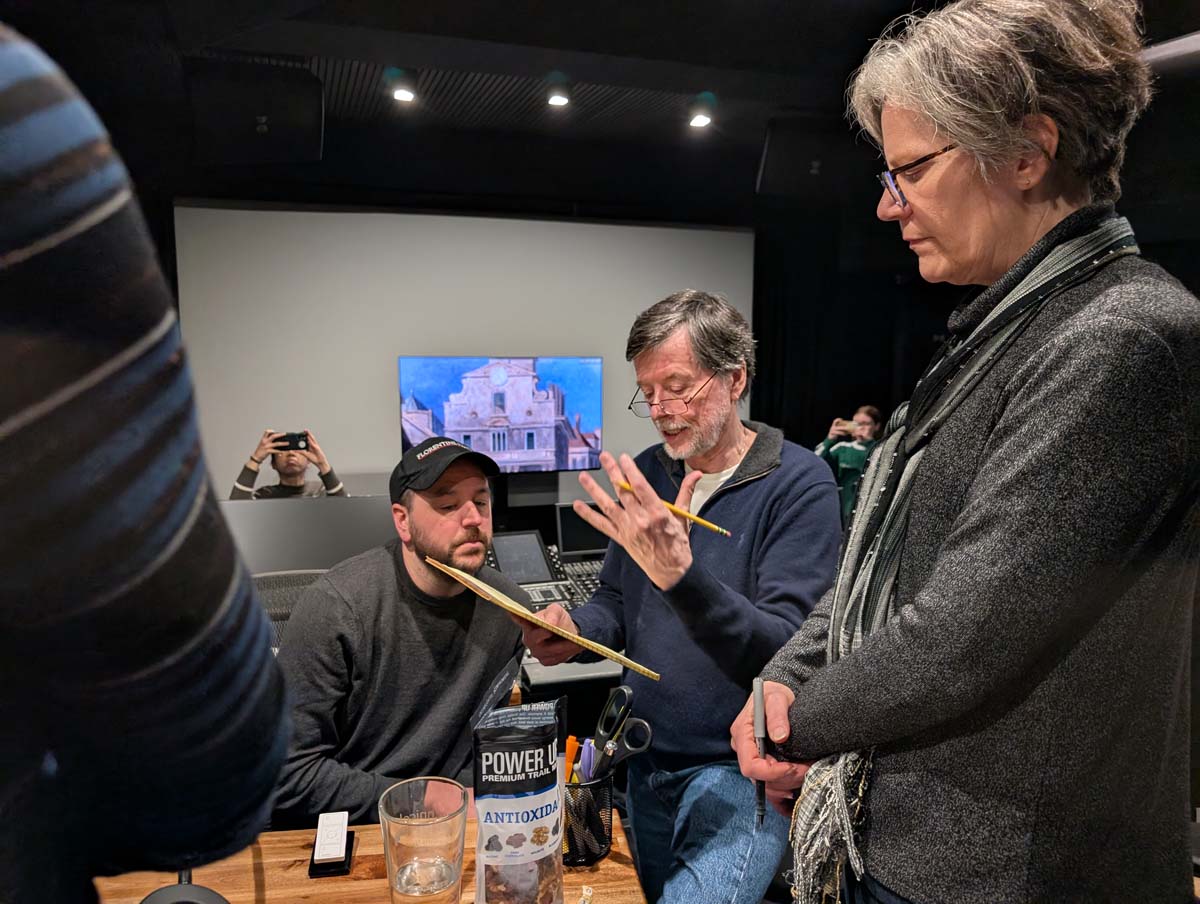
There was a 3D animation of a harbor. It’s cool because it’s 3D, but it also looked like it was 3D animation made in 1776.
It’s created from a very famous graphic. It depicts the arrival of the British in Boston to occupy Boston. We had lots of different kinds of story telling elements in The American Revolution because we had 12 hours.
So, and there were a few of these images that sort of lent themselves to making them 3D. There’s one in episode one, there’s one in episode two.
As the film continues, we started using actual 3D images. One of our producers contacted 422 South in London. These people do unbelievable 3D, and Ken was buying it, which was very unusual. He’s not - generally speaking - someone who likes to manipulate images in that way.
His formal training in college was with a photographer, his mentor, so manipulating an image like that. It’s not his usual protocol, but it seemed to work for the scene. It was very subtle and lovely.
That 3D animation was from an image sketched by Paul Revere. The Boston Massacre is his more famous image that we talk about later.
But this was also Paul Revere. We obviously had to get permission to manipulate. It was not a simple thing. You can’t just mess with a Paul Revere.
Let’s talk about the macro pacing of the whole story - the 12 hours of the series or the 2 hours of the first episode. How are you determining how long to make the story of Lexington and Concord? Should that be six minutes? Should it be two minutes?
We’re always recalibrating. You posed that question about killing your darlings. For example in this film I think at every screening, I asked, “Do we really need to explain the Quebec Act?
It’s slowing us down.” Historically, the writer and producers would say, “You have to do the Quebec Act if you’re doing a film on the American Revolution, so get over it.” So then it’s a question of, “How do we shrink this down so that it does not take down this whole 20 minute section of the film?”
We’re trying to race towards the end. We’re trying to get to Lexington and Concord. I think everything’s building to the first shot, but we have this Quebec Act. We’re doing this historical documentary and sometimes you can’t kill your darlings. You just can’t do it. You have to tell this story.
So, the solution was just to get it down. Can we just bring this to the barest bones to make it to understand it?
The graphic really helps you understand why this might piss off colonists to have half of their colonies taken over by the Canadians with the help of the British. It’s always a calibration thing about what you have to tell and what you really want to tell.
I try to let those scenes breathe because the story just demands it at that point. It’s a hard thing to keep everybody’s attention for two hours. And we can’t re-structure: the Boston Massacre comes where the Boston Massacre comes historically.
The trick with the Quebec Act and its importance is that you might want to get rid of it because it’s slowing things down, but as an editor, you don’t really know how important it is to history, maybe.
That’s why we have these consultants. Goeff Ward, the writer, has done an amazing job of making this story but the consultants are not just brilliant writers and thinkers about the American Revolution, they also have great storytelling ideas.
We had one who said, “You really don’t have a loyalist. You’re kind of missing that thread.” It was a great note, and once we got one character in who was a loyalist, you kind of understood the story in a much more interesting way.
But you also need the “film storytelling” sense to tell the history consultants, “Not every single fact about history needs to be in the movie.” You and Ken and the producers need to push back against some of that stuff.
Ken is really the first to say it is a movie.The producers and the directors tried very hard to make it historically correct. But Ken will ultimately lean back on if it’s a good story, it’s a good story. And if it’s not, we’ll try to shape it down.
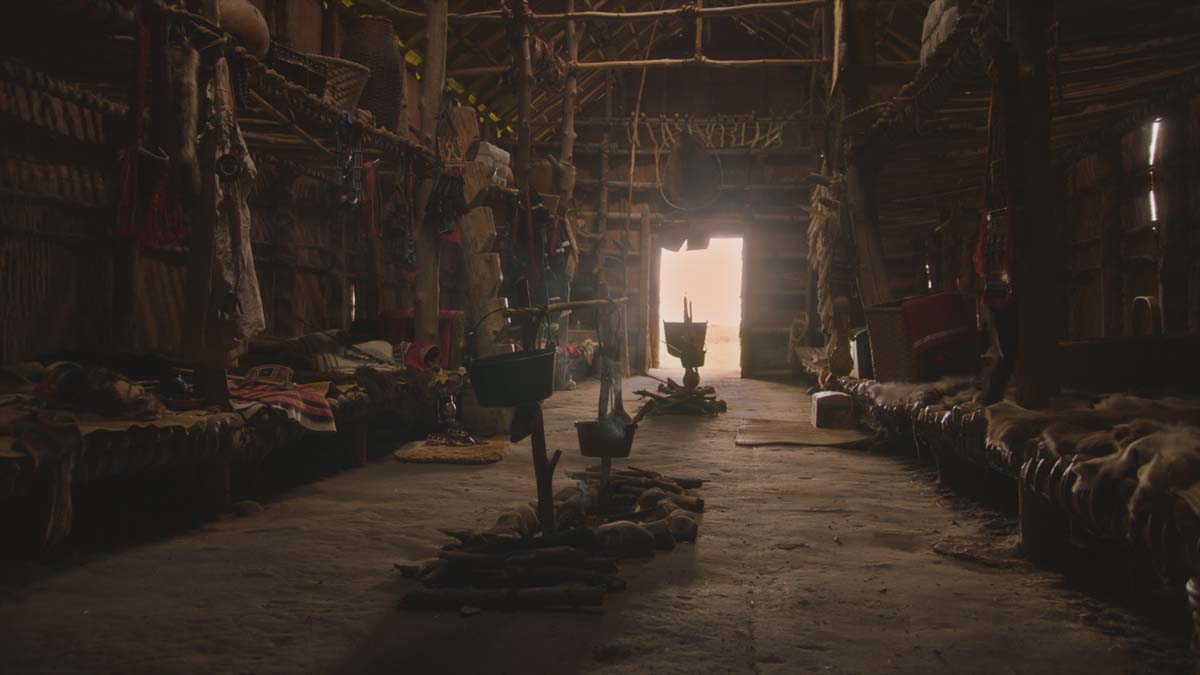
I did love the graphic in the Quebec Act that shows Chicago and the whole Great Lakes region would have been in Canada. That’d be a very different map of the US.
When that map went in, that’s what made the scene work, really. Lots of people have to be involved in screenings and decisions on these films.
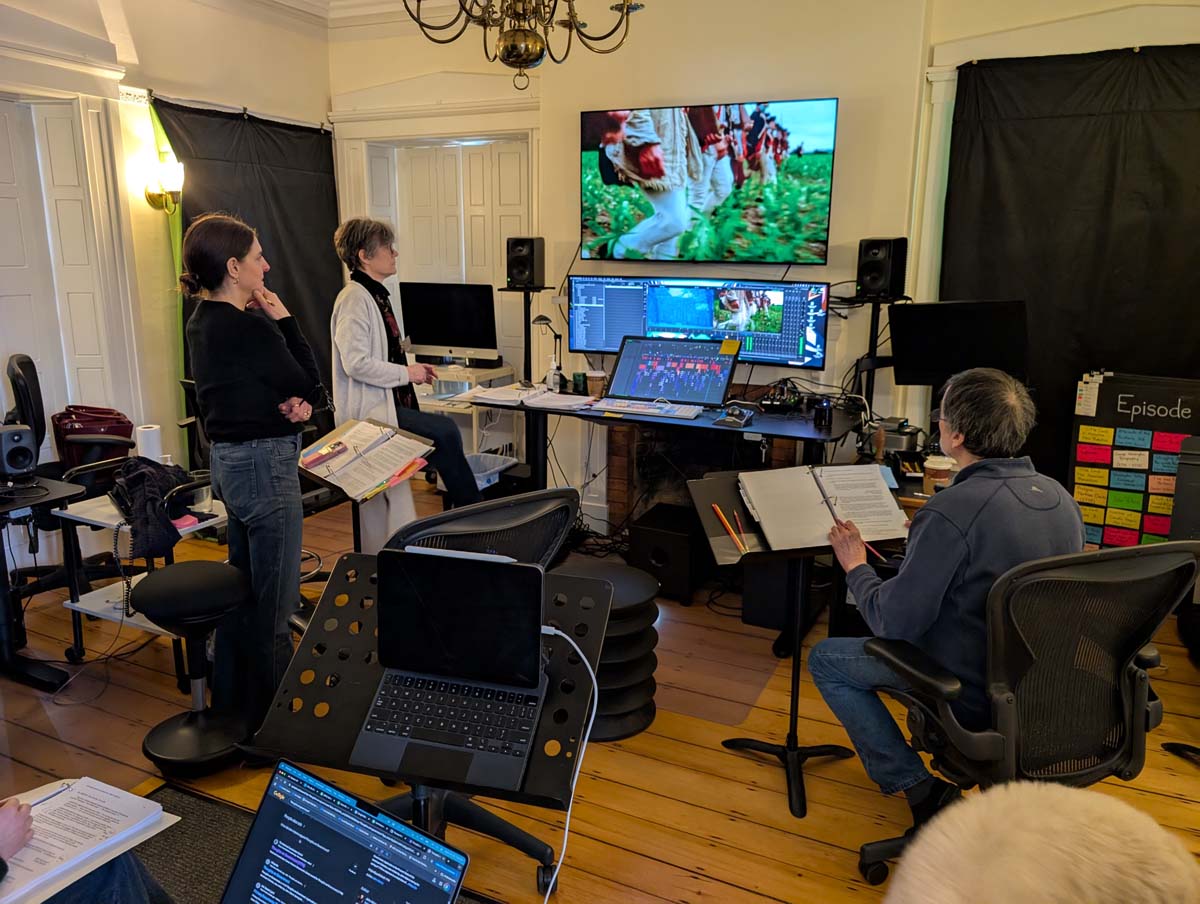
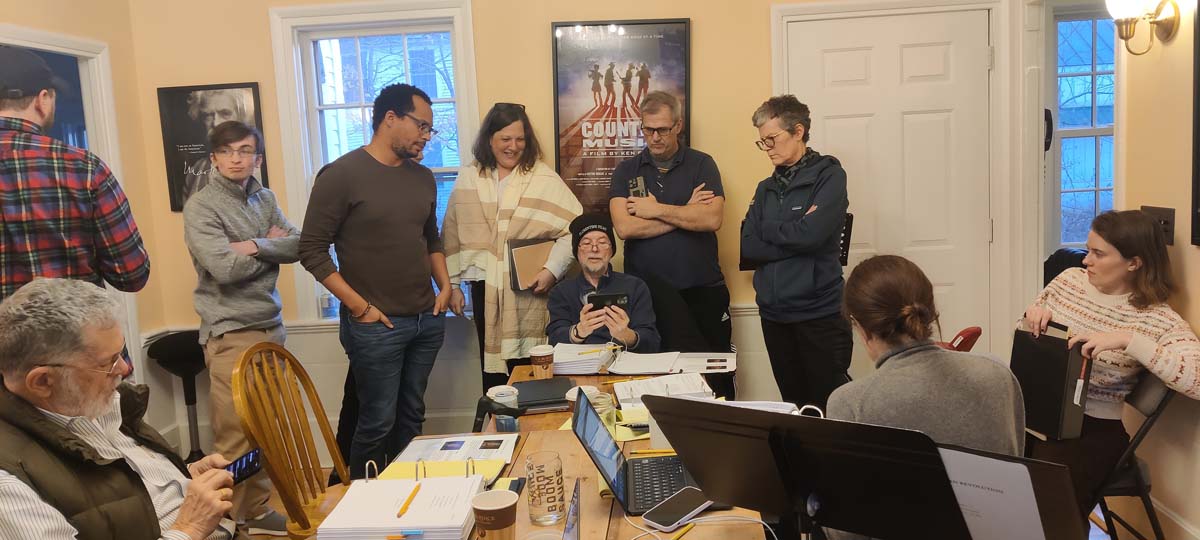
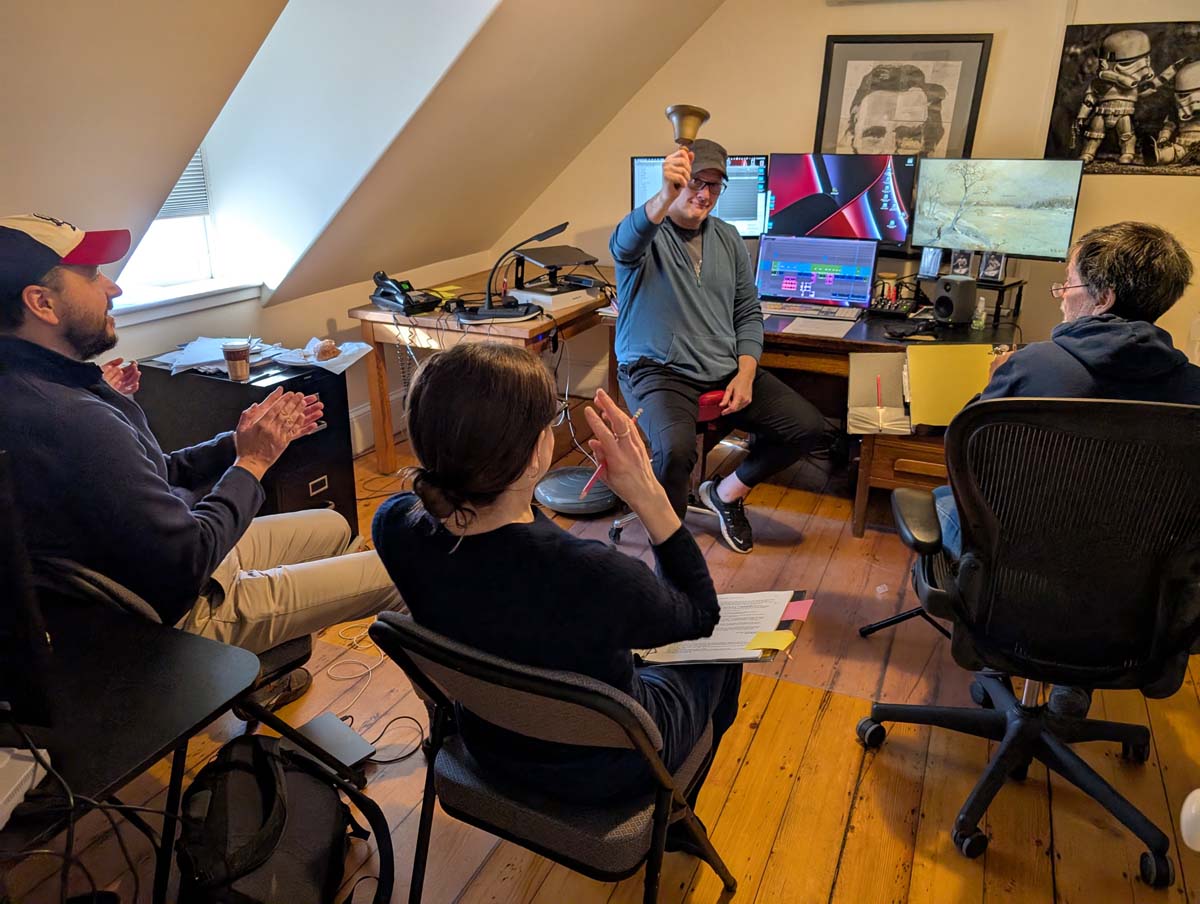
I saw a picture from Craig Mellish doing a screening, and there were 20 people crammed in his editing room. Talk to me about that screening process and the evolution that happens because of them.
We do the first assembly as a “blind assembly,” - no pictures. The first assembly is basically the editor, director, producers, and visual producers. There’s a little assessment of: “Okay. You’ve got this coverage for this scene. You’ve got these images for this scene. We’ve got nothing for this scene.”
There’s a constant back and forth with the visual team: “Can you get me this tape? Does this exist?” That kind of thing.
The first assembly is usually our best guess at what the film wants to be. All the producers, all the researchers, assistants, apprentices are all there for the screening of every assembly. All the other editors and their assistants and their apprentices will be there.
Everyone will screen and we’ll talk about what’s working, what’s not working. Then we sit around a table and it’s a massive rewrite. You just better be ready with your script because it goes very quickly.
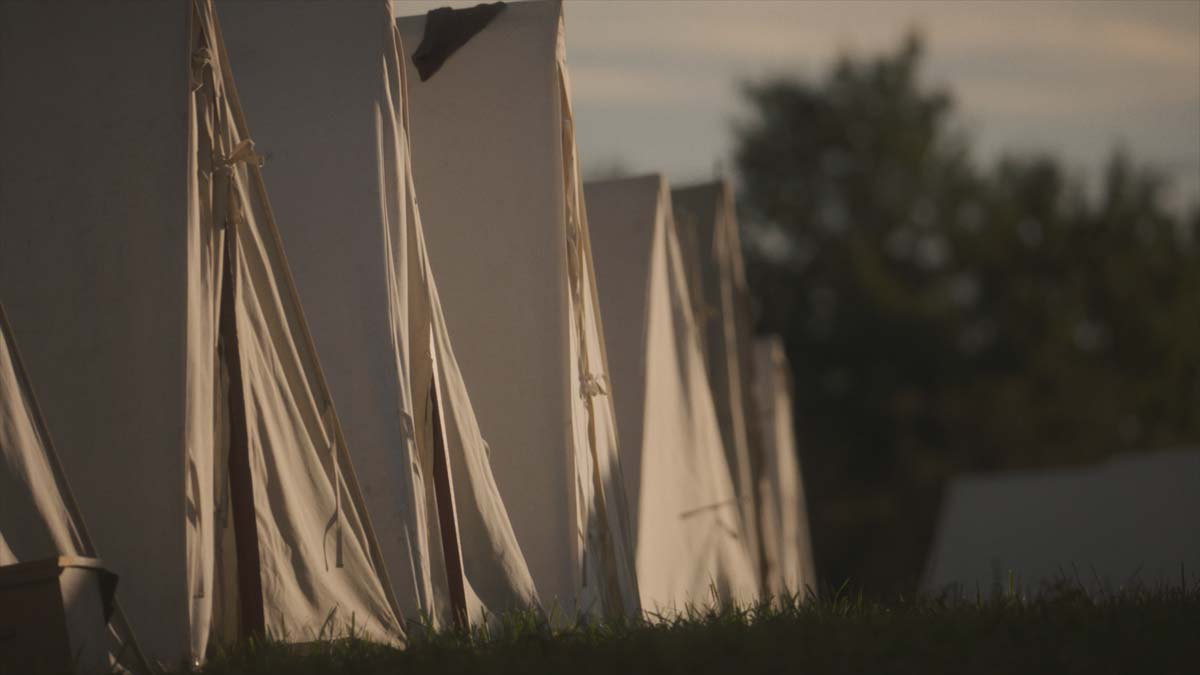
I recommend for every new member of the team - of the editorial team - if they’ve haven’t been through one of those script meetings, that they should take a prophylactic acetaminophen because they’re going to have a headache by the end of the day.
Then we start to recut. I think on the The American Revolution the next pass was probably with consultants.
I don’t think we had an episode six at that point, but we had probably one through five, maybe we had six. And they are invited to give notes. So the team is there, the consultants, That’s maybe 15 people plus another ten people in the room and they give notes about what they think is working and not working.
They will then be given scripts after the screening, and they will make physical notes. They’re not given the scripts for the screening. Then we collate all their notes and we rewrite again, and that process goes on and on. Different people are invited.
As we get closer we always put a “warm body” into the room for screenings - someone who’s completely new to give us more feedback about what they think is working. It helps me see if everybody’s shifting in their chairs and there’s yawning going on, then you know you’ve got a little bit of a problem. You don’t always get that unless you have new people who don’t have a stake in the film.
So screenings are very valuable. Different people are invited to each of these screenings. It helps me decide where to put breaths. I think it’s kind of the hardest thing and really the last to get ironed out - those breaths - because it requires you to see the whole thing, for example, in my case, I have five hours of screen time that I’m responsible for. It’s hard on your own to watch through two hours, so I am almost waiting for those screenings to have people in. That’s the most difficult thing about a canvas this big.
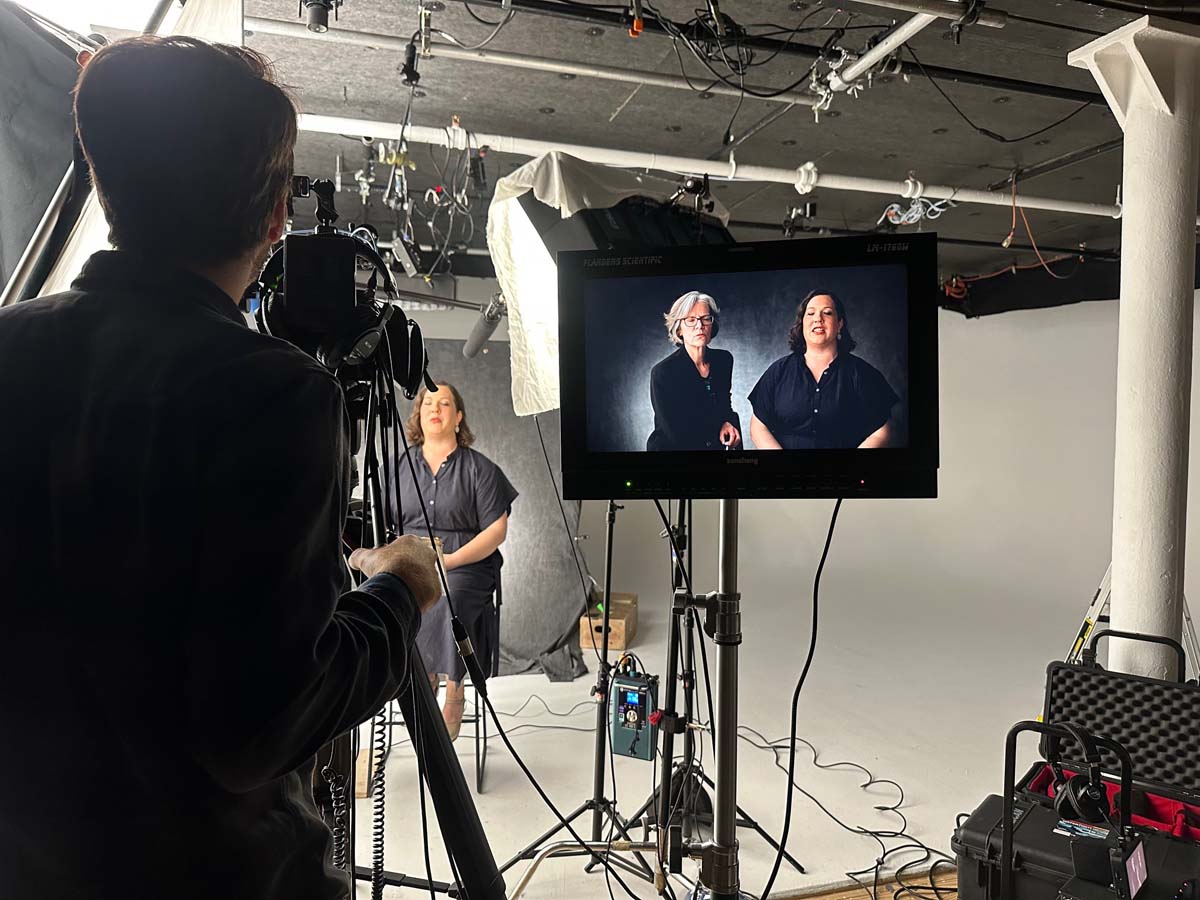
I’m working on a documentary passion project right now about a dog that was put on trial for murder. I’m having a rough time with it right now. Do you have any advice?
I heard some great advice from Francis Ford Coppola - he was talking to Terry Gross. He said the difficult creative problems with The Godfather were unlocked when he realized that it was really about succession, then he could answer basic questions. It took a while for him to understand what the film is actually about. So you need to know what your film is really about.
We talked a bit about “killing your darlings.” Any more thoughts on that?
Killing your darlings has a lot to do with calibration, really. It’s maybe not killing it completely. The opening of Episode 1 of The American Revolution had a fantastic talking head and we finally we said, “You know what? There’s too much here.”
And we took out a fantastic talking head from the opening. It was great, but everything was a little bit too long and we decided that what the talking head said was going to be covered later. It doesn’t need to be here. So the calibration there was a clear instinct of killing it for pacing.
Once we understand that this first episode is going to be about the country coalescing - are these 13 colonies going to coalesce into one in order to fight this war, or are they going to fall apart?
The theme was “Unity.” Then you start to understand what’s going to stay and what’s going to go in terms of helping you calibrate the whole thing.
Once that theme becomes real and you understand there’s going to be a war, then we have hope that that’s going to dictate some of the pace we are pushing towards.
So your editing decisions become “Is it on theme? Is it on task?”
Yeah. And is it calibrated properly. Is it fitting what we want people’s takeaway to be? And I think it’s easier in a short film. In a film that’s ultimately 2 hours or 12 hours, it is a broad, big canvas and it has a lot of things that are contradictory - which is Ken’s favorite thing. He wants it to be a bit contradictory because there is no one view or attitude.
Do you use story cards on a wall?
You bet! It’s easier for everybody to understand.
Are the cards text only or images?
It’s just text of what the scene is. I don’t remember who wrote the cards, but they were such a brilliant distillation of what the scene was. You got it immediately.
You mentioned the editors’ cut. Episode 1 ended up being broadcast at about 1:50. How long was the editor’s cut?
I think that the blind assembly was probably 2:45, and the first assembly was probably just 2:20 or 2:15, so it wasn’t crazy.
What about the use of celebrity voices to read letters and documents? I definitely heard Tom Hanks in there someplace. Does the edit change when you go from a scratch video to a final?
That might be the single most dramatic change because the scratch is just read by everybody on the team. It’s every producer, every associate producer, the apprentice has a couple of readings and they’re good. You understand them, but some of these characters didn’t really come alive until we had somebody - like Josh Brolin is Washington.
That’s a difficult read for anybody. Washington - God love him - was not a great writer, so they’re hard to read. And the list goes on and on.
Maya Hawke is Betsy Ambler. She’s introduced in episode one, and I think she’s in every show - a young kid from Yorktown who wrote about it later in life. Her dad worked for the English and but was pro-revolutionary.
They ended up having to move a million times because every place that they lived was invaded by the English. But until Maya Hawke read it… she breathed amazing life into this character. And there’s Joe Carey who read this kid called John Greenwood…
He’s the fife player?
Yes. Joe Carey kills it. He smashes it out of the park.
I felt like that was recorded in 1776.
The producers did an amazing job finding the voices. Tobias Menzies and all these British actors. I think the single most dramatic change is when all of those scratch voiceovers were replaced by actors. There’s a lot of different characters and there are no pictures of them.
We don’t have a picture of Betsy Ambler or of that fife player, so you’re kind of dependent on the audience recognizing this voice.
The narration, which will hopefully remind you about who this guy was or who Betsy Ambler was, but there are a lot of characters, so it’s hard to hold on to. But when you get that recognizable voice, it really does help the storytelling a tremendous amount.
Does it change the edit itself?
Yeah. It definitely changes the pace. Peter Coyote has done our narration for us for a very long time. He’s really brilliant. He usually lands it in two takes, which is impossible. Ken’s cadence tends to be very similar to Peter’s, but our scratch voiceovers of characters compared to the final actors tends to be a little bit different.
I’ve noticed that it does change the emotional quality, so I can often strip out music because these actors are so good. They bring so much to the performance that the music kind of messes it up. Particularly Hanks. His voice is very subtle and the emotion is so subtle that you don’t want anything messing it up.
What was your background before you became a documentary editor?
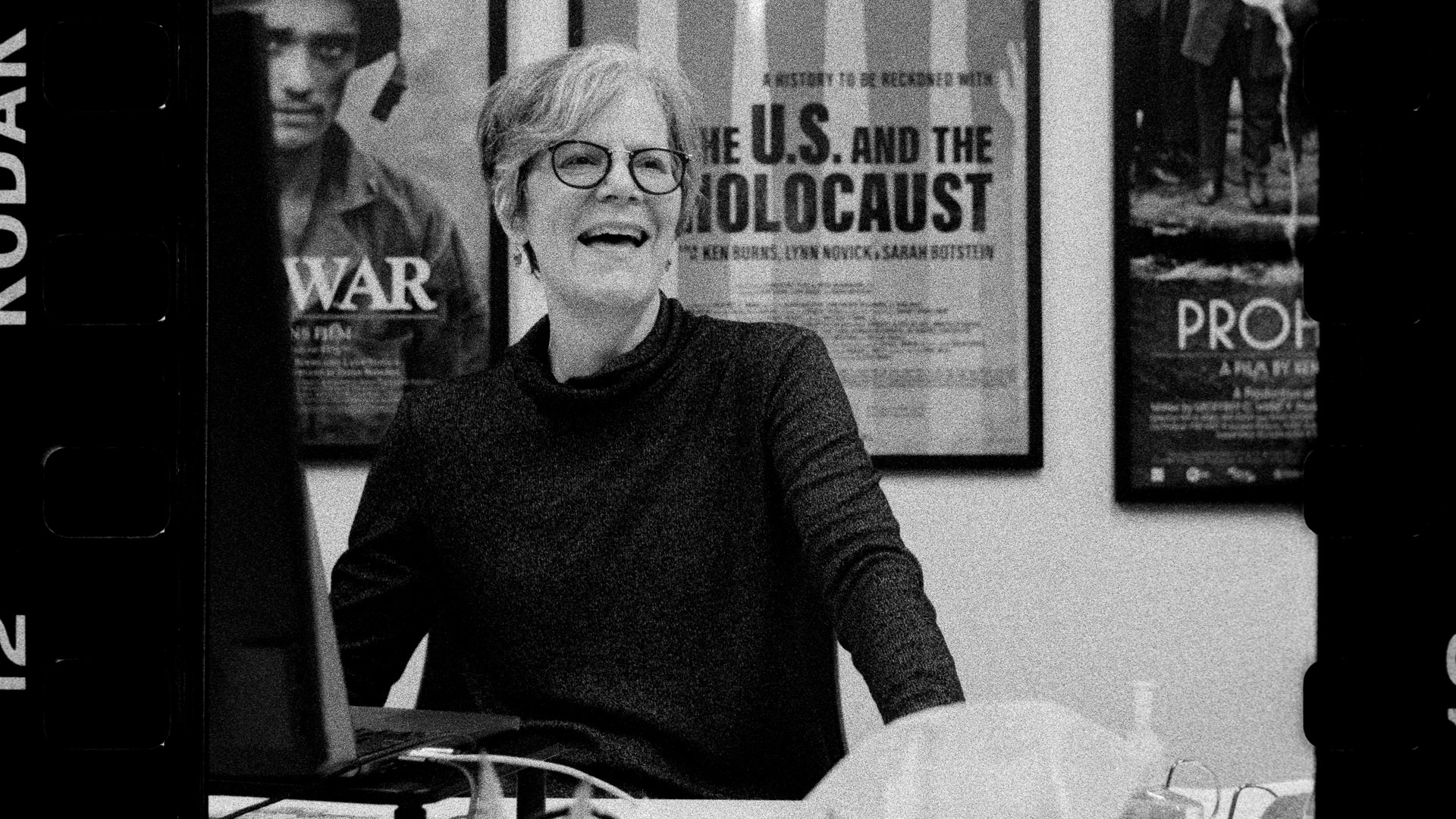
I’ve really only done this. Straight out of college I actually met Paul Barnes, who was editing his first film for Ken on the Statue of Liberty. Paul was teaching at NYU, so I met him, and I begged him to be his intern. So I met them both when I was 21.
A couple years later they started editing The Civil War. That was also in New York. Paul was supervising editor, and I came on as the first send assistant.
Bruce Shaw was the other editor. It started as five shows, then it ballooned into nine shows, so they were looking for another editor and they couldn’t really find anybody, so they said, “Let’s just bump Tricia up.” So I did some associate editing on The Civil War, so I like to joke: “I’ve known Ken since before the Civil War.”
That’s a good line!
So I’ve really only done this. It’s hard, I think, for people coming up to learn the process. We have an advantage on these big films because we have an assistant and often an apprentice. They might not get their hands on a scene, but they get to see what a first assembly looks like, then what a rough cut looks like.
They get to see the process and they get to see how an editor and a director talk to each other. They just get to witness it.
The best way to learn is to do it, but to learn first by going through the process from beginning to end is a really great thing for somebody coming up.
Not everybody gets that opportunity anymore - particularly in documentaries. They tend to be small and very small crews. I think it’s harder for people coming up to learn that part of it.
I’m worried that AI is going to take it out even more. Producers are going to say you don’t need an assistant editor.
Wow, that is very interesting. You’re probably right.
How do you judge the editing of others? That’s not fair. I can’t do that.
It’s mostly what hits emotionally. It’s an emotional reaction for me, in the same way that you judge great writing. Some of it is the technicality of the writing, like: “That sentence structure is fantastic.”
So some of it would be the visual language that the editor might have created to get that emotion. Then there’s sort of the balance between the technique and the storytelling to make an emotional thing.
Do you have any wisdom or pieces of documentary filmmaking advice for young filmmakers?
I heard a great Maya Lin interview once when they were celebrating 30 years of the Vietnam memorial in D.C. When she was 22 she won the “blind” competition to design the memorial. Then all the well known designers were weighing in about what should change about her design, but she said, “I’m not going to do that.”
The interviewer asked, “How - at 22 - did you have the wherewithal to say no to the world’s best architects? She had a very wise reply: “Because I was 22, I thought I knew everything.” Documentary filmmakers really have to have that kind of hutzpah.
Like, “This is what I’m gonna do and no one’s gonna stop me.” I think it really takes that kind of wherewithal. I guess that’s my advice: to be a lot like Maya Lin.
I love it. Tricia, thank you so much for this lovely interview.
Absolutely. And I look forward to your new book. Thank you so much.
 March 26, 2026
Young Sherlock
Today on Art of the Cut, we speak with four of the editors on the buzzy new Amazon Prime series, Young Sherlock. With us are ...
Read more February 12, 2026
The Pitt
Today on Art of the Cut we speak with editor Mark Strand, ACE, who is nominated for an ACE Eddie for Best Edited Drama Series ...
Read more February 3, 2026
The Perfect Neighbor
Today on Art of the Cut we’re talking with editor Viridiana Lieberman about the Oscar-nominated and BAFTA-nominated Best Documentary, The Perfect Neighbor. The film was ...
Read more