













Cover-Up
The director and editors of Cover-Up discuss the importance of allowing breaths to allow the audience to feel and absorb, the ethics of documentary, and the difficult choices of killing one’s darlings to streamline the story.


Today on Art of the Cut, we speak with Oscar-winning directorLaura Poitras, who also edited the documentary Cover-Up with fellow editors Amy , ACE, and Peter Bowman. Cover-Up is available to watch now on Netflix.
Laura’s documentaries have been nominated for three Oscars: All the Beauty and the Bloodshed, My Country, My Country, and CitizenFour, which won the Oscar. She’s also been nominated for three Emmys, winning one, for CitizenFour, which also won a BAFTA.
Amy’s been on Art of the Cut before for All the Beauty and Bloodshed, for which she was nominated for an ACE Eddie, and Hail Satan? Her other work includes Father Soldier Son, which won an Emmy for Best Documentary Editing, and Girls State, among many others.
Peter Bowman is a Cinema Eye Honors nominee for Cover-Up, along with his co-editors. His other work includes Girls State, How to Fix a Drug Scandal, and USA versus Chapo: The Drug War Goes on Trial.
Let’s start out where I often do with documentary films, which is this kind of mysterious open. You drop us into a situation where we don’t really know as an audience what’s going on. It’s not explained. Why start the documentary that way?
Poitras: Well, a number of reasons. We wanted this film to have thematic through-lines that are going throughout all of it. Cycles of violence and cover ups and impunity and lies. I always want to tell a film that is cinematic in nature - that is scene-driven.
The footage at the beginning is archival footage which shows the gassing of these sheep, then the military lying about it kind of captures the whole film. It was kind of a preamble that almost tells you what the film is about in two minutes, so it was very compelling. I always want to begin a film with a sense of mystery.
I’ve interviewed Amy before for your other film, All the Beauty and the Bloodshed. You did not take an editing credit on that. Why do you choose on some projects to edit and some projects not to edit?
Poitras: It’s a good question. I started out as an editor - as an assistant editor. So I’ve been cutting on Avid. Every film I’ve worked on, I’ve been in the Avid cutting - roughing out scenes.
Sometimes I just didn’t do enough to think it was appropriate to have an editing credit, but I’m usually cutting scenes and working with editors where - rather than like notes, which I think is a bit tedious - we can bounce back scenes to each other.
I would bounce them to Amy and Peter with markers, then they would send them back. We would recut each other’s scenes a lot. So it becomes much more of a fluid editing process that works for me.
I’m assuming you were doing the interviews while you were editing. How did those two processes inform each other?
Foote: They had done some test interviews and created a proof of concept, but the main interviews hadn’t been done yet.
So when I started it was maybe a month later when the first interviews were done. They were conducted throughout the entire length of the edit. I think we had about 127 hours of interviews with Sy (Seymour Hersh, the main protagonist) throughout the process.
Poitras: That’s just with Sy!
As you were editing - knowing that there was an interview coming up, or that you had a possibility of an interview - how was that affecting the edit or how were the editors deciding, “These are questions we need answered?” or “This would make a great transition.”
Foote: There was not a period where I didn’t have something to do because I was waiting for an interview because we had so many stories of Sy’s that we wanted to explore. So we might not have everything for this story, but let’s see what we do have, then we’ll have a sense of what we’re missing.
But in the meantime, we’ve got these dozen things we want to explore that we have archival for. So it was just a continuous process when sometimes we would drill down and figure out “We need to know more from Sy here.” In a way, that made the interviews a little easier, I’d assume.

Director Laura Poitras
Poitras: Going back to the question of one of the reasons why I felt like I should be editing on this film: Sy’s body of work is so massive, it was an “all hands on deck” project. We were working with Olivia Streisand - who Amy and I had worked with on All the Beauty and the Bloodshed - who was producing and pulling the archival.
She pulled over 6,000 archival elements. So we were constantly getting in archival as we were shooting.
Amy and I had worked on All the beauty and the Bloodshed, and her questions in the edit were always informing my questions in the interviews. We’d done this proof of concept where we had created some aesthetic ideas about the type of storytelling we were going to use for this film.
Peter, did you find anything in the archival that you thought was really intriguing, then you wanted interview to go along with the archival that you’d found?
Bowman: One of the rewarding things was that even if we hadn’t interviewed Sy about the bin Laden killing yet, we would take a crack at it.
We have all this archival and I think often some editors feel just like you make a radio cut, you lay it down, then you look for something to put over top. But how our film worked is it just drops into archival.
You’re finding ways that aren’t just based on Sy interviews. The edit is not just him saying, “…then I got a letter from Abe, and this is what it said.” You could start on the letter or start on an ominous shot. For me it was just always continuing to learn and appreciate the practice.
I liked how it forced you to think instead of just going for an interview. Is there a way to ease into it? It didn’t always work, but I think that was a good way to think, instead of just narration and illustration.
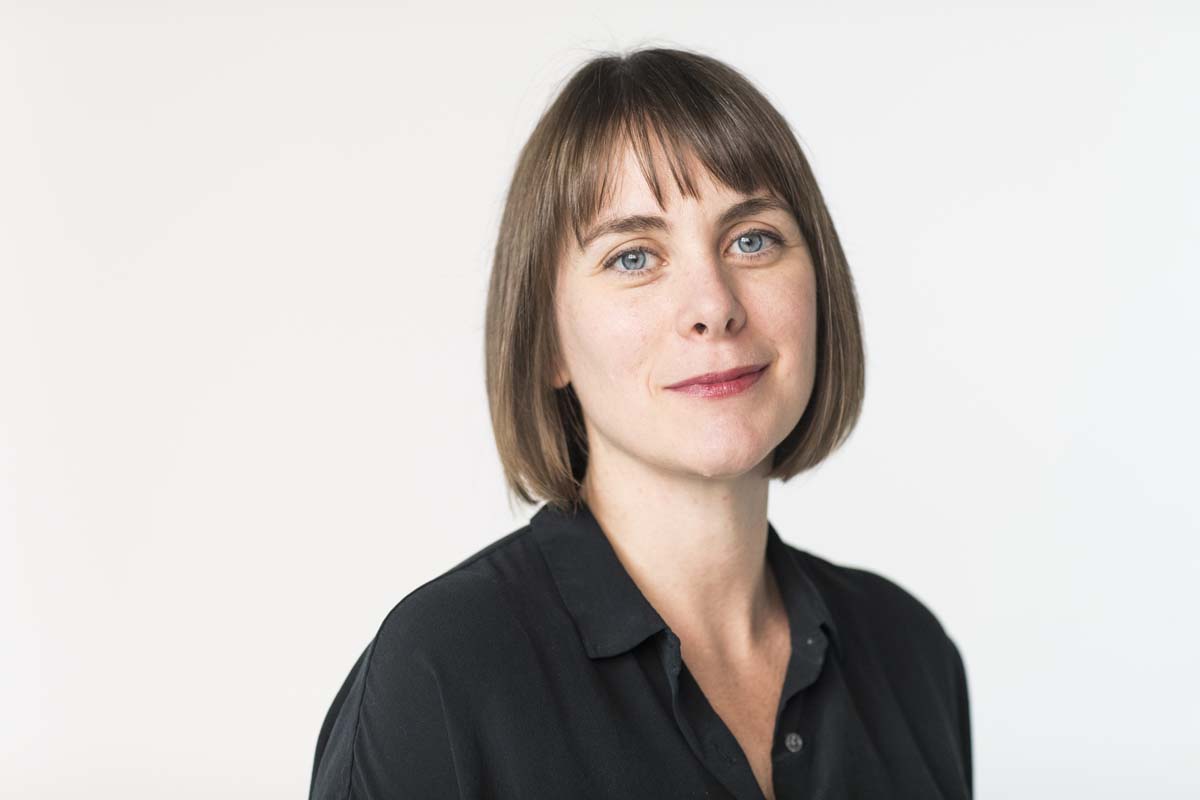
Editor Amy Foote, ACE
Foote: The examples of the things that we found in the archive that completely changed the edit: the Colby/Sy debate at the end of the Family Jewels section about the domestic spying by the CIA was such an incredible exchange.
Getting the CIA domestic spying right took all of us many attempts to cut, but we knew that whatever we had had to make this Colby/Sy scene land.
And if we hadn’t had that, we would have perhaps cut that section very differently. Or in My Lai there were these maps and with annotations that said, “Stopped for lunch after seeing bodies in a ditch.” We wanted to highlight that.
We had a photo of guys resting after that massacre. We also had Sy’s radio interview at the time talking about “how could this happen? Was it just another day in Vietnam?”
All those things created something where we didn’t even need a contemporary interview to pull off. We were constantly finding things like that, which became an important element of the film.
I’m assuming you knew all along that there’d been a previous documentary done with great footage from the ‘70s of Sy working?
Poitras: That was in our proof of concept. We spent three months before we really went for funding, because for me, that was going to be the make-or-break: whether or not there was archival to be able to show Sy reporting in the past was make-or-break for me, if I was going to be the right filmmaker.
I needed that. I wanted to be able to transport the audience into the moment that the film is in, so that it doesn’t feel all retrospective – so that we’re in the present tense even when it’s the past.
Going back to Olivia’s incredible work on the film: once we saw that there was really a lot here to work with of Sy - both video - actually 16mm - which was amazing to work with for us as filmmakers - gorgeously shot 16mm. Incredible photography.
Sy did a lot of radio interviews. His commentary about the press that he speaks in the late 60s that actually you could say it today and it would have the same resonance.
We were interested in those historical echoes. How does the past inform today? How do we keep repeating the same mistakes as a country?
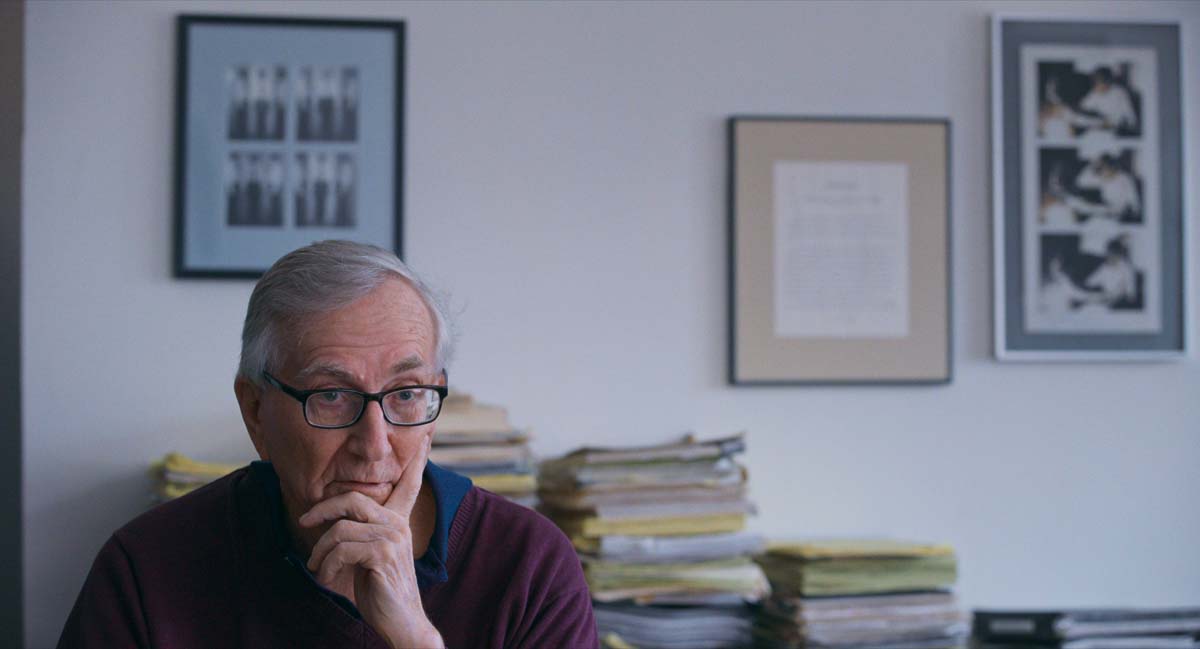
Sy Hersh from interview for Cover-Up
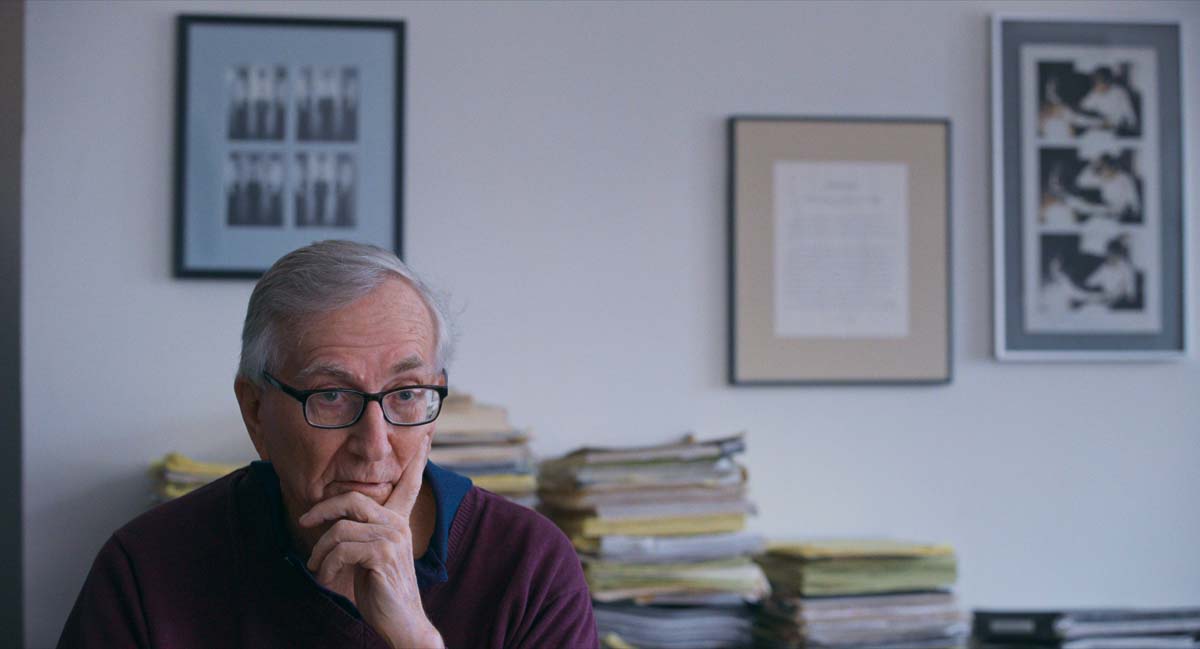
I thought it was interesting that you allowed the audience to know that Sy was kind of distrustful of you.
Poitras: To me, it’s the heart of the film. For Sy, source protection is everything. He wants his work to speak for itself, that’s why it took a couple decades for him to agree to be in this film. It wasn’t easy for him to agree. It wasn’t easy for him to hand over his notebooks.
We wanted to create a sense that there was drama in the room. And there was, because we were asking him questions that he felt very uncomfortable answering in some cases. So that was really important to keep it in.
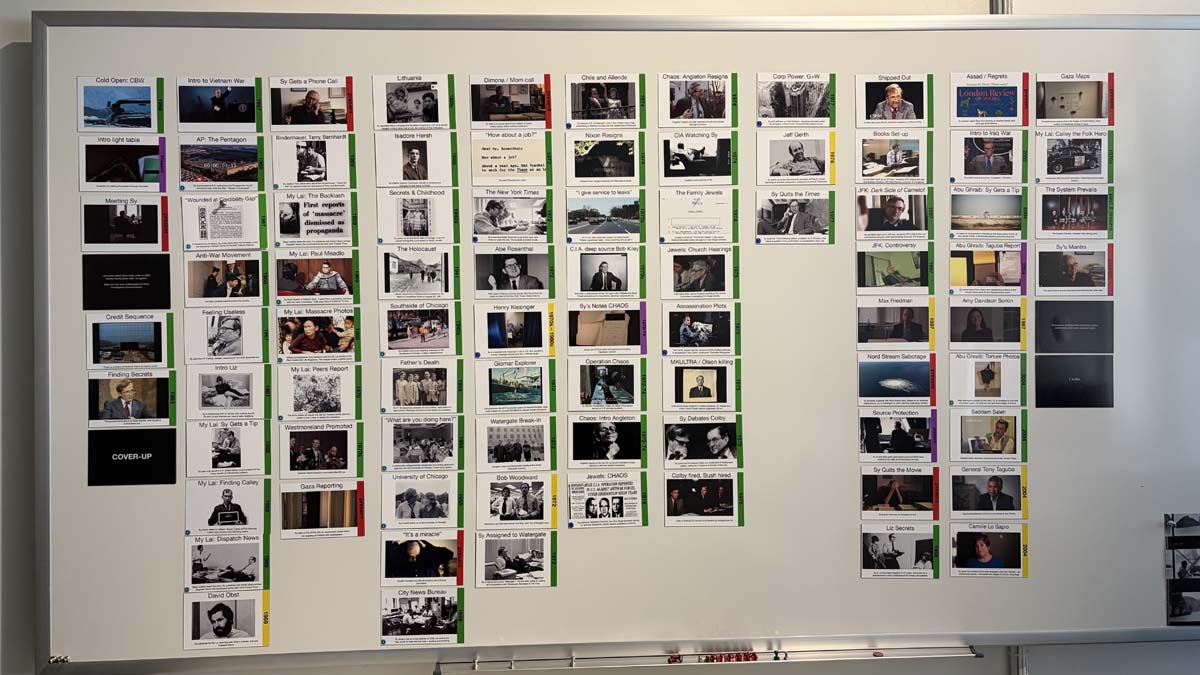
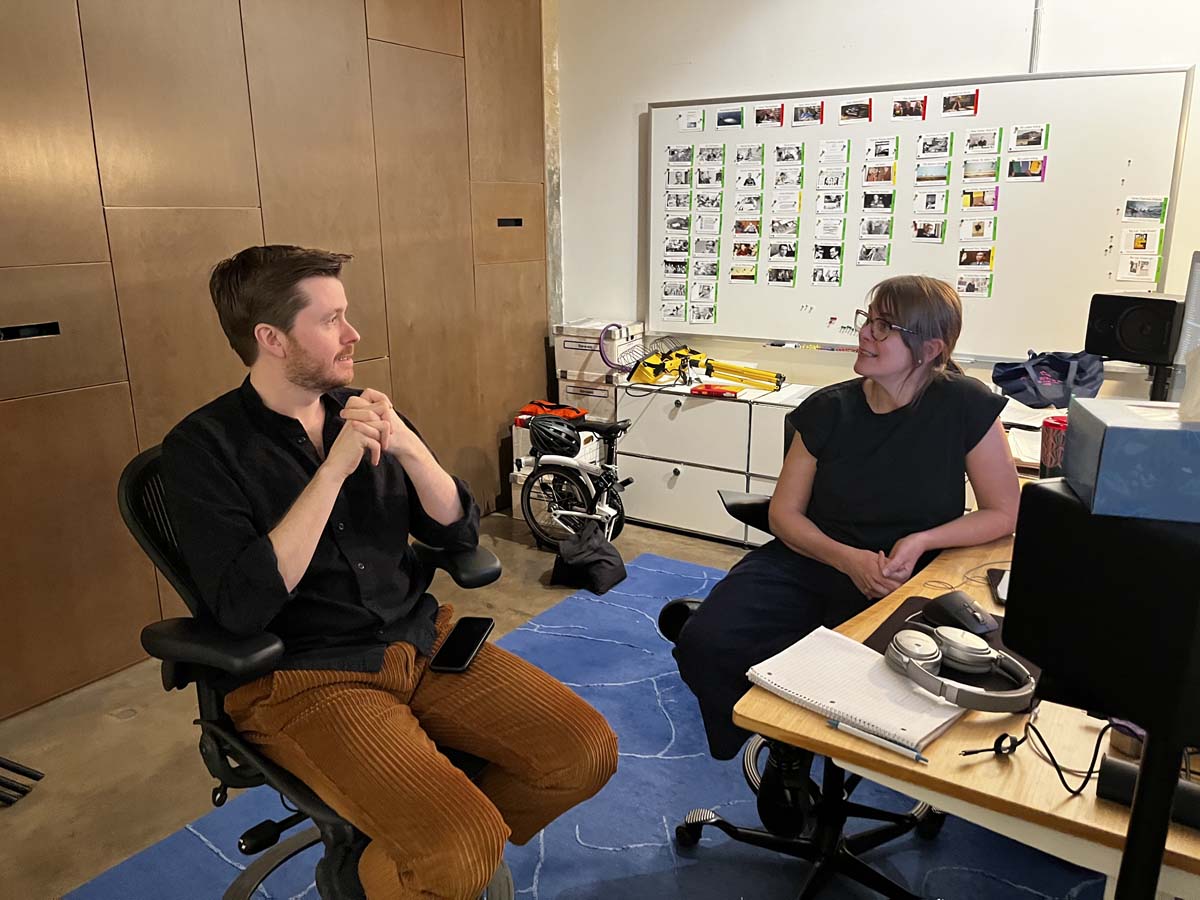
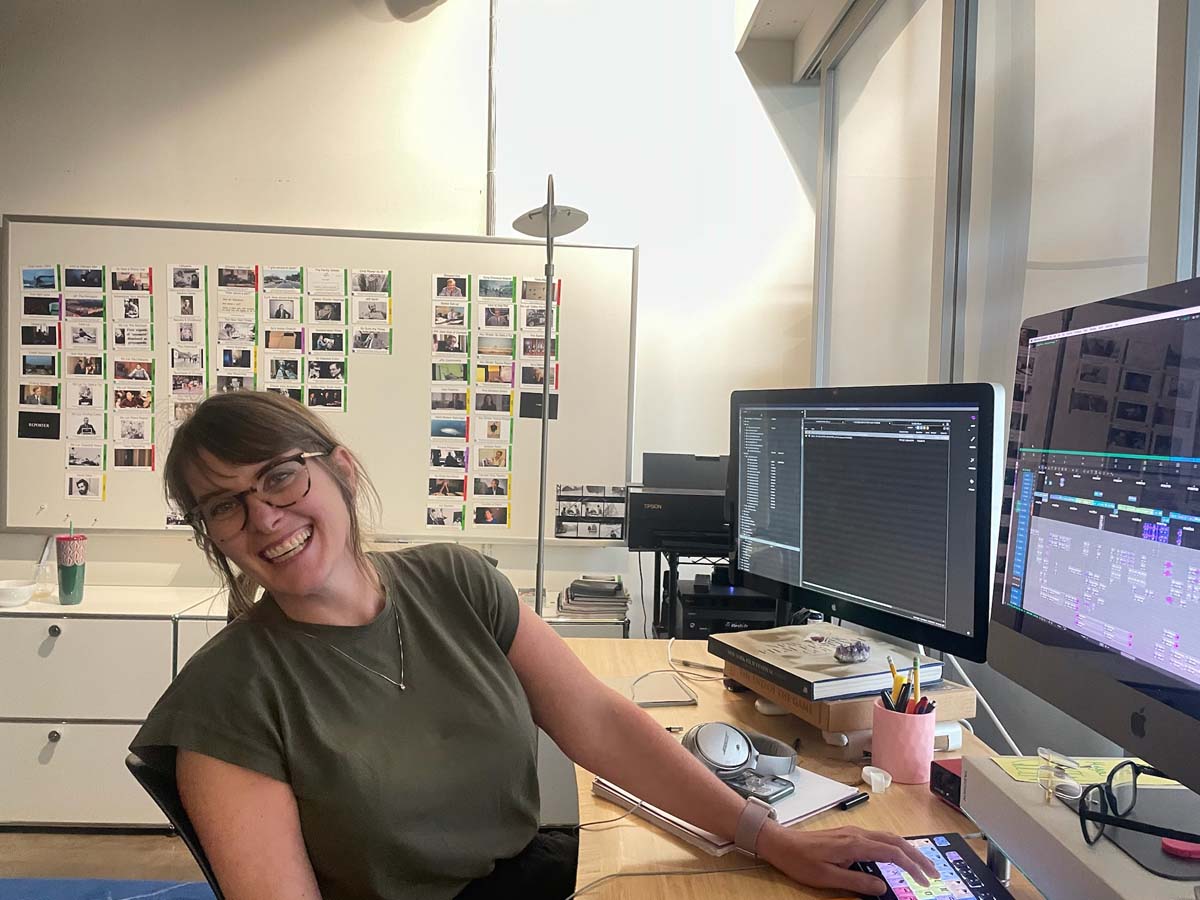
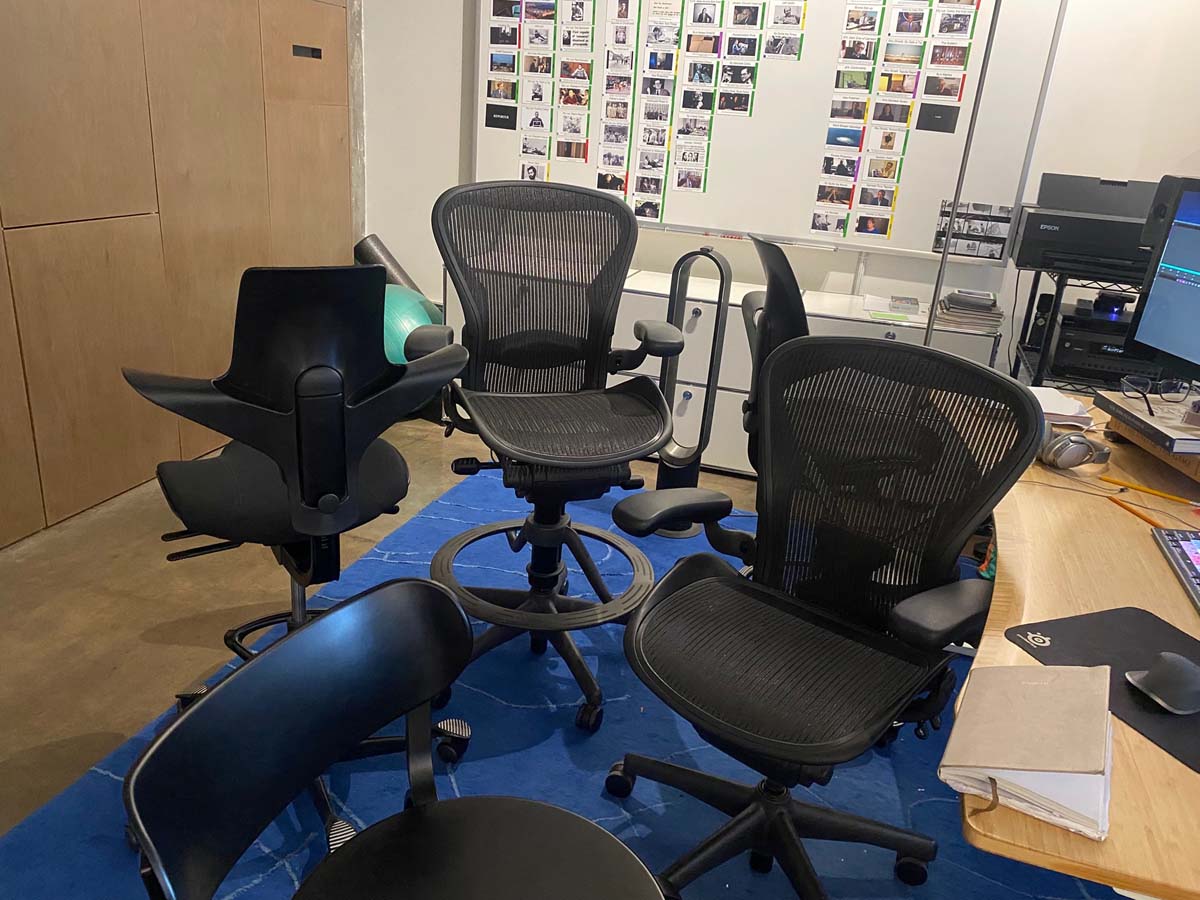
We had a big storyboard. We had scene cards with an image that described what was happening. There were a bunch of cards that said: “Sy, quits the New York Times” “Sy quits the New Yorker.” “Sy quits the movie” became a story card at some point. So it said something about Sy as a character.
He’s volatile. He could walk away at any moment. We knew that was possible. It wasn’t hard to know that that would be part of the film.
But it’ mostly about the fact that there’s something sacrosanct about the relationship between a journalist and their source. It’s a very hard thing to talk about, even though I knew we weren’t asking for names. We just wanted to understand: “How does it work with a source?
How do you know you’re not being played? How do you know if the source has full context? How do you know if the source is not feeding you misinformation?” Those were some of the themes we wanted this film - which is a film about journalism - to include.
It makes it more interesting to know that there’s this reluctance and there’s something at stake for him to participate. If you don’t know anything about him, there’s a human quality that I think is compelling.
That’s the second part of the opening that we created: to pull you in and help you get to know who this person is.
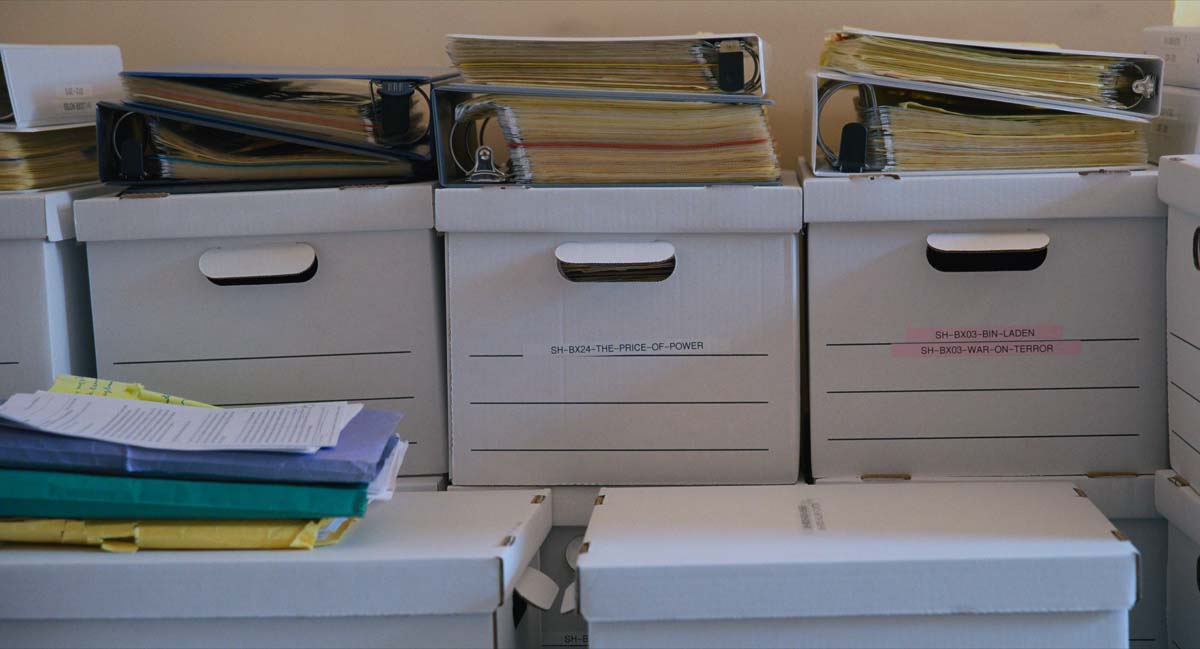
There’s some original-shot material. There’s a great little scene of Sy’s attaché case opening with some documents coming out. I love the section with the Rolodex. Tell me about deciding as editors that there’s something we really need something to visualize. Or “It would be great if we could get this.” Or didn’t it work like that?
Poitras: We would never use a word like visualize in the film. We treated the primary documents as evidentiary - that they spoke to us and that our job is to let them speak. They’re not filler. They’re speaking back to us about what Sy is reporting and how he’s reporting.
Bowman: In a more boilerplate scenario, you’d have your original camera media and your archival. But we have this third space that was where the world meets the archival - sort of re-situating the archival. So it’s not just this period-flavored wallpaper.
It’s actually this body of work. And it’s the stuff of history and it is a matter of testimony and witness and proof and not just historical texture. It was nice to have this sort of verité of archival.
I think the way that the film tries to operate with Sy as a sort of conduit into these different periods was kind of a nice sort of third realm.
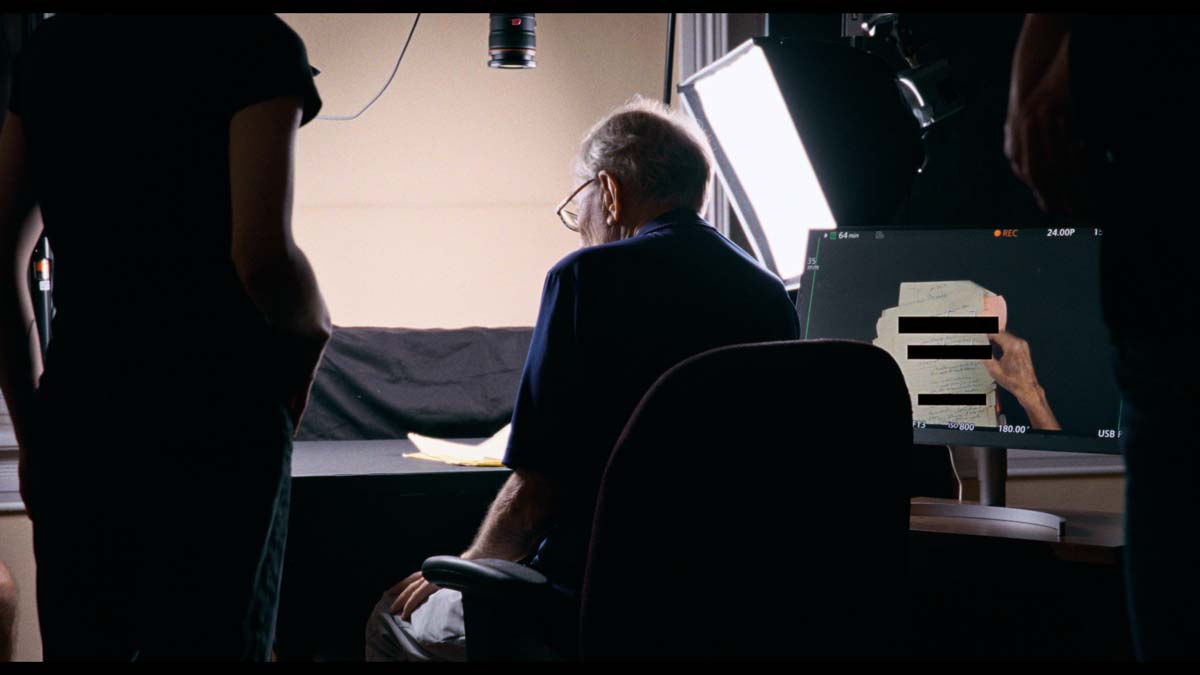
That also explains why you showed the behind the scenes of setting up an interview where there’s another camera shooting documents at the same time that he’s talking and describing the documents.
Foote: There was the idea with these notebooks, that it could also help Sy access the past and these stories in a new way, by putting these notebooks in front of him and by filming that. It sort of evolved in the process of filmmaking.
Poitras: The notebooks and documents could be portals and into history. They had a charge to them because Sy would look at them and they’d bring memories.
Oftentimes, particularly somebody like Sy, who’s done a lot of interviews in his life, there’s a certain way in which you tell the story and you just sort of go down the road of what the story is.
So the notebooks would create a stop sign and he’d realize, “I need to rethink this story.” He would think of things that felt like they were happening in real time that we were really interested in.
At the beginning of the film there’s this moment where we show this piece of his typing and it’s all scratched out. It’s from the Kissinger book, “The Price of Power” and you hear Sy mumbling to himself, “Just get it right. Just get it right.”
He’s not talking to us. It’s not an interview moment. For me it says something about Sy’s drive and also how tough he is on himself. So those kinds of things give you a sense who Sy is and what drives him.
Was your idea about the presentation of archival also the reason why you didn’t do “Ken Burns” moves? All the documents and photos seemed to be shot locked off, still. Why was that creative choice made?
Foote: There’s lots of reasons. We all have a real respect for the archive as historical documentation. We have respect for the person who shot the film and we want the full frame.
There is something about holding on a static image that’s not what we’re used to, so it triggers the audience to think, “It’s not telling me what to look at. I have to take this all in.”
In specific places where we show an entire page of a newspaper to give you a sense of where Sy might have found this tiny article that’s very much at the bottom, sort of what it looked like in context at the time.
Poitras: Aesthetically, as a filmmaker, I like hard cuts. I don’t think I’ve ever done a dissolve in my films. There just certain things that I’m not going to do aesthetically. I like hard cuts.
Like what Amy was saying, I like seeing an article in the newspaper and you see: here are some crazy ads for some dresses. Then you see this tiny little article about some torture story. Then you punch in. I’m interested in that context.
We’re also always thinking about: how can we tell history so that it’s not inevitable. History is created and it’s present tense. So we really wanted that. And we also wanted to activate the audience’s mind so that the audience is searching the frame - that the audience is asking questions, so you have that kind of triggering rather than leaning back and letting the film wash over you. We want the audience to work.
Bowman: So much of the film is about that work and that activation and Sy not letting things wash over him and being dogged in his pursuit of the truth.
Obviously, it’s like a stylistic thing that we all definitely vibe with, and I think is also doing something that is intensifying one of the themes of the film, which is the pursuit of truth, and these artifacts that persist through time as witness of atrocity and impunity.
Not that there couldn’t have been a different approach, but I don’t think another approach would have suited this film. We just really want to see the image, see the text, and let the viewer experience it as an artifact.
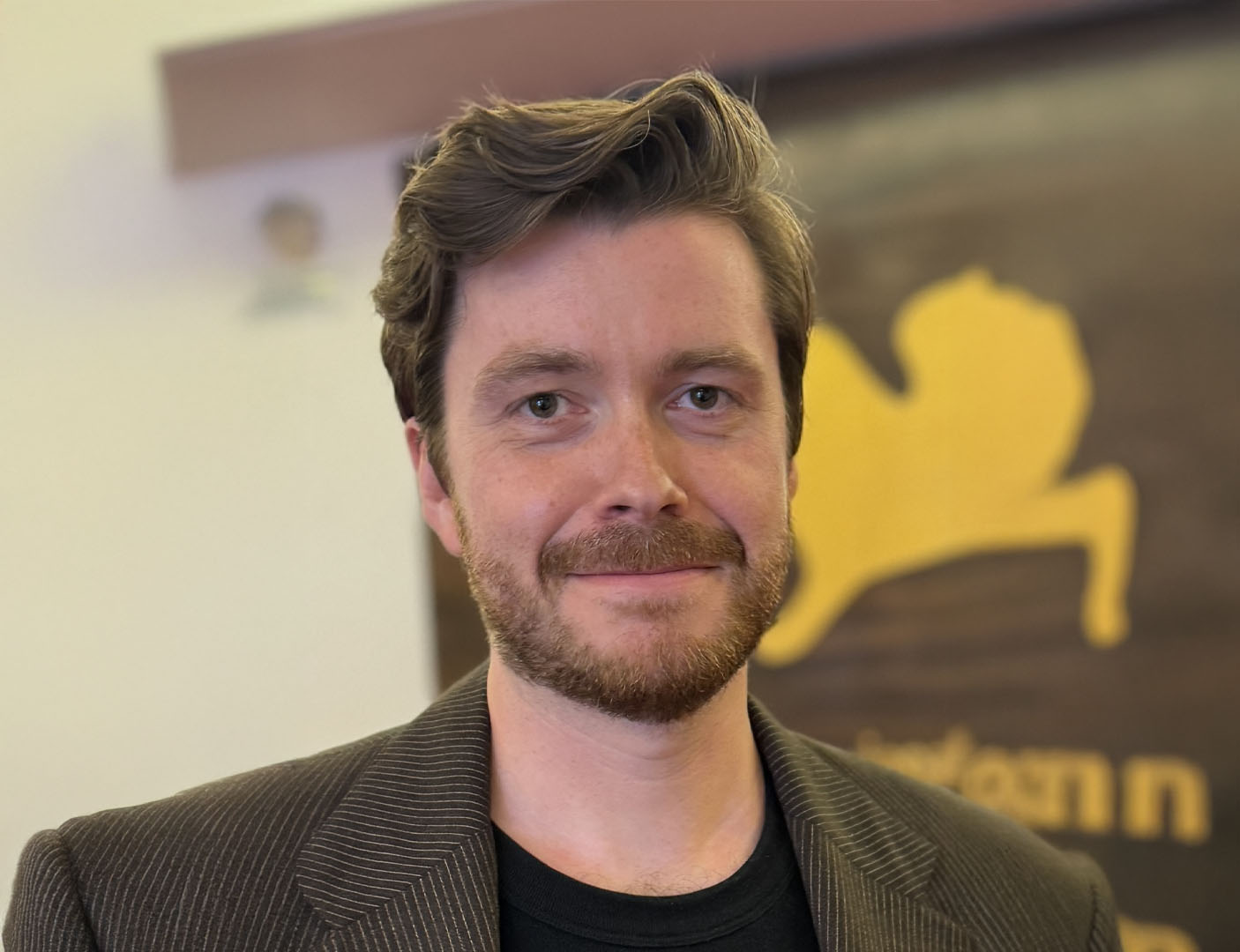
Editor Peter Bowman
I was interested in the idea of not doing the pushes because - like with music - often it’s a way to lead the audience. By not zooming or panning you’re allowing the audience to find in the image what they want to find.
Foote: The opposite example is when we do these ultra close ups of the My Lai maps at the beginning without any sort of context. You don’t really know what they are. You see little markings. That is teased throughout.
We were inspired by Nickel Boys (2024) which we had watched around the same time. Eventually we reveal what the source of the maps are. It helps the viewer experience being part of Sy’s investigation, like Peter was saying.
Was there a structure to the film before you started editing? You mentioned this big card wall. Were these things found in editorial?
Poitras: We didn’t have a structure going in, but we knew that there were some stories that were going to be in that had to be in. We knew My Lai had to be in. We were interested in these echoes of the My Lai massacre and Abu Ghraib torture and Gaza genocide.
There are through-lines there. There’s one point in the film where we go from My Lai to Gaza back to Sy growing up. To me, that’s kind of where we understand what the film is about or what it’s trying to do. This was a tough one to wrestle!
We were three people working every day constantly. First trying to make a story with the archival and Sy’s interviews, wrestle it, then, once we got to assembly: what were the structural choices that would allow the themes to emerge?
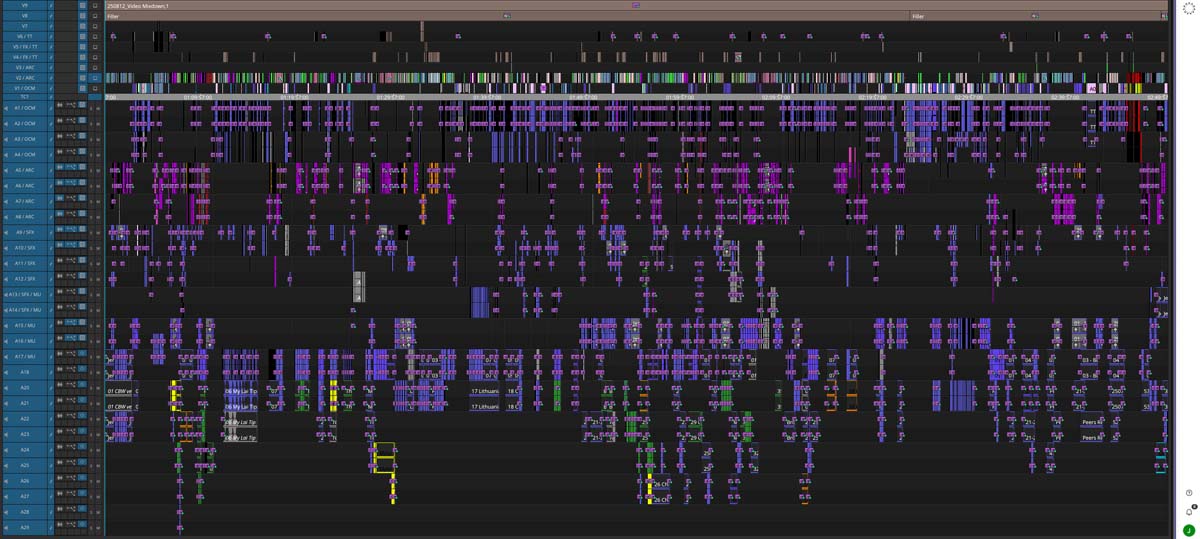
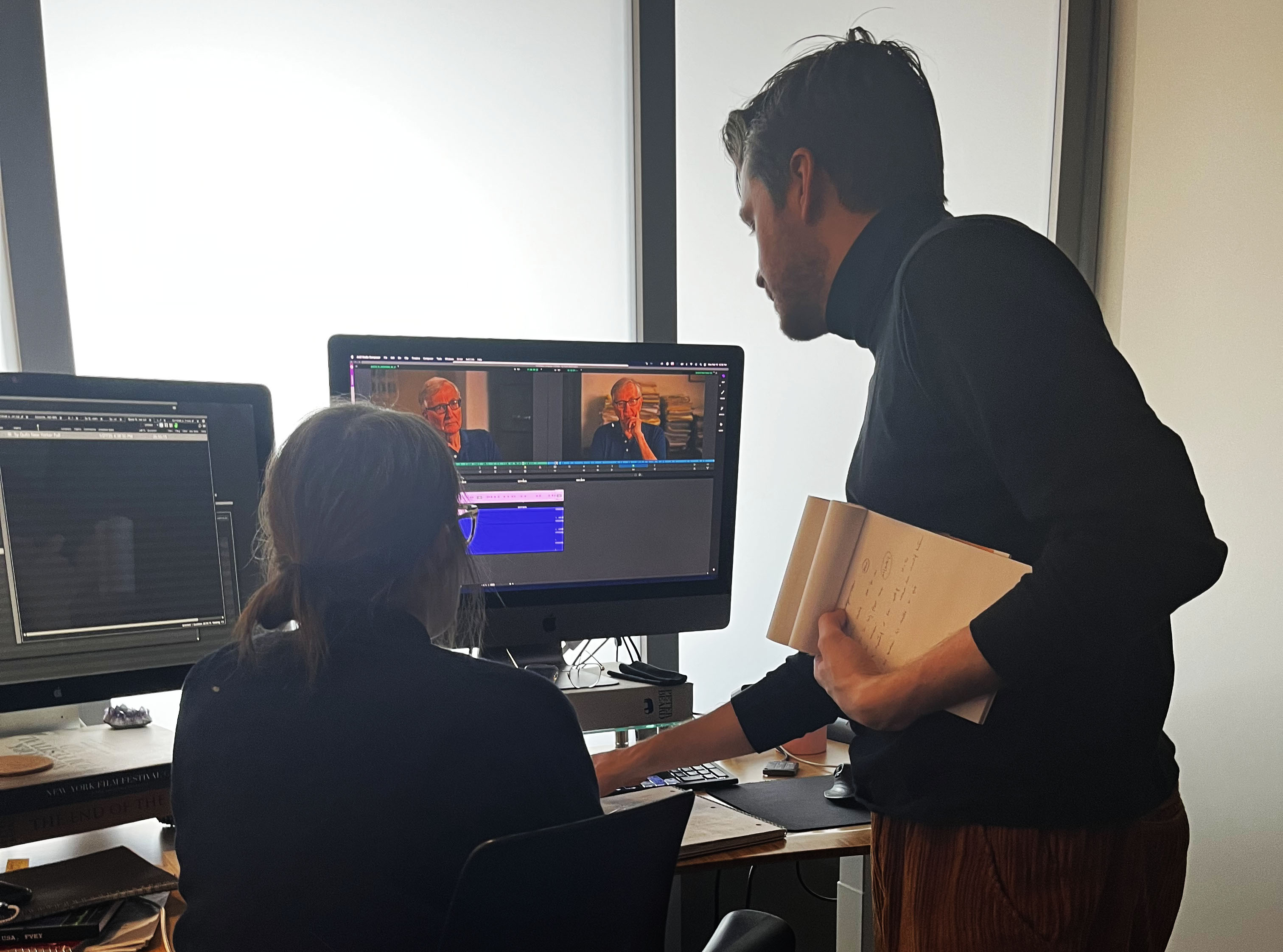
Avid timeline for Cover-Up
So to create that structure and have something to do every day, you were really working in scenes?
Poitras: Absolutely in scenes. And then we were also trying to figure out the balance because it’s not a biopic, but it is a portrait of Sy, but it’s also a portrait of the United States and the balance between being a portrait of the United States but not history of the United States.
We spend a lot of time figuring out the balance between those things. We spent a lot of time watching, iterating, changing, restructuring.
There were beautiful moments of breath. There’s a moment where napalm is falling over Vietnam. There’s no narration, there’s no interview, there’s just a breath. Can you talk to me about the importance of those breaths and where they belonged?
Foote: There are so many reasons that we gravitated towards that. Laura really pushed for that: wanting things to feel like a scene, wanting to drop yourself in.
Also with Vietnam and Watergate, these are topics that we’ve seen a lot of images for, so how to show Vietnam without a rock and roll montage or Nixon’s resignation without his victory sign? It’s to create this rhythm.
Also the film is very dense, and these moments of space sort of activate you to make connections, to process, to feel things, to just engage more.
So there are lots of different reasons. And the footage - especially when we had 16mm film - it was so beautiful that we really wanted to let it play.
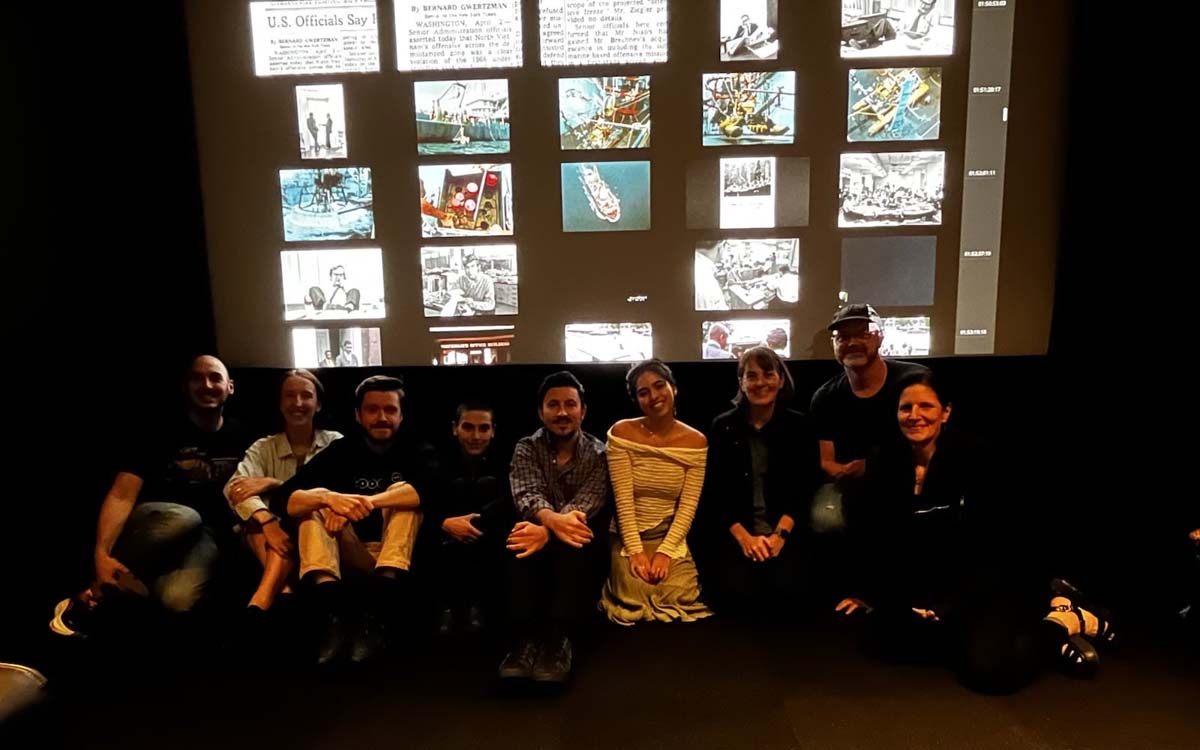
Post team: Yoni Golijov producer, Nora Wilkinson co producer, Peter Bowman, editor, Olivia Streisand archival producer, Jesse Gamar assistant editor, Ana Maldonado associate editor, Amy Foote ace, editor, Nat Jencks, colorist, Laura Poitras director producer editor
Do you want to talk about a place where you felt like a breath was really important? Maybe after a big reveal happened, or where the audience needs to absorb some kind of emotion?
Bowman: Olivia found this great shot of a car approaching the Watergate complex through this tunnel that’s maybe longer than it would be in another film.
It’s like you’re entering a new portal. You’re passing through the archival into this new thing that you don’t really know what it is yet.
But to Amy’s point about de-familiarizing familiar things, I also think it just gives you time to reflect on what you’ve seen and prepare for what’s coming up next. That is more cinematic, I think. There’s a foreboding to it that’s there visually. You’re not just being told, “…and then I went on to Watergate…”
Can you think of a moment where you felt like maybe there wasn’t a breath there and you said, “We really need a breath here. We need to pause for a moment. We need time for the audience to think.”?
Poitras: We did it a lot with sound. Sometimes we went big with sound, then it’s just Sy’s voice with very little sound. We wanted there to be these separations.
Sy was haunted by this war, so at the beginning of the film, the abstractness of that one shot that you talked about, of the bomb falling - to let that linger as almost a psychological space as much as it is a documentary space.
We knew we were doing a lot. We were covering over half a century in this film, which is a lot. So to slow down sections also allows the audience to absorb where they are in the film and not feel rushed.
It was always a strategy that we wanted that. Then emotionally, there are times when there’s annotations of the My Lai maps where you have the soldiers and then there’s a cut to Sy and he’s almost silent. You can feel that the emotional burden of doing that reporting of learning that soldiers had murdered babies.
That it still with him today. So in that space we wanted there to be a sense of space to feel and to be present. In a way, it comes down to emotion.
Particularly when you’re dealing with these images and incidences of extreme violence and atrocity. How do we provide enough context that the audience can experience emotion in those moments?
When do you choose to cut to Sy on camera? He could be a talking head for the whole two hours or you have the archival to cover him the whole time, so at what moments do you feel this needs to be on the interviewee?
Poitras: Over 70% of what you’re seeing on screen is archival, so it’s really driven by the archival, then Sy’s voice layered with it. We’re trying to cut versions of Sy’s interviews that could play as scenes.
We had three cameras recording Sy - different focal length - so we could cut internally so we could stay with Sy. I always felt like that the archival was going to lead.
Foote: The times that you want to see him is when his face is really animated or there’s something else going on besides how he’s telling the story - the way his eyes sparkle or the look he gives.
Or sometimes we’re going to punctuate the end of a beat with seeing him on camera. There’s those kinds of editing techniques. It’s also: what else are we going to get out of the words he’s saying by actually connecting with his face?
There are some of the family or biographical moments - like learning about Hersh’s father or his wife or going to UIC - that could have gone anywhere. You could have started the film with them. What was it that led you to place those elements where they were in the film?
Foote: At one point we started with his childhood at the beginning – not at the very, very beginning - but then who cares? The audience doesn’t know who this film is about and why they would care about his background.
So we tried so many different things, but I think once you get through My Lai and have an understanding of what this film is about, and you’re sort of wowed by the breaking of the My Lai story, then there are other aspects that you want to learn about a person.
So waiting until after My Lai and after seeing Sy in present day reporting on Gaza, it felt like the right time to understand a little bit more about who he is, where he came from, and what drives him.
Bowman: The film’s a portrait of Sy, and a portrait of the US. In addition to all the reasons Amy was saying about not wanting to start from childhood, one thing that’s nice about going to Sy’s father’s backstory after his Gaza reporting is that there’s both a biographical explanation and a thematic historical resonance there.
So it just feels like it’s doing double duty in a way. If it was just a movie about Sy, then let’s start from when he was like six and cue the generic ‘50s home video. That might get one of those things, but it wouldn’t do both.
Poitras: Because it’s also a film about journalism there’s a moment where he’s learning the ropes in Chicago, and we thought, “That could be an interesting beginning.” I think with every film - particularly probably more with documentary than with scripted - it seems obvious once you’ve gone through the very long process of hopefully making it work.
We started where we were off to the races. We’re moving. He’s mid-career. He’s got a book. He’s got a job. He’s pissed at people. He’s already disillusioned. And that just works. And it allowed us then to use this prologue, which is the mysterious sheep death.
Then we dive into Vietnam and the My Lai story, and that just gave us a lot of knowledge about who this person is. I like the fact that we delay the biography so long that the audience has no expectation that they would ever get it.
Then they get to a point where they actually are thirsty for it, but they don’t know that they’re thirsty for it.
In retrospect, it makes a lot of sense. The Gaza reporting was really crucial for us because we wanted to say that this is not a chronological story. History repeats itself. There are these themes that are driving this film - not a march through time.
One of the moments that I loved was the choice to bring his wife in so late. She’s mentioned at the beginning briefly, but there’s a reason she’s brought in where she is. Sy’s disillusioned. He’s broken by some of these stories, and his wife is the support that allows him to get through that. So the structure of the story telling gives a reason for their relationship to be included.
Poitras: We do foreshadow Liz at the very beginning. We hear that he’s feeling despondent about the war. He’s got a kid, we see her. So she’s very much foreshadowed.
Then you get this much more emotional reveal and you learn that he’s protective of his family’s privacy and that his wife is particularly protective of her privacy because she’s a psychoanalyst, so we wanted to reveal why she has this privacy concern.
It’s a reveal later in the film and comes at a moment, hopefully, where there’s an accumulation of understanding through Sy’s work, then understanding the toll it takes doing this kind of reporting, and that he didn’t do it alone.
There’s some lovely sound design to the film. You’re getting a lot of archival that probably doesn’t have sound. Adding in the loop group stuff of voices and street sounds, and Foley - talk to me a little bit of how that brings the archival to life.
Bowman: It’s sort of dependent on what we’re trying to do, but we weren’t just slapping… whatever… sound effects of a park.
For the baseball game, for sure. Some of that had sound effects, some of it didn’t. We wanted to make sure it was period-appropriate, doing all that kind of sound work.
But there are also times where we remixed what was on the 16mm. Some of the protest footage where we meet James Angleton, you could hear the tape sort of spin out at the end, and we kept some of that because we were kind of going into surveillance mode.
There’s one clip where you’re walking down a hall at the Pentagon. The original footage was taken from a propaganda film. President Johnson would do these monthly propaganda films to help sell the public on the war.
It had this really cheery, patriotic music, so we buried that and made it more echoey to try to pull you in - take something that was once used to sort of lie to the public and pull out the truer meaning by burying it in a more ominous sound architecture.
How can we take this archival and de-familiarize it more - or to something Laura mentioned earlier - we’re looking for these historical echoes. So it’s less about, “This needs to sound like the 70s, and this needs to sound like the aughts” and it’s more like these are all part of the same cycle of American violence and impunity and wanting it to sonically resound with the same feeling of dread. Sometimes it’s impressionistic and sometimes it wasn’t.
Poitras: In terms of references and films, we were constantly referencing the 1970s and the paranoia thriller genre. So, Alan Pakula’s Parallax View, All the President’s Men, Coppola’s The Conversation.
Those were the type of films where there’s something sort of sinister and hidden, and how to use sound as a way to evoke that emotion.
Peter worked a lot with both that soundscape, then also with the bringing in first the temp music then working with our composer, Maya Shenfeld.
Were you also referencing those movies in temp?
Bowman: The Parallax View type stuff was more visual and the general mood. We weren’t importing ‘70s soundtracks. We were using a lot of drone ambient music. Lawrence English, even like Arovane - a mix of things - Thomas Köner.
We wanted things that existed in this space somewhere between like sound design and score. Having this sort of echoing, resounding dread throughout the film or maybe wanting to de-familiarize all of these moments not just like “it’s a Watergate movie,” but that it’s about something deeper and darker.
Scores can be really leading emotionally. Obviously, we do lead emotionally with some of the stuff that we ended up with. Some scores can really feel like editorializing.
We wanted to create a sonic space where the viewer could be activated rather than just, “Here’s triumphant Sy. We need a triumphant cue or here’s a lull, and it’s sort of sad.
Instead it’s maybe a more ambiguous sonic space.
Foote And it’s something that you’re maybe sort of picking up but not really noticing it. It’s something that you’re feeling, but you’re not totally super-aware of. It’s holding the space in some way.
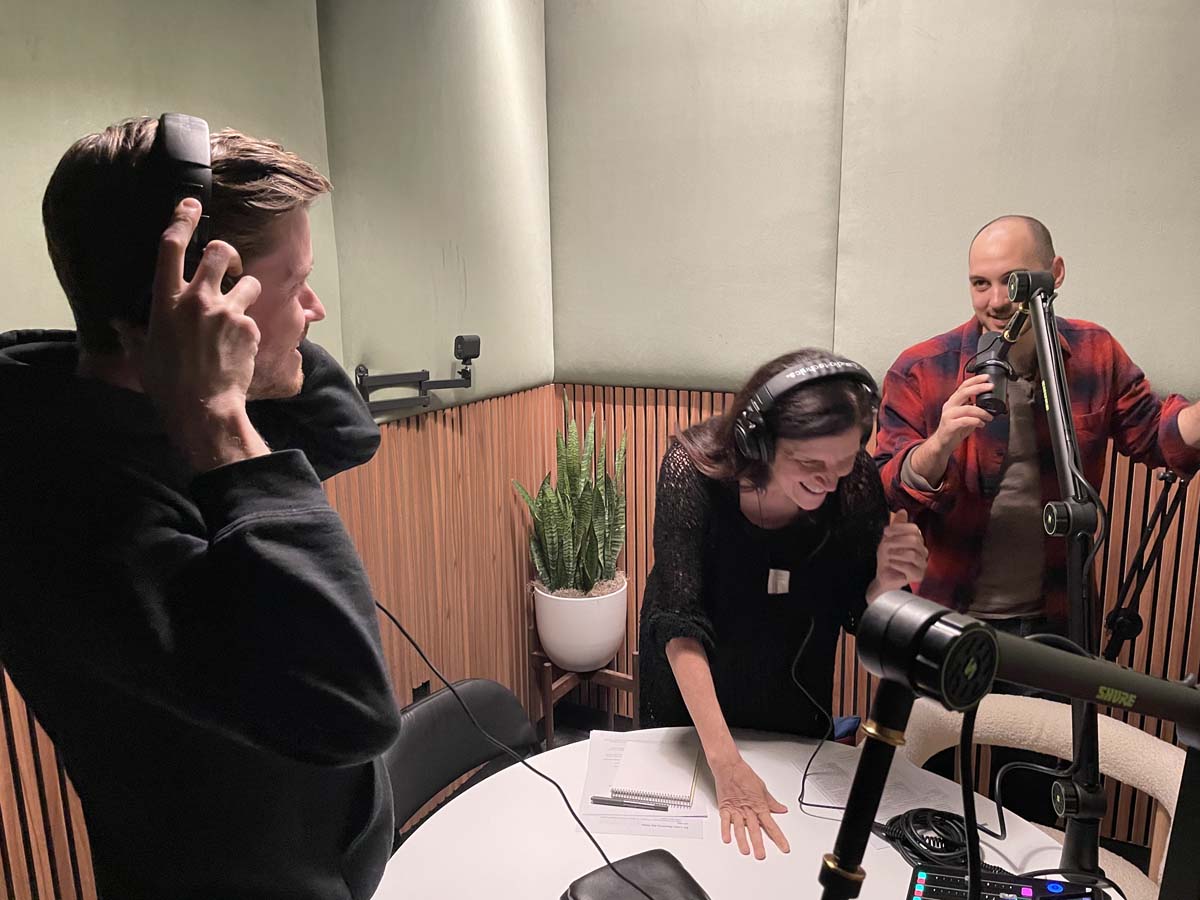
I didn’t actually remember too much music, except there’s an interesting cue when Sy goes to UIC.
Bowman: That’s Mancini, actually. It’s from the Peter Gunn movie. So I guess we did do it once, but it was period-specific, and it’s not like it’s CCR.
Sy covered a lot of stories in his career. Obviously there were a bunch of big central ones. What ended up on the cutting room floor? What were the “killing your darlings” moments?
Poitras: There were a lot of heartbreakers. I think we went into it with everything on the table. Length was on the table. We were going to edit the stories that we had really good archival for - that we felt were compelling stories. That included the killing of Osama bin laden. That included Sy’s book “The Samson Option,” which documents Israel’s nuclear weapons.
It includes Sy joining the presidential campaign of Senator Eugene McCarthy in ‘68, which wasanti-war. Sy worked as McCarthy’s press secretary and wrote speeches for him. There’s some really great footage of Sy in 16mm. We didn’t take anything off the table.
We wanted to work with it and see how it fit in the whole, but knowing we were going to have to make some hard choices, because although everything was on the table in terms of runtime, I didn’t want to make something episodic. We felt like this is going to be a feature length - if it’s two hours, three hours, four hours - but the whole needs to be more than the sum of its parts.
And if the sum of its parts start to weigh down, then it’s just not good for anyone. Even though it was literally like cutting off limbs – well, maybe not literally, but it was painful.
Sy’s reporting is the engine that drives the film, so we had these really amazing elements and stories that we had to lose, so those were three of the big heartbreakers. What else do we lose?
Foote: Korshak.
Poitras: Oh, that was so painful.
Bowman: There was a little Noriega story. That wasn’t so painful to lose, but Sy did get death threats for his Noriega reporting in the ‘80s.
Did those things actually make it into the rough cut?
Poitras: It made it into an assembly. Yeah. Certain scenes made it in, came back out, went back in. I tried to get in a few more scenes at the last minute that didn’t work. Some got back in.
That’s something that I think young filmmakers don’t realize is that things do come out and some things go back in. So you do decide to excise something, then you watch a version of the film without it and say, “It really has to come back.”
Foote: That’s such an important thing that you learn every time making a film. But after a certain amount of years of doing it, you know that in the end, what’s going to go in is what’s meant to be.
So you can just play with stuff and not be scared if something’s not working or if something isn’t in or is in that you don’t like.
Like Laura says, in the end, it just seems like there’s no other way it could be, so sometimes it’s actually really hard to remember how it all happened, because it just seems so obvious and there’s no other way it could have been. There were many, many other ways that it was.
Poitras: We had a great interview with Sy’s daughter Melissa, who’s an emergency room doctor. She was great. It was funny. I edited it. I felt so excited. I showed it to Amy. She was really excited. We were all really excited.
We put it in the assembly and we thought, “No. It doesn’t work. It felt like a different genre. It felt like it was going someplace that was outside of the film that we were creating.
You don’t know. In isolation, something can be really exciting. You think it’s a no-brainer. It’s going to be great. Then in the whole - for whatever reason – it doesn’t work.
It drags, it slows things down, feels like the wrong direction. Particularly with covering so much history, we didn’t want it to be plodding, like a March of Time.
We were like trying to hone in on certain themes. It still has to arc in those ways that we feel the film as a whole needs, and not discrete stories.
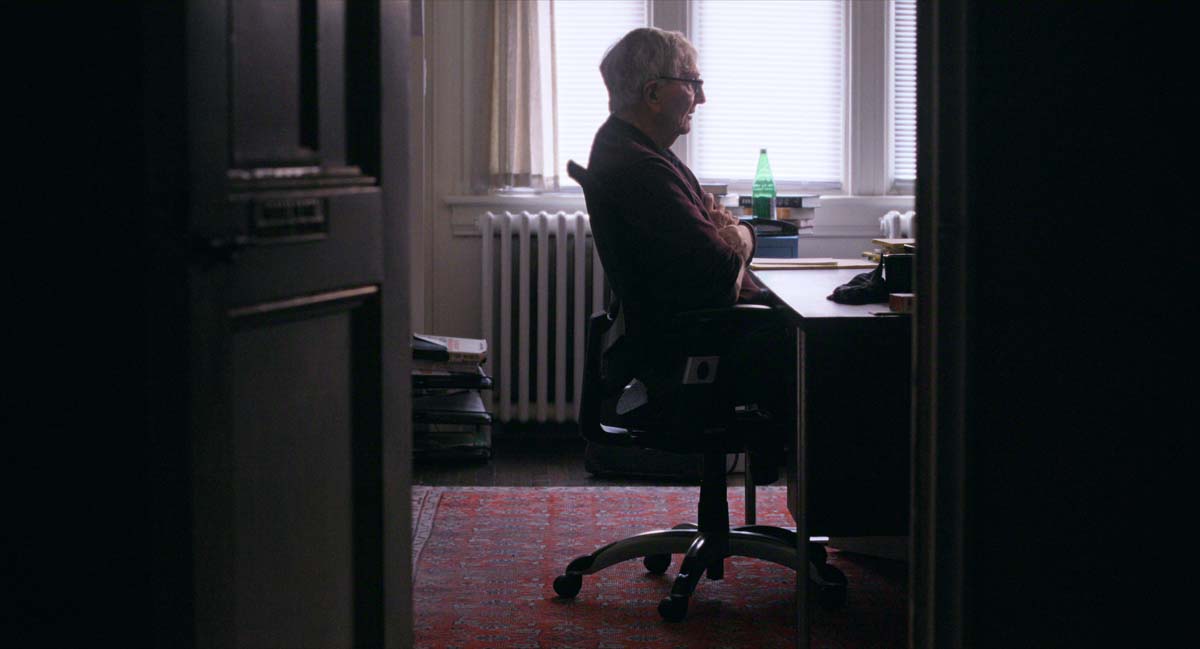
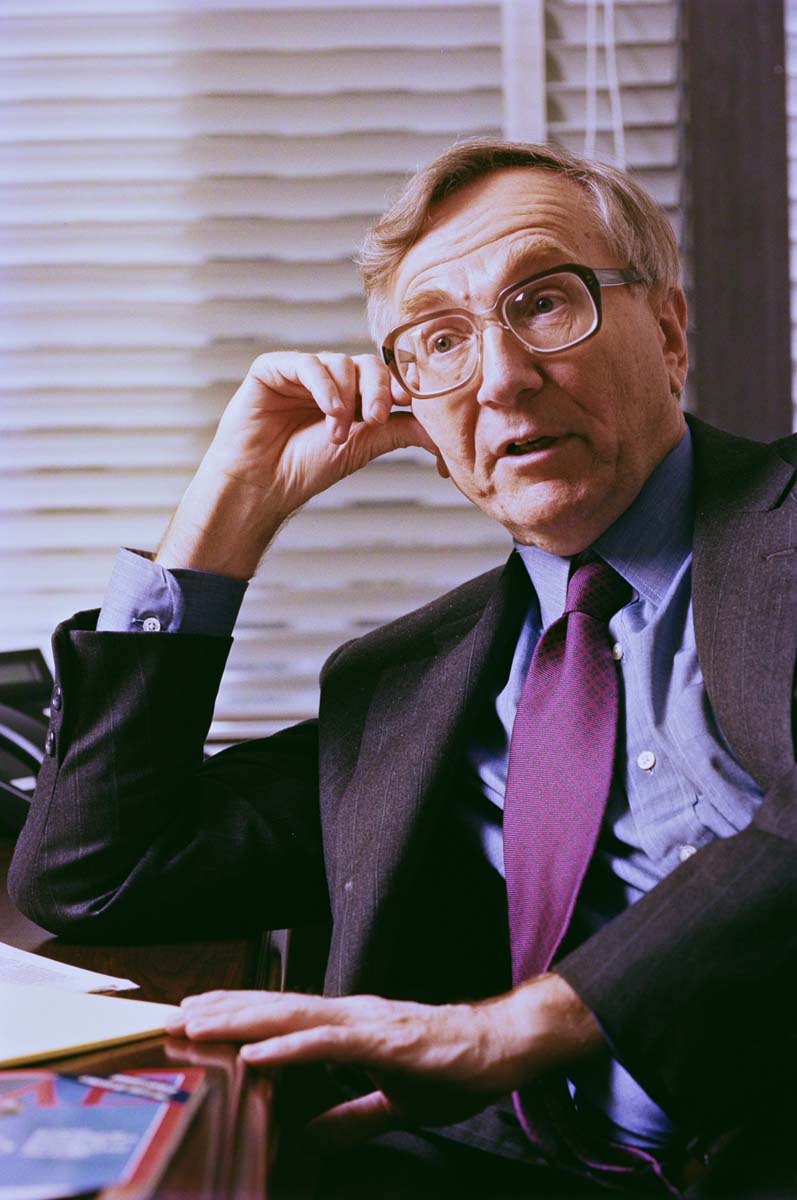
You’ve got all these images of Sy that are archival photographs, and you have to portion them out. There’s one great image I love where he’s talking to his boss and he says, “Every source tells me the lawyer said it was okay!” Sy’s kind of disgusted and demoralized, and there’s a great shot of him kind of slouching in a wingback chair. That could have gone a bunch of places, but it went there. Talk to me about choosing who gets to use that? Which storybeat will it illustrate?
Foote: There were times when images would be in multiple places. There were never any battles over it. When it found its spot, it just elevated and worked so well. We all had tons of disagreements about stuff, but we also very much connected about the same things that worked.
That one felt inevitable. It’s like the perfect spot for that image.
Talk to me about the decision to do things like showing behind-the-scenes stuff, showing slates and that kind of thing. There’s a point where they’re talking about Marilyn Monroe and Kennedy, and you’re actually seeing the behind-the-scenes. Why add that to the film?
Poitras: If you look closely, you’ll see that Mark Obenhaus, the co-director on Cover-Up, made the JFK film with Sy. So you actually see Mark’s name on the slate.
Then you hear Sy saying, “Are we rolling?” And you hear Mark’s voice say, “Yeah, rolling.” Hopefully, maybe even subconsciously, you connect this voice from the ‘90s to the present. It was kind of showing that Mark and Sy have a long history.
The film doesn’t quite start with the My Lai Massacre, but it’s close. Then we kind of come back to that at the end. Can you talk about that decision to kind of bookend that or why the Lt. Calley section at the end wasn’t with the rest of the story?
Bowman: That was something actually that Amy had cut pretty early but it didn’t quite fit. For me, the reason that I liked it was that the film is about more than just telling you about Vietnam or this one thing that happened.
It’s about an entire country and a system that is built on no one ever getting their comeuppance. You see those generals in the boardroom at the very end and that’s really what Sy’s up against. I think to do a zoom out to the wider cultural rot with everyone wanting Calley to walk free after shooting up a village and ordering people to do so, that’s an important thing to make it not just about journalism and his adversaries in the government, but about a larger cultural question of: do we as a society even think people should be held responsible or not?
Poitras: At one point we had chapters and that was the epilogue. In the first assembly we had tried it earlier in the My Lai section, but it felt too rounded out.
Then where do you go from there? So it wasn’t going to ever work in the middle of the film, so it could either not be used or it was at the end, and it’s a very dark ending.
There was some resistance because, “Shit, that’s a really dark place to end this film.” Peter felt really strongly it was important because it activated the audience’s mind, which I also agreed with. But the danger is: does it become too individualizing?
We’re making a film about systems of power and the higher levels of power, not the individuals.. We talked about it and we changed what Sy’s saying under it.
Another thing that takes a long time with every film is like, what do you call the film? What’s the title? One of the working titles - or one of these titles that rotated in - was a chapter in Sy’s book called “Cover-Up” that’s about the My Lai massacre. It’s his second book about My Lai.
The final chapter is called “The System Prevails.” The System Prevails is a potential title that’s incredibly dark and who wants to watch a film called The System Prevails? But it is one of the themes of the film: that the system prevails.
Yet people like Sy keep doing the work that they do, so in a way, I think that ending is kind of “the system prevails” countered by Sy talking about his need to continue to do the work, even if people get away with it.
Amy, thoughts on that? Pulling that section about Calley out from the middle after My Lai and putting it at the end?
Foote: That Calley scene wasn’t originally cut with My Lai. It was something that I wasn’t that interested in cutting because the story was about so much more than Calley. Then we thought, “Well, we have all this archival, let’s just explore it. This issue with Calley does need to be resolved.”
So we cut it as this standalone thing. It never was going to go after My Lai because it would be a 45 minute film at that point about only Vietnam - maybe a little less.
But as we were playing with the structure, we tried it as the epilogue because we thought it said so much after Abu Ghraib to revisit this moment in history.
That’s why it’s really important to try everything. It was a really dark ending. Laura wanted to try this beat about why Sy keeps going at the end. On paper, I just thought, “No. I don’t think that’s a good idea. It’s going to become too much about Sy.
It’s going to become too personal. I really resisted even trying it. But you always learn the lesson that everything is worth trying. The minute we put it there - at the final hour - I felt it immediately.
I felt so moved. It’s a dark ending, but Sy continuing to do what he does because there is no other way leaves you with some hope and inspiration to just not accept defeat.
Poitras: I remember seeing the Calley footage. I was shocked by the footage because of all the support for Calley. I wanted to deny this part of our country. I was shocked that there was a hit song – that there were all the telegrams to have him released.
Then I realized it had an echo to where we are in this country today, right? That there are contested views of what this country means and what it’s about.
There are different narratives. That ending is speaking to a narrative that I think we all felt echoes to the present-tense country that we’re living in. Those were the kinds of activations we wanted the film to make.
Is there a difference between journalism and documentary as far as ethics and the truth and viewpoints are concerned?
Poitras: Do you have another hour? We have a massive fact checking document with multiple sources. You have to do all the statements of fact. That kind of fact checking is necessary. Journalism also is dealing with people’s lives, but with documentary you really have a profound obligation to the people you represent.
I think it’s probably more of a sense of obligation than if you’re quoting somebody in a news article because their lives are being represented, so I think there’s a really profound ethical obligation.
I loved this conversation. Thank you so much for joining me.
Foote: Thank you so much, Steve.
Bowman: Thanks, Steve.
Poitras: Thank you.
 April 2, 2026
Project Hail Mary
Joel was last on Art of the Cut for his work on the Disney film, Jungle Cruise. Joel’s other work includes Thor: Ragnarok, Transformers: Rise ...
Read more March 26, 2026
Young Sherlock
Today on Art of the Cut, we speak with four of the editors on the buzzy new Amazon Prime series, Young Sherlock. With us are ...
Read more March 18, 2026
KPop Demon Hunters
Today on Art of the Cut we speak with editor Nathan Schauf about his ACE Eddie and Annie award-winning work on the Oscar-winning Best Animated ...
Read more